The Hidden Reason Your Mobile Shoppers Disappear at Checkout

Implementing a structured funnel conversion tracking framework is the most critical operational adjustment a mid-market e-commerce business can deploy to diagnose cross-channel behavioural friction points and eliminate hidden conversion leaks across the transactional funnel. Many digital brands monitor aggregate performance metrics in absolute isolation, assuming that surface-level traffic increases automatically translate into efficient bottom-line scale. This inward-looking analytical focus introduces immense structural vulnerabilities, as it completely ignores the micro-drops that occur when consumers switch devices or cross channel boundaries. Transitioning to a data-driven path auditing model allows growth operations to identify precise user-experience friction points, preserve media capital, and protect compounding revenue assets before they suffer from severe conversion decay.
Modern digital retail landscapes operate across diverse consumer interaction environments that challenge standard client-side analytics tools. Consumers routinely initiate product discovery paths on mobile devices during active browsing sessions, only to transition to desktop environments for final transaction execution. When an e-commerce infrastructure fails to bridge these device environments smoothly, users encounter unnecessary validation hurdles and configuration walls. This lack of alignment fractures purchase momentum, driving qualified buyers away from your checkout flow.
Relying on separate, unlinked reporting views to track these multi-stage pathways introduces profound risk to your weekly scaling decisions. Standard analytical platforms treat a single consumer transitioning from a smartphone app to a desktop browser as two entirely separate anonymous visitors. This reporting distortion masks critical path abandonment loops, making it difficult to isolate where users experience genuine transactional friction. Protecting your contribution margins requires a technical architecture configured to trace continuous user identities across all active brand touchpoints.
To insulate your business from these unindexed funnel drops, growth engineering teams must establish an outbound tracking protocol. Accepting fractured data streams leaves your storefront highly vulnerable to user-experience bugs that escape standard desktop quality testing loops. Shifting to an integrated behavioural tracking model helps your team identify hidden friction points early, deploy surgical technical corrections, and ensure your conversion architecture handles multi-device consumer pathways efficiently.
A sophisticated optimisation programme requires far deeper behavioural insight than aggregate daily transaction volumes can supply. True growth intelligence depends on a thorough understanding of step-by-step funnel drop-offs, touchpoint concurrency metrics, and post-purchase engagement timelines. By mapping these behavioural layers, analysts can determine which campaigns generate profitable buyer groups and which ones merely deliver hollow, single-touch traffic sessions. This disciplined operational oversight prevents brands from spending capital on misaligned positioning angles.
This discipline builds directly on the foundational practice of customer journey mapping, extending it from a qualitative planning exercise into a strict, server-verified engineering process. An early operational study published by the Harvard Business Review established mapping the customer journey as the essential first step to identifying where the buying experience creates friction. Deploying a structured tracking model helps eliminate internal design silos, ensuring your frontend changes actively support your conversion rate targets.
Protecting your existing customer assets from external acquisition pressure also relies on maintaining highly fluid post-purchase pathways. Historic research published by the Harvard Business Review confirms that a 5% improvement in base customer retention behaviour drives a corresponding 25% to 95% escalation in corporate profitability. This empirical baseline shows why deploying an effective customer retention strategy demands a deep understanding of your post-purchase journey. Restricting backend interaction leaks protects customer lifetime value metrics across your entire catalogue.
| Journey Phase | Primary Technical Metric | Operational Goal |
|---|---|---|
| Discovery Capture | First-touch click-through rate | Maximising early traffic relevance while controlling platform auction costs. |
| Device Cross-Over | Profile cross-synchronisation rate | Eliminating account log-in hurdles when users transition to desktop browsers. |
| Checkout Execution | Gateway latency and form success rate | Minimising input friction to lower the overall cart abandonment rate. |
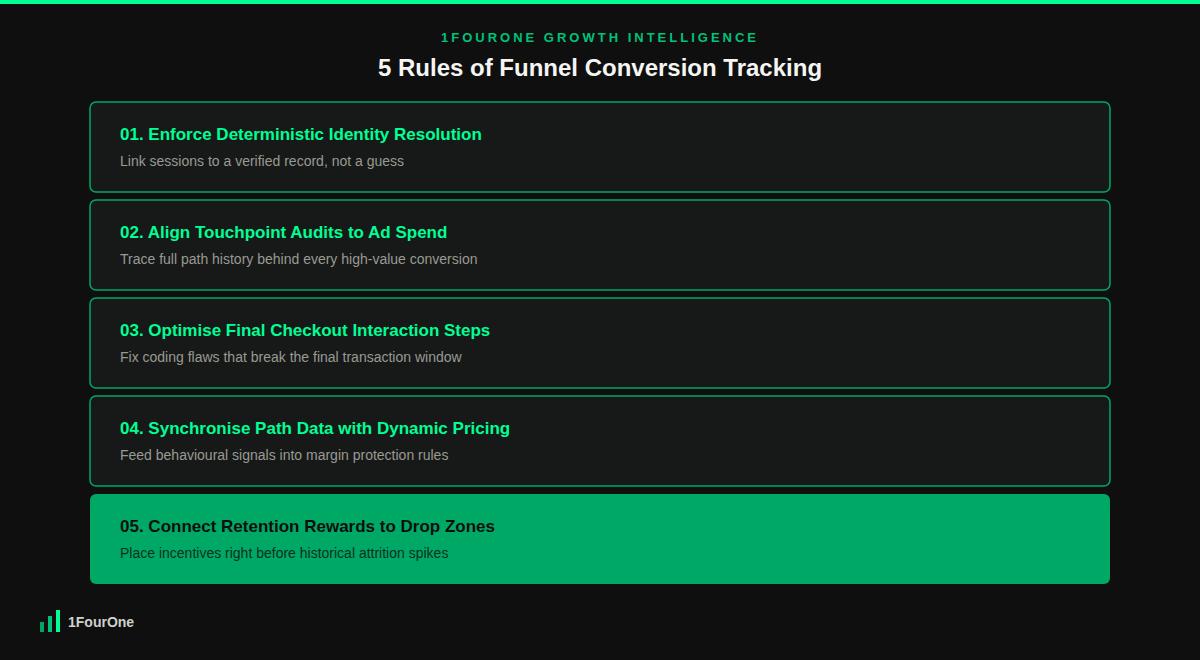
To systematically maximise your transaction paths and eliminate multi-channel capital waste, your operations team must apply this discipline with technical rigour. This protocol moves your funnel planning away from subjective layout preferences, anchoring it in structured, data-driven rules that ultimately protect customer lifetime value at every stage of the path. The following five rules provide a repeatable framework to monitor path conversions, optimise touchpoint data, and defend marketing spend efficiency.
The primary source of analytical confusion in multi-channel retail is relying on probabilistic matching models to evaluate cross-device user pathways. When tracking systems try to guess user transitions based on temporary IP addresses or unstable browser characteristics, data reporting quality drops. To eliminate this operational issue, your technical architecture must enforce strict deterministic identity resolution protocols across all active storefront properties.
Require secure, centralised login utilities and implement persistent first-party identifiers that link sessions to a verified customer record the moment an interaction occurs. As detailed in our operational framework for an ecommerce first party data strategy, capturing clean, owned signals directly from your server environments prevents client-side ad blocks from breaking your reporting paths. This technical structure ensures your growth teams trace multi-device user pathways with absolute accuracy.
Operating paid traffic campaigns without mapping how initial ad impressions link to final transaction conversions leaves your media buyers vulnerable to bidding inflation. Your growth operations team must perform regular touchpoint audits to trace the complete path history behind every high-value conversion. Isolating a competitor acquisition channel that is actively poaching your traffic loops allows your media buyers to spot rising bid environments early.
This systematic path review must be paired with automated competitive tracking tools. As outlined in our strategic breakdown of competitor ad audits, observing the creative velocity and offer longevity of rival campaigns helps you identify where they target your shared audience segments. Use these behavioural benchmarks to optimise your own paid media distribution, ensuring you divert capital from crowded networks into lower-competition traffic spaces.
Discovering that consumers complete early discovery phases smoothly only to abandon their sessions during the final transaction window indicates severe bottom-of-funnel friction. Your technical teams must execute a comprehensive review of the entire payment interface to identify coding flaws and form hurdles that disrupt user actions. Long forms, unoptimised validation notices, and lack of local express options represent direct threats to your sales margins.
To address these specific conversion leaks, your development teams must prioritise mobile-first layout refinements and continuous script acceleration. As documented in our guide on reduce checkout abandonment tactics, engineering a friction-free payment journey is mandatory to protect transaction completion rates. Eliminating input delays and removing non-essential fields ensures that users move through the final checkout steps effortlessly, maximising your marketing spend efficiency targets.
Digital consumers constantly adapt their shopping behaviour in response to changing promotional frameworks and pricing structures across the industry. A major operational failure is mapping user paths without connecting those insights directly to your product pricing architecture. To maintain a clear commercial advantage, your customer path metrics must integrate cleanly with your automated inventory systems to protect core product margins.
When journey analytics indicate a specific customer segment is highly sensitive to shipping costs at the cart line, your systems should automatically adjust offer presentation parameters rather than slashing base product values. This integration is covered extensively in our strategic guide on ecommerce dynamic pricing strategy, which highlights the need for real-time coordination between behavioural tracking and margin protection rules. Aligning these systems protects your unit economics from sudden industry conversion drops.
Evaluating funnel pathways purely on immediate front-end conversion metrics ignores the immense financial impact of repeat buyer behaviour. A traffic source that initially looks highly efficient can deliver cohorts with abnormally rapid drop-off rates after their first purchase. Your funnel conversion tracking model must trace the post-purchase timeline to identify the exact weeks where customer interaction velocity drops across your database.
When your behavioural maps indicate an attrition spike between the first and second billing cycles, you must deploy targeted rewards to reinforce the product habit. Growth teams should reference our comprehensive framework on loyalty program design to build digital rewards systems that drive long-term engagement. Placing specialised incentives right before historical drop windows increases customer switching costs, protecting your core accounts from drifting toward rival alternatives.
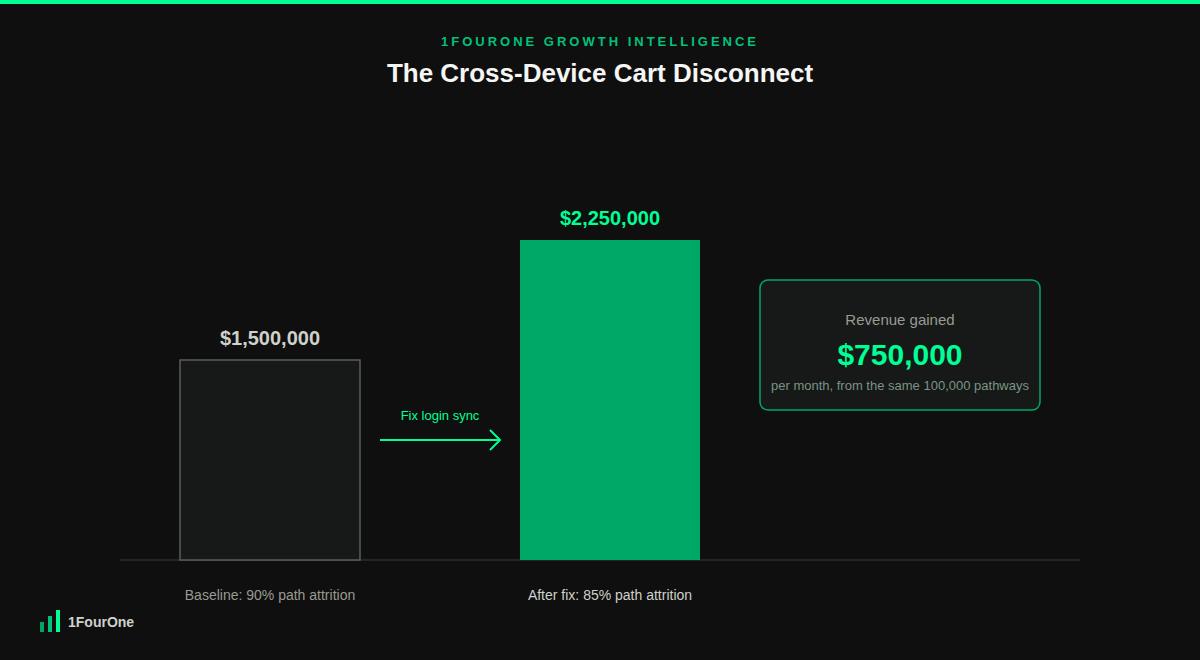
To evaluate the direct commercial return of structured funnel conversion tracking, let us examine an established mid-market omnichannel retail brand that generates exactly 100,000 monthly user pathways crossing from a mobile social ad impression to a desktop site cart save. Under the unmapped baseline configuration, the digital storefront experiences a painful 90.0% path attrition rate before checkout completion. This setup delivers exactly 10,000 completed monthly multi-stage transactions to the store.
With the average order value fixed at a stable $150 across these digital transactions, this baseline configuration generates exactly $1,500,000 in monthly gross revenue (10,000 transactions multiplied by $150 average order value). Reviewing the front-end analytics panels displays a reported mobile conversion rate that looks extremely poor, prompting the media buying team to constantly experiment with alternative target audiences and higher ad bids. This reaction scales media costs while failing to fix the underlying conversion hurdle.
The brand’s growth operations team executes the tracking methodology to analyse this cross-channel leak. The data tracking uncovers a critical technical design friction point: the shared shopping cart state fails to synchronise profile login data automatically when users transition between device environments. This configuration error forces 25,000 high-intent buyers to encounter duplicate password entry demands on their desktop screens, causing them to abandon their items out of sheer frustration.
The development team immediately resolves this device cross-over friction by deploying centralised first-party session tokens and implementing automated cart persistence across all user profiles. Because these structural refinements allow consumers to access their saved carts instantly without manual entry hurdles, the path attrition rate drops from the baseline of 90.0% down to exactly 85.0%. The total marketing spend required to drive the traffic remains completely flat.
Applying this optimised 85.0% path completion metric to the identical baseline traffic flow changes the transactional dynamics completely. The volume of completed monthly cross-channel transactions climbs from the historical baseline of 10,000 up to exactly 15,000 completed purchases (100,000 monthly user pathways multiplied by a 15.0% total path completion rate). Assuming the average order value remains stable at $150, the store’s newly optimised gross revenue scales to exactly $2,250,000 per month.
The financial return of this data-driven adjustment is immediate and highly profitable. Without spending a single additional dollar on paid media customer acquisition campaigns, the brand expands its gross monthly revenue by exactly $750,000 ($2,250,000 optimised revenue minus $1,500,000 true baseline revenue). The improvement is derived entirely from removing interaction friction within the transactional layers, providing a scalable framework to fund future business expansions safely.
Traditional journey mapping relies heavily on qualitative visual layouts, loose customer personas, and highly subjective team assumptions about consumer preferences. This technical discipline treats the consumer pathway as a strict engineering graph, using server-side event tags, deterministic identity tracking, and precise cohort transaction metrics. This approach ensures that every identified path drop reflects real transaction blockages rather than cosmetic design concepts, and that any customer retention strategy built on top of it rests on genuine behavioural data.
When browser-based cookies are blocked by user privacy selections, you must rely on server-to-server tracking architectures and unified first-party login tokens. Routing your interaction events through a secure first-party subdomain allows you to capture operational signals cleanly without client-side interception. This data structure respects explicit privacy consent parameters while providing the essential metrics required to maintain structural reporting continuity.
Integrating identity resolution will not slow down site response times if you move the heavy processing loads off the client browser and onto a secure cloud container. Use asynchronous script delivery and execute event tracking server-to-server to minimise the device script burden during the critical browsing phases. Speeding up your storefront properties keeps your page delivery fast, directly supporting your conversion rate targets.
Macro journey path analytics should undergo a comprehensive operational review every calendar quarter to catch broad shifts in multi-channel user behaviour. However, your automated server dashboards should monitor step-by-step conversion drop-offs daily to identify sudden technical bugs or payment gateway errors instantly. This continuous monitoring ensures you maintain total control over your conversion pipeline before leaks damage cash reserves.
Your team should prioritise optimisation efforts on your highest-traffic channel where minor conversion improvements yield the largest absolute revenue gains. Fixing a micro-leak in a primary traffic loop returns far more operating capital to your balance sheet than completely reworking a low-volume entry point. Once your primary volume pathways are stabilised, you can safely apply the same rules to smaller channels.
Allowing unmapped behavioural friction to quietly drain your cross-channel digital retail margins is an expensive operational failure. At 1FourOne, we eliminate analytical blind spots by deploying comprehensive funnel conversion tracking frameworks that isolate user friction and improve traffic performance. Contact our growth operations team today to secure a data-driven path audit built directly for your retail category.
Get your competitive audit in 48 hours and see exactly where your revenue is leaking.
Get Your Audit →