Checkout Abandonment: 5 Proven Tactics to Boost Revenue
Checkout abandonment is the final, most painful stage of the customer journey. A user has navigated your site, selected their desired products, and committed to a purchase, only to exit at the very last second. This is not a failure of interest, it is a failure of execution. Every abandoned session represents a completed marketing funnel that hit a wall the moment the customer was ready to transact.
For many retailers, this stage is treated as an inevitable cost of doing business. When you actually analyse the friction points within your payment architecture, the barriers are usually structural and entirely preventable. From unexpected shipping costs to mandatory account creation, your checkout process may be actively working against your own conversion goals.
To capture this lost revenue, you must move from passively watching drop-off rates to actively engineering the payment experience. This guide covers the financial mechanics of checkout abandonment and a practical framework for building a frictionless checkout that converts.
Most checkout abandonment is driven by unexpected costs or unnecessary cognitive load. When a customer reaches the final step and is suddenly presented with high shipping fees or complex tax calculations that were not previously disclosed, the perceived value of the purchase collapses. They re-evaluate the transaction on the spot and often decide the effort or cost is no longer justified.
Another major driver is account creation. Forcing a user to register before they can complete a purchase introduces a real barrier, and the data backs this up directly. Baymard Institute’s research consistently lists mandatory account creation among the leading causes of abandonment, with roughly a quarter of shoppers citing it as the specific reason they left. Many users view it as an intrusion into their privacy or simply an unnecessary step that delays their goal of buying the product.
Technical uncertainty plays a major role too. If your checkout page takes too long to load, or lacks familiar payment methods like digital wallets, users often lose confidence in the security or reliability of the transaction. In a competitive e-commerce landscape, the user’s default response to any doubt is to close the tab and return to a site they trust more, which is exactly the cart abandonment rate every retailer is trying to bring down.
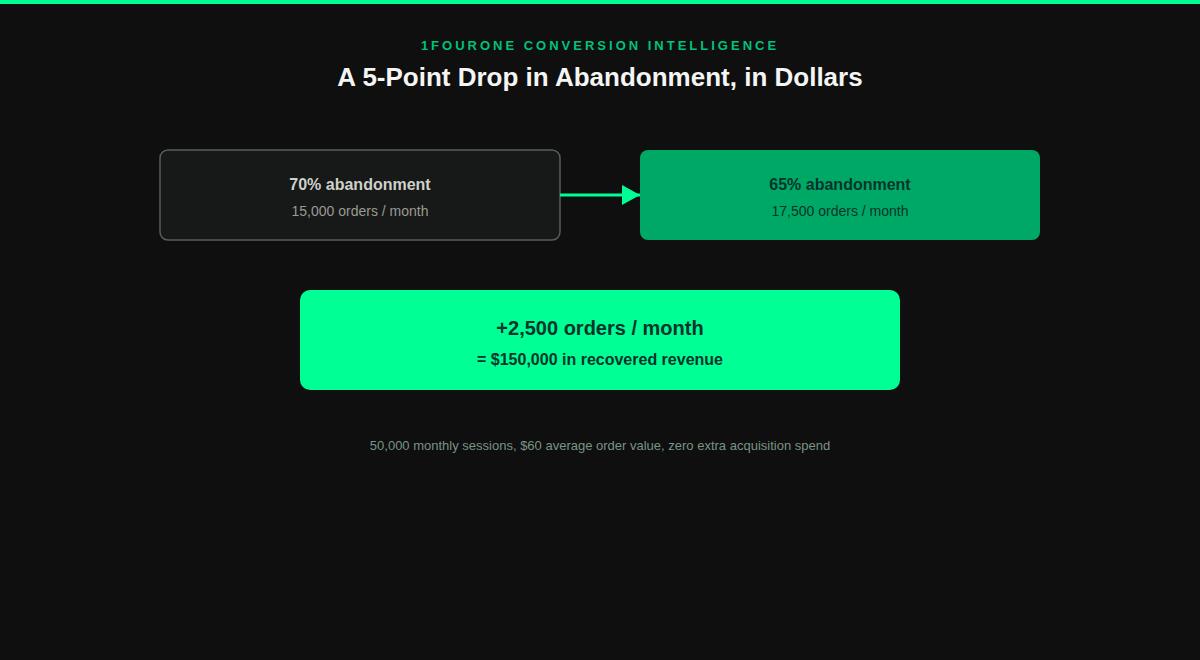
A worked example shows why this matters financially, not just experientially. A mid-market retailer driving 50,000 checkout sessions a month at a 70% cart abandonment rate completes roughly 15,000 orders. Reducing checkout abandonment by even five percentage points, down to 65%, recovers 2,500 additional orders a month without spending a single extra dollar on acquisition. At a modest $60 average order value, that single change is worth $150,000 in monthly revenue sitting inside traffic the business already paid to acquire.
To find where users are dropping off, you need a granular funnel analysis. Look beyond the total abandonment rate and map the drop-off percentage at each specific field, from the shipping address input to the final card submission. A spike in exits at the shipping cost calculator is a clear, specific barrier that needs immediate attention, not a vague sense that “checkout feels slow.”
We recommend running a regular customer journey mapping exercise to test the experience across multiple devices. Often, a checkout flow works perfectly on desktop but becomes a cluttered, error-prone mess on mobile. Manually testing every step catches validation errors and layout issues that analytics software alone tends to miss.
Session recording tools are worth the investment too. Watching anonymised users struggle to find the apply discount button or repeatedly trigger validation errors gives qualitative evidence that is far more actionable than a raw drop-off number. That insight lets you fix the actual cause of the frustration rather than guessing at a solution and hoping it sticks.
Treat this diagnostic work as the foundation of your wider conversion rate optimisation programme, not a one-off project. Funnel friction shifts as your product mix, traffic sources, and device split change over a year, so a checkout that was well optimised in January can quietly develop new leaks by the next major sales event without anyone noticing until the abandonment numbers move.
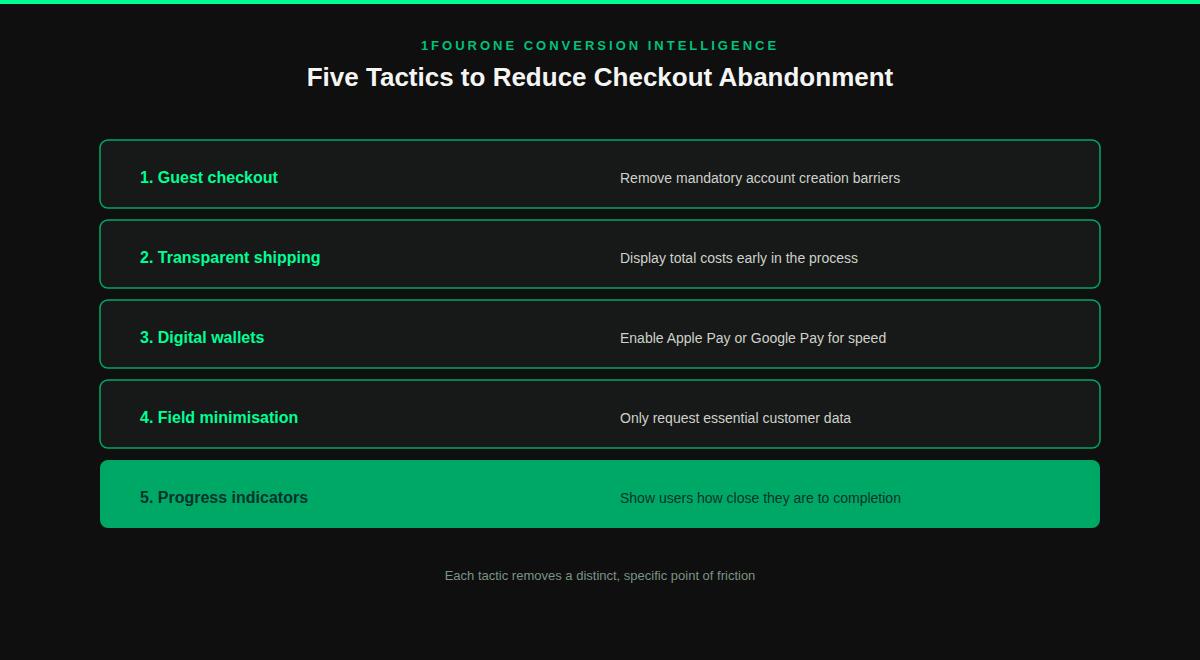
Improving conversion rate optimization at checkout comes down to reducing time-to-transaction wherever you safely can. Here are five proven tactics, summarised first and then explained in more depth below.
| Tactic | Operational goal |
|---|---|
| Guest checkout | Remove mandatory account creation barriers |
| Transparent shipping | Display total costs early in the process |
| Digital wallets | Enable Apple Pay or Google Pay for speed |
| Field minimisation | Only request essential customer data |
| Progress indicators | Show users how close they are to completion |
Your choice of payment gateway has a direct, measurable effect on conversion. Modern consumers expect a variety of options, and a limited payment menu is a frequent, specific reason for checkout abandonment. If your gateway does not support local payment preferences or deferred options like Buy Now, Pay Later, you are turning away a segment of your audience before they even reach the card field.
The conversion impact of digital wallets specifically is well documented. Stripe’s own research across global merchants found that offering Apple Pay produced an average 22.3% increase in conversion and a 22.5% boost in revenue among eligible checkouts. That is not a marginal gain, it is one of the single most effective changes available in payment gateway optimization.
Beyond wallet support, payment gateway optimisation also means minimising the number of redirects required to complete a transaction. Every redirect to a third-party server is a fresh risk of technical failure or a moment where the customer’s trust wavers. A gateway that supports embedded payment forms keeps the user inside your own branded environment for the entire transaction.
Finally, make sure your gateway is properly configured for mobile-first payments. The card-entry interface should adapt automatically to the mobile keyboard, with validation happening in real time. If a user has to refresh the page or manually fix an error on a small screen, the chance of completing the purchase drops sharply.
Run a quarterly audit of your actual payment mix against your customer base. A B2B store selling to enterprise buyers has a completely different optimal mix to a DTC fashion brand selling to mobile-first Gen Z shoppers, and a gateway configuration that was right at launch rarely stays right as the customer base evolves.
When abandonment does happen, your first-party data strategy is what lets you recover the lost revenue. Capturing an email address or phone number early in the checkout flow lets you trigger automated, personalised recovery sequences. This is not just a generic “you left something in your cart” email, it is an opportunity to provide actual helpful context.
Use your data to work out whether the abandoning user is a frequent buyer who was simply distracted, or a new visitor with unanswered questions about your shipping policy. Tailor the follow-up to their specific situation. If they were looking at a high-value item, a limited-time free shipping code or a direct link to live chat support can close the final gap that a generic discount code never would.
Make sure recovery efforts comply with local privacy regulations while still making proper use of the data you have collected. By closing the loop between your checkout analytics and your email marketing engine, a moment of lost revenue becomes an opportunity to build a stronger relationship with that customer instead.
Unexpected total costs, such as shipping fees, taxes, or service charges revealed late in the process, are consistently the leading driver of abandonment across published research.
Not always, but increased length generally correlates with a higher cart abandonment rate. Each additional form field is another opportunity for a validation error or a moment where the customer loses momentum.
For high-ticket items, these services can meaningfully lift conversion by reducing the psychological barrier to a large purchase. They are usually unnecessary for low-cost, impulsive purchases where the barrier was never there to begin with.
Use an A/B testing platform to show a small percentage of traffic the new flow while the majority still sees the original. This validates a redesign against real performance data before you commit to it fully.
Yes. Mobile users have less screen space, different input methods, and a higher chance of getting distracted mid-flow. A genuinely frictionless checkout on mobile needs a simplified interface that prioritises speed and large, forgiving tap targets.
The first message typically performs best within one to three hours of checkout abandonment, while intent is still fresh. A short follow-up sequence over the next few days, rather than a single email, captures buyers who needed more time to decide.
It typically takes under 60 seconds for a returning customer using a saved digital wallet, with no mandatory account creation, shipping costs visible before the final step, and no more than two or three screens between the cart and order confirmation. A frictionless checkout is not about removing every field, it is about removing every field that does not directly help the transaction complete.
A high cart abandonment rate is rarely caused by one single issue. It is usually the accumulated result of several small points of friction that built up over time without anyone auditing the whole flow end to end. Without that audit, you are likely leaving meaningful revenue on the table every single day. 1FourOne specialises in diagnosing these leaks and engineering a checkout experience that is as frictionless as it is secure.
We run a full technical audit of your checkout infrastructure, mapping user drop-offs and testing your payment gateway for both efficiency and trust. We then connect your first-party data strategy to turn abandoned sessions into genuine re-engagement opportunities, rather than generic blanket discounting.
Payment gateway optimisation and a falling cart abandonment rate are not separate projects inside a properly run audit, they are the same project measured from two different angles. You have worked hard to attract your customers, do not lose them at the finish line. Contact our Growth Intelligence team to baseline your checkout performance and build a path to purchase that converts on every device.
Get your competitive audit in 48 hours and see exactly where your revenue is leaking.
Get Your Audit →