First-Party Data Strategy: Stop Renting Your Customers
For the past decade, mid-market e-commerce growth ran on a simple equation: inject capital into performance marketing channels, acquire traffic, and capture the margin. Brands built entire commercial operations by renting audiences from Google and Meta. Today, that equation is mathematically breaking down. The cost to acquire a new customer has outpaced the margin that customer generates on their first purchase, which threatens the profitability of the standard retail model.
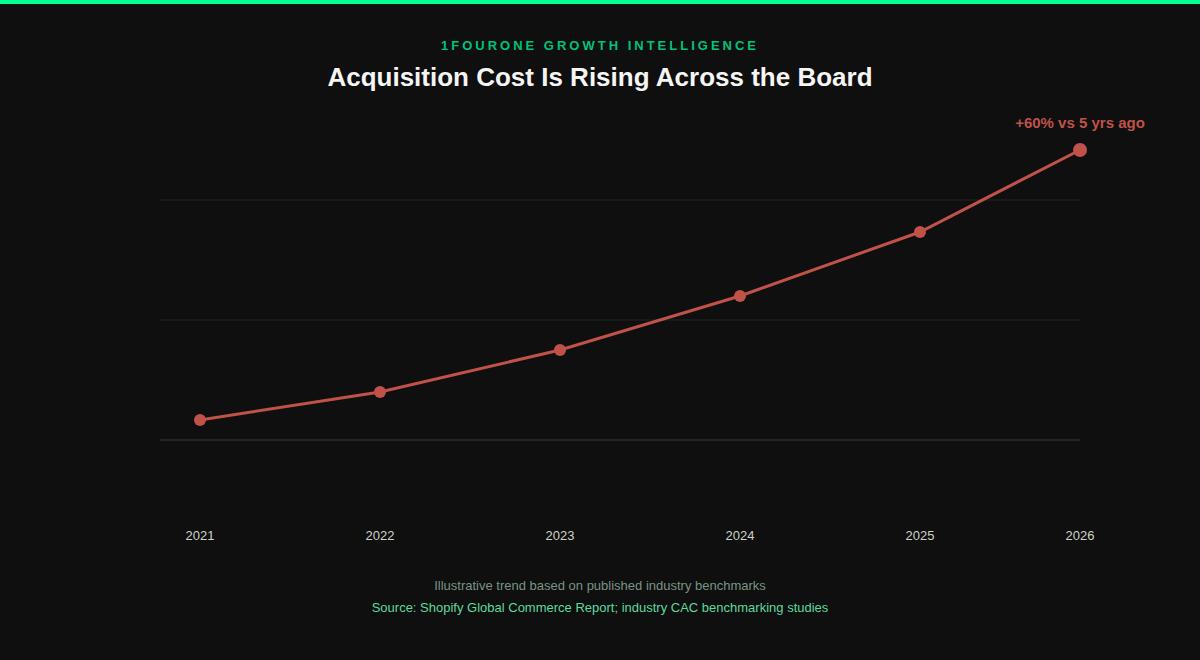
This margin compression is not a temporary fluctuation. It is a structural reality driven by increased auction density, privacy regulation, and the decline of third-party tracking. As acquisition costs rise, relying purely on top-of-funnel paid media becomes a fast track to insolvency, and the only real defence against a rising Customer Acquisition Cost is a disciplined first-party data strategy.
This approach shifts a brand’s commercial focus from renting temporary clicks to building a permanent, owned data asset. By systematically capturing, organising, and activating direct customer information, merchants can insulate their margins from the volatility of external advertising platforms. This article covers the mechanics of that shift, and why e-commerce retention now sits alongside acquisition as a core part of the business model rather than an afterthought.
To understand the urgency here, marketing directors need to confront the current state of the advertising ecosystem. The era of cheap, precisely targeted third-party data ended with iOS 14.5 and the privacy legislation that followed. Algorithms that once predicted consumer behaviour with real precision now operate with significant signal loss, and platforms have raised the cost of their inventory to compensate.
For an e-commerce brand selling a product with a $50 margin, an acquisition cost of $15 used to leave ample room for profitability and overhead. Today, that same acquisition cost might sit at $45 or $55. Shopify’s own Global Commerce Report found that average e-commerce CAC rose from $274 to $318 in a single year, a 16.1% jump. When CAC exceeds the first-order margin, you are effectively paying for the privilege of serving a customer, and the model only survives if that customer returns a second, third, and fourth time without further paid media spend.
Without a first-party data strategy, you have no mechanism to bring that customer back organically. You are forced to re-acquire them through retargeting, paying the platform a second time for a buyer who already knows your brand. That is a commercially fatal loop. The fix is to treat your initial acquisition cost as an investment in a long-term asset rather than a sunk cost for one transaction, which is exactly what e-commerce retention is built to protect.
In a growth intelligence context, a first-party data strategy is an architectural and operational framework for collecting information directly from your audience, with explicit consent, and using it to deliver personalised, high-converting experiences. It is the data you own, housed on your own servers, generated through direct interaction with your brand’s digital properties.
This sits in direct contrast to third-party data, which is collected by external entities and sold to you, often aggregated, anonymised, and sold to your competitors at the same time. A genuine version of this strategy spans purchase history, on-site behavioural tracking, email engagement, and explicitly stated customer preferences. It turns anonymous website traffic into known, addressable people.
Many retailers mistakenly believe they have this covered simply because they collect email addresses at checkout. That is data collection, not a strategy. A functional first-party data strategy dictates exactly how that email address is unified with the user’s browsing history, how it triggers predictive replenishment flows, and how it informs broader merchandise planning. It elevates data from a static CRM list to an active, revenue-generating engine.
The strategic case here is the move from a rented commercial ecosystem to an owned one. When you rely exclusively on Google Search or Meta Ads for revenue, you are a digital tenant. The platforms act as landlords, and they can, and do, raise the rent at any time through algorithm updates or higher auction floors. If they double their prices tomorrow, your margins vanish instantly.
An owned ecosystem operates entirely differently. When you own the data, you control the distribution. An authenticated database of 250,000 engaged customers lets you communicate directly with them by email, SMS, or app notification at a fraction of a cent per message, bypassing the algorithmic gatekeepers entirely.
| Attribute | Rented audience (third-party) | Owned ecosystem (first-party data) |
|---|---|---|
| Cost structure | Variable, rising continuously with auction pressure | Fixed infrastructure cost, near-zero marginal cost per message |
| Data accuracy | Inferred, probabilistic, vulnerable to tracking blockers | Deterministic, explicitly provided, highly accurate |
| Competitive advantage | None. Competitors can buy the same audience segments | Strong. Your database is proprietary and inaccessible to rivals |
| Asset value | None. The value disappears the moment you stop spending | High. A clean database directly increases business valuation |
This shift requires realigning marketing KPIs. Rather than tracking Return on Ad Spend on a 7-day click window, a mature operation measures Customer Lifetime Value over a 12-to-24-month horizon. You accept a break-even or slightly negative first purchase because the data you have built guarantees the subsequent, more profitable transactions.
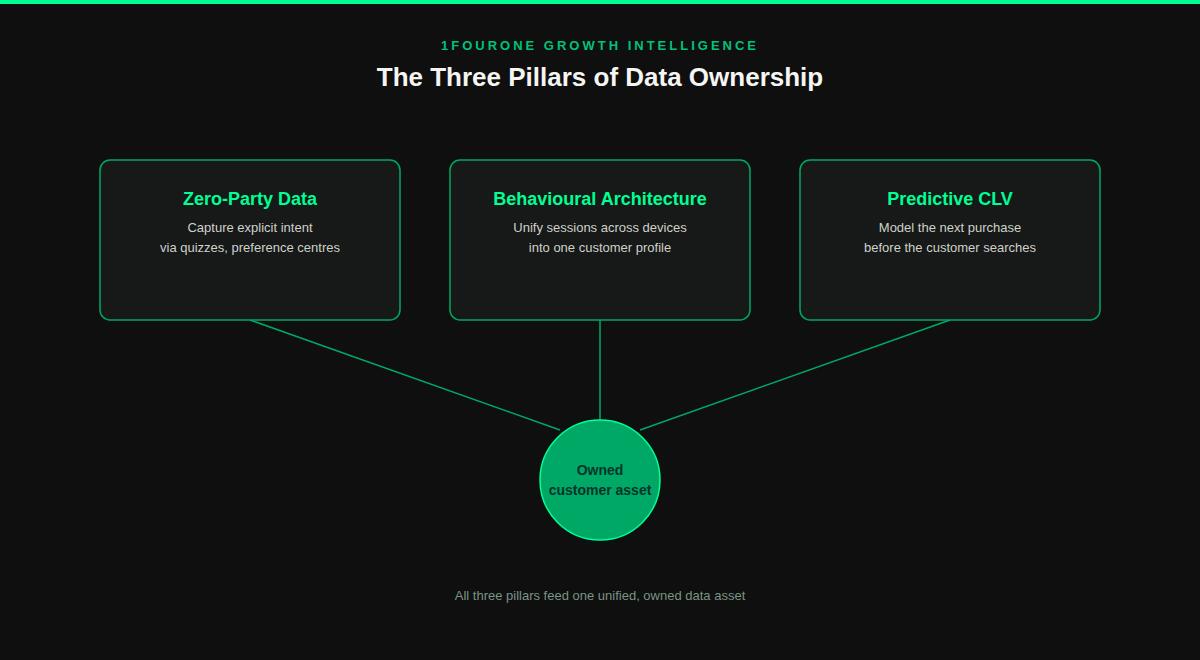
Executing this properly requires specialised technical architecture. It cannot be achieved through generic email newsletters or basic web analytics. It requires building three distinct, integrated data pillars across your e-commerce ecosystem.
Within this approach, zero-party data is the most valuable asset you can acquire. It is information a customer intentionally and proactively shares with your brand: preference centre data, purchase intentions, personal context, and how they want to be recognised.
Instead of relying on tracking pixels to guess what a customer wants, this approach simply asks them. A skincare retailer might deploy an on-site diagnostic quiz. When a user says they have dry skin, live in a cold climate, and want an anti-ageing solution, they have handed you the blueprint for their entire purchasing lifecycle, and you stop wasting margin showing them ads for oily skin products.
This level of capture requires a value exchange. People will not hand over zero-party data for nothing. A successful approach incentivises the exchange with personalised recommendations, exclusive access, or a direct discount in return for explicit data profiling. Once captured, this data needs to sync instantly with your CRM so it can change the user’s on-site experience in real time.
The second pillar is resolving customer identity across multiple touchpoints. A user might discover your brand on mobile via Instagram, browse anonymously, leave, return three days later via an organic desktop search, and finally purchase. Without a unified profile, those look like three different people to your analytics platform.
To solve this, e-commerce brands deploy a Customer Data Platform, or an advanced CRM architecture, to build Unified Customer Profiles. This uses deterministic identifiers, such as an email login, a clicked SMS link, or a loyalty programme authentication, to stitch fragmented sessions into a single, cohesive timeline.
Once the profile is unified, the behavioural data becomes actionable. If a known, high-LTV customer visits a specific product category page three times in a week without buying, the system should automatically trigger a specific, plain-text email offering a consultation or a time-sensitive incentive. That is automated revenue retrieval, driven by owned data rather than paid retargeting.
The most advanced application here is moving from reactive marketing to predictive modelling. Once you have enough historical data, RFM analysis, recency, frequency, and monetary value, predicts when a specific cohort is likely to make their next purchase, or when they are at high risk of churning.
Consider a brand selling consumable sports nutrition. A basic setup emails the entire list a 10% discount every month. A more sophisticated model calculates that a customer who bought a 30-serving tub of protein exactly 25 days ago is statistically likely to need a refill, and deploys a replenishment offer at the moment of highest intent.
This is also where the economics become hard to ignore. Bain & Company’s research found that increasing customer retention by as little as 5% can lift profits by 25% to 95%, depending on the sector. Anticipating need this way captures the revenue before the customer thinks to search for a competitor, and the same modelling lets you identify the top 5% of customers, the ones who generate disproportionate revenue, and give them the white-glove treatment that locks in their loyalty.
A first-party data strategy does not exist in a vacuum. It is the connective layer that ties together the other parts of your growth intelligence framework, directly influencing how you map customer journeys and how you defend market share.
When you run a competitive market share analysis, your own customer data tells you exactly which of your customers are being siphoned off by rivals. If your predictive models flag a sudden drop in purchase frequency in a specific geographic cohort, you can cross-reference that against your competitor analysis to check whether a rival has launched a localised paid media push, then use your owned channels to respond directly.
Similarly, when you are mapping the customer journey to plug revenue leaks, this data supplies the qualitative context. You are not looking at anonymous cart abandonment rates, you are looking at the abandonment behaviour of your most valuable repeat buyers, which is the precise, segmented intelligence needed to make high-impact structural changes to your digital architecture.
It has to be said plainly: implementing a genuine first-party data strategy is a real data engineering project. It requires auditing your current tech stack, moving to server-side tracking to bypass browser-based ad blockers, and maintaining strict compliance with GDPR, CCPA, and other evolving privacy frameworks. The architecture has to be secure, fast, and able to scale.
Many brands fail at this stage because they bolt together mismatched Shopify apps and legacy CRM systems, which produces siloed data that cannot talk to itself. A working setup requires a single data layer, where the e-commerce platform, the email service provider, the customer service helpdesk, and the analytics suite all read from and write to one source of truth.
Get that technical foundation right and your marketing team stops fighting its own tools. Segmentation works as intended, automations trigger correctly, and the brand is no longer entirely at the mercy of two advertising platforms for its daily revenue.
The window for building a sustainable, owned audience is closing as acquisition costs keep climbing. If your brand is still entirely reliant on third-party algorithms for daily revenue, you are carrying an unacceptable level of commercial risk. A fragmented CRM and a generic email newsletter will not protect your margins.
1FourOne provides established retail brands with the technical engineering and strategic oversight needed to build an enterprise-grade first-party data strategy. We audit your current data capture, implement unified customer profiling, and deploy predictive retention architecture that maximises customer lifetime value. Contact our Growth Intelligence team to baseline your current data maturity and start taking real ownership of your commercial ecosystem.
Get your competitive audit in 48 hours and see exactly where your revenue is leaking.
Get Your Audit →