Loyalty Program Design: Points, Tiers, or Cash Back
Many retail brands treat customer retention as a secondary concern, focusing almost exclusively on top-of-funnel acquisition. They eventually launch a loyalty program to fix their churn rates, often choosing a standard points-based system without considering their unique unit economics. The result is usually an expensive, underused programme that fails to meaningfully shift repeat purchase behaviour.
True retention intelligence is not about handing out digital coupons. It is about engineering a behavioural loop that rewards your most valuable customers for actions that increase your bottom line. A well-designed programme aligns the customer’s incentive to return with your need for predictable, high-margin revenue.
If your loyalty structure does not directly improve your customer lifetime value, you have created a cost centre rather than a growth lever. This article breaks down the mechanics of modern loyalty program design and how to choose a model that builds a defensible, recurring customer base, as part of a broader set of customer retention strategies.
The primary goal of any retention framework is to lower the cost of the second, third, and fourth transaction. When you rely on paid media to bring customers back, you are paying an external platform tax every time your customer wants to buy again. A successful programme shifts that transaction into a channel you own outright.
However, many programmes are designed in a vacuum. They offer rewards that are too easy to reach, creating unnecessary margin erosion, or rewards that are too difficult to reach, causing customer apathy. Effective loyalty program design requires a clear understanding of your average order frequency and your profit margin per unit, not a generic template borrowed from a competitor.
You need the cost of your rewards to sit well below the incremental profit generated by increased purchase frequency. If the programme does not drive a measurable increase in orders per year, you are simply giving away margin to customers who would have bought anyway. This is why a data-first approach belongs ahead of any loyalty infrastructure, not bolted on after launch.
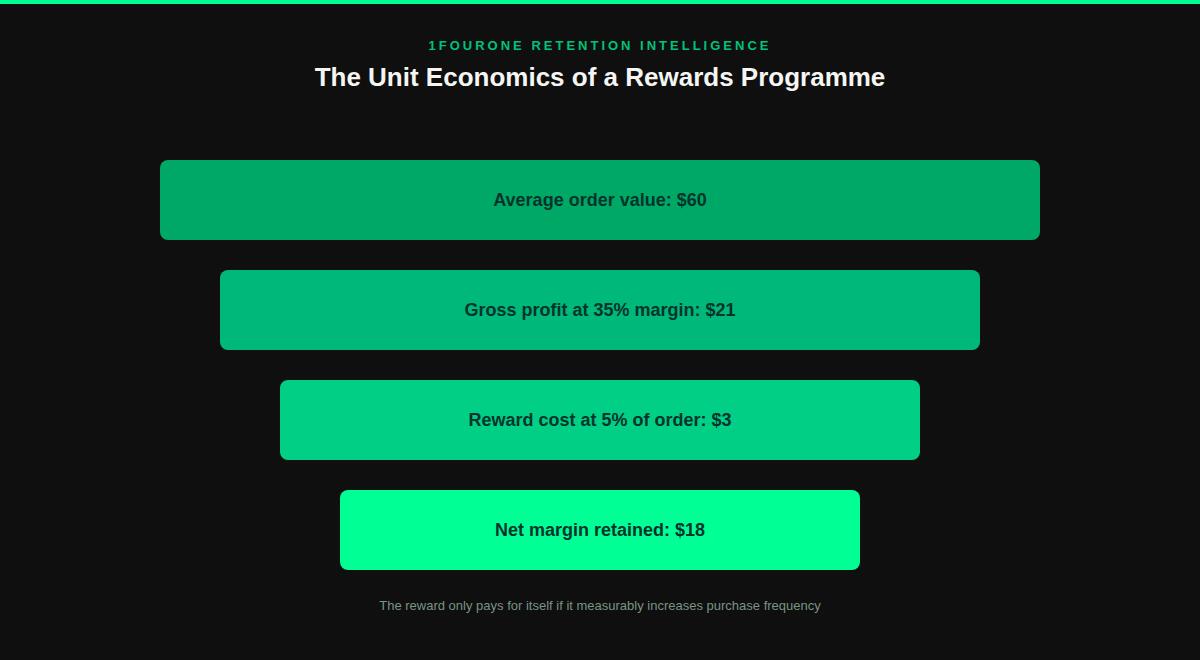
A worked example makes this concrete. A retailer with a $60 average order and a 35% gross margin earns roughly $21 gross profit per order. A points programme that gives back 5% in redeemable value costs $3 per order, which is sustainable only if it genuinely lifts purchase frequency, not if it simply rewards the same orders that would have happened anyway. The most successful e-commerce loyalty programs treat that 5% as a deliberate investment in a specific, measured behaviour change, not a blanket cost of doing business.
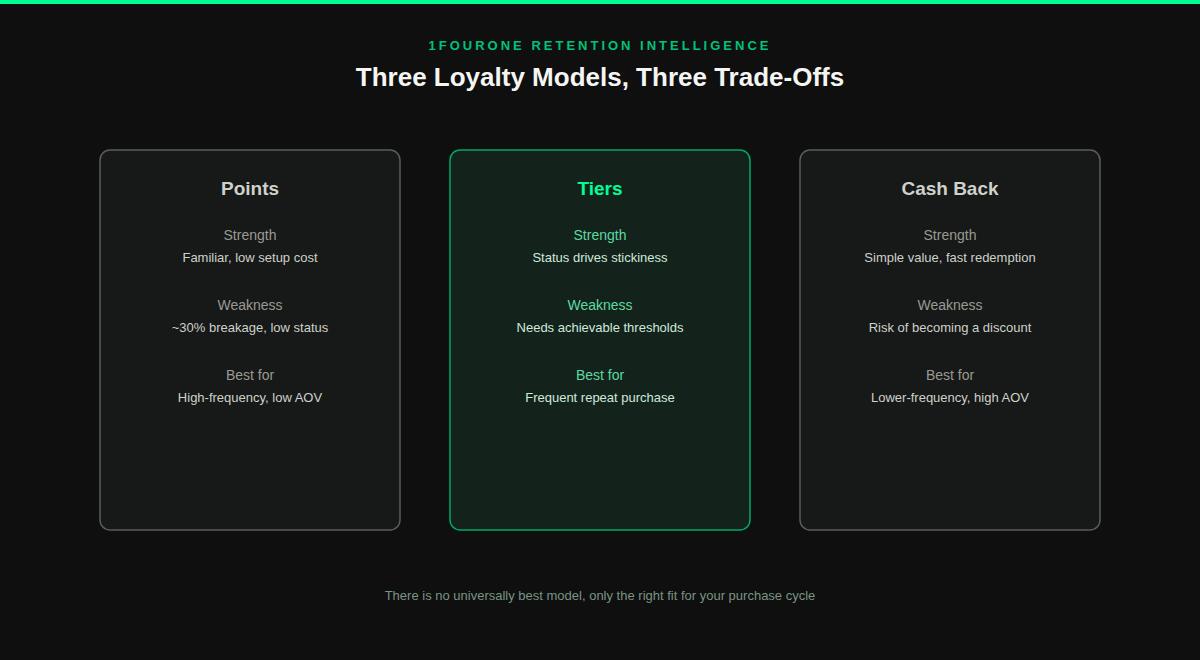
Points-based models are the most common form of loyalty program design, and they are frequently the least effective for mid-market retail. They often lack exclusivity and fail to create any real sense of status for the customer. Points can become invisible to the shopper, accumulating quietly in the background without ever influencing the decision to choose your brand over a rival’s.
The data backs this up. Bond Brand Loyalty’s research puts annual point breakage, the share of points earned but never redeemed, at close to 30% across the industry. A reward that nearly a third of customers never bother claiming was never a meaningful incentive in the first place. Points-based systems are also often purely transactional, rewarding spend rather than advocacy or engagement, so a competitor offering a slightly better price can win the sale regardless of how many points a customer has stockpiled.
Points can still work, but only when paired with clear, attainable benefits that feel like a genuine advantage. If points only convert into a small percentage discount, they rarely act as a real barrier to switching. The reward has to be meaningful enough to change behaviour, not just a small rebate on a purchase the customer was going to make anyway.
Tiered structures tend to be more effective at driving high-value behaviour because they tap into status rather than just transaction value. When a customer reaches a higher tier, they gain access to benefits that are not available to the general public, such as early access to new product drops, free expedited shipping, or dedicated support.
This creates a genuinely sticky experience. A customer in your top tier is far less likely to defect to a competitor, since they would lose the convenience and the social capital tied to their status, not just a discount. This is growth intelligence in practice: you are engineering a structural advantage that protects revenue rather than just renting attention with a coupon. KPMG’s research on paid loyalty programmes found members are 62% more likely to increase their spending with a brand once they are inside a structured tier, and 88% of satisfied members prefer that brand over a cheaper competitor.
Tiers still need to be transparent and achievable. If the gap between tiers is too wide, customers disengage well before reaching the next level. The path to the next status level needs to be clear and tangible, and the tiers themselves should reward behaviours that align with your actual business goals, such as high-margin category purchases, not just total spend.
The most common design mistake is copying a competitor’s tier structure wholesale rather than building one around your own margin and purchase frequency data. A tier threshold that works for a brand with a 45-day average repurchase cycle will feel completely unreachable to customers of a brand whose typical cycle is 120 days, even if the dollar value of the threshold is identical.
Cash back or store-credit models often outperform traditional points systems because they simplify the value proposition. A customer immediately understands what five dollars in credit is worth, in a way that five hundred points never quite translates. That simplicity reduces cognitive load and makes the reward feel like real currency, which tends to drive a faster time to redemption.
Direct discounting, a fixed percentage off every purchase, is a margin-eroding strategy disguised as loyalty. It trains customers to wait for a sale rather than valuing the product at full price. It does not build loyalty, it builds price sensitivity, and price-sensitive customers are the easiest ones for a competitor to win away.
If you do choose a cash-back or credit-based model, make it time-bound. A balance that never expires creates a long-term liability on your balance sheet and removes the urgency needed to actually drive repeat purchase behaviour. Good loyalty program design treats the reward as a nudge, not a permanent discount baked into how customers value your product.
Your loyalty framework needs to be fully integrated with your first-party data strategy. This is where loyalty program design and data strategy stop being separate projects: every interaction inside the programme should feed your customer profile, building richer data on preferences, purchase timing, and category affinity that you then use to trigger specific, personalised communication.
If a loyalty member consistently buys from one category, your retention messaging should reflect that. You are not sending generic newsletters at that point, you are surfacing relevant updates, early access to new items in their preferred category, and incentives that genuinely move the needle for that specific customer.
This integration also enables predictive churn modelling. By monitoring engagement inside the loyalty programme, you can spot customers whose activity is declining and reach out proactively with a win-back offer, anticipating the moment a customer might consider switching to a rival rather than reacting after they already have.
Start an audit by comparing the repeat purchase rate of loyalty members against non-members. If there is no meaningful difference, your loyalty program design is not driving behaviour, it is just tracking customers who would have returned anyway. Look at redemption rates too: if points or credits are sitting idle, the design is either too complex or the rewards are not seen as valuable.
Check the margin impact of your rewards next. Are you subsidising customers who were already loyal, or genuinely incentivising new purchase frequency? A healthy e-commerce loyalty programme should show a clear correlation between engagement and an increase in lifetime value, not just a cost line with no measurable return.
Finally, ask customers directly. Exit polls and post-purchase surveys reveal whether your rewards are perceived as genuine value or just a generic discount with extra steps. The goal of loyalty program design is a frictionless, rewarding loop that cements the relationship with the buyer, not a points balance nobody bothers to check.
Not automatically. A loyalty programme only makes sense once repeat purchase behaviour and margin per order can support the cost of rewards. A brand with a long replacement cycle and thin margins may get more value from first-party data work alone before adding a formal programme on top.
Match the model to your purchase frequency, which is the core decision in any loyalty program design. High-frequency categories tend to suit tiers, since status compounds with repeat visits. Lower-frequency, higher-AOV categories often do better with cash back or credit, since the reward needs to feel substantial on a less frequent cadence.
There is no universal number, but a programme with breakage well above the roughly 30% industry norm is a signal the rewards are not perceived as attainable or valuable, not a sign you are saving money.
It can, but the two need clear, separate roles. Use discounting to move specific inventory or acquire new customers, and reserve the loyalty programme for rewarding the behaviour you actually want to encourage, such as repeat purchases or category loyalty. Blurring the two trains customers to wait for whichever offer is cheaper that week, which undermines both.
Contact our Growth Intelligence team to audit your existing retention architecture and build a loyalty programme that actually scales lifetime value rather than just sitting on your balance sheet as a liability.
Get your competitive audit in 48 hours and see exactly where your revenue is leaking.
Get Your Audit →