Ecommerce Dynamic Pricing: 4 Proven Rules for Survival
Implementing ecommerce dynamic pricing is often misunderstood as a race to the bottom. When retailers deploy automated repricing tools without a strategic framework, they usually train their algorithms to match the cheapest competitor blindly. This reactive approach strips away profit and rapidly diminishes the perceived value of the products being sold. Over time, customers learn to wait for the inevitable discount rather than purchasing at full retail value.
This cycle creates a severe structural vulnerability. A competitor with lower overhead costs or cheaper capital can force your business into an unprofitable position simply by manipulating their own digital price tags. If your response to a competitor’s price drop is an immediate, uncalculated matching discount, you have effectively handed control of your financial health to a rival. The solution requires a shift from pure volume acquisition to intelligent revenue defence.
To survive a retail price war, directors must transition from basic repricing to a sophisticated margin protection strategy. This involves setting strict mathematical boundaries, evaluating price elasticity, and understanding when to surrender a sale rather than absorb a loss. This guide details the financial mechanics required to protect your commercial viability when the market becomes aggressive, using ecommerce dynamic pricing as a defensive system rather than a blunt discounting tool.
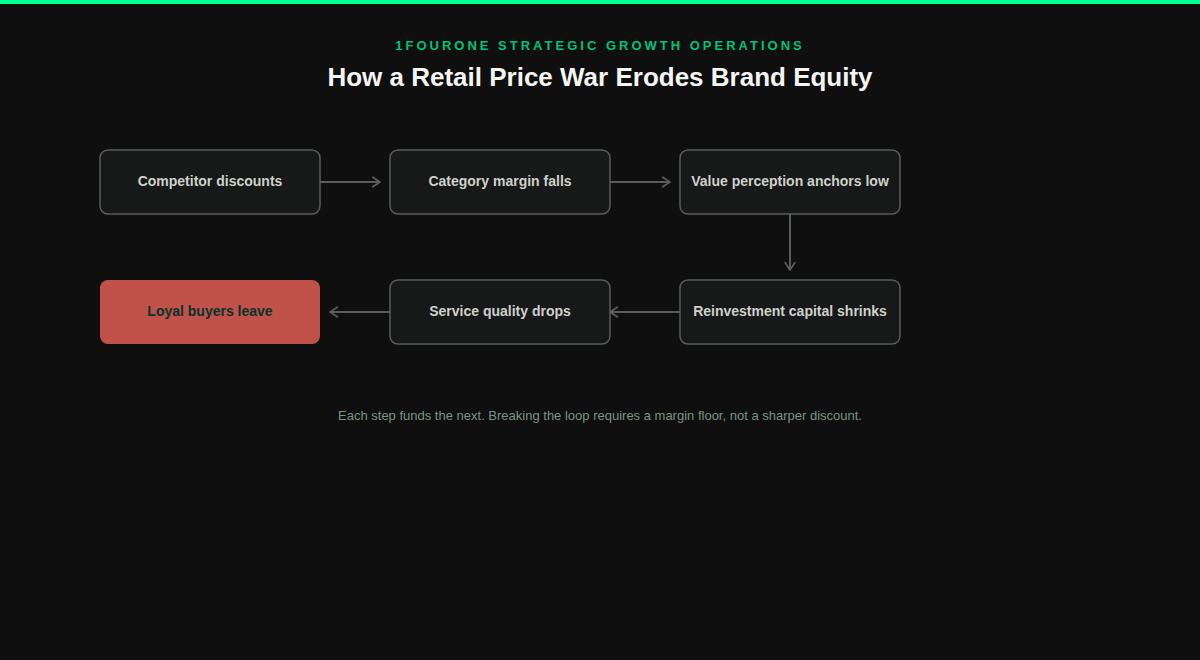
A retail price war is rarely an isolated event. It typically begins when one vendor attempts to clear excess inventory by undercutting the market average, prompting algorithms across the sector to follow suit. While the instigator might secure a temporary spike in sales volume, the collective margin of the entire category is permanently suppressed. Once a premium item is consistently sold at a steep discount, the consumer’s perception of its true value is anchored to that lower figure.
This erosion of brand equity means the company can no longer command a premium based on quality, service, or reputation. If a customer buys a high-end appliance for 40% off, they will feel exploited if asked to pay full price for a similar item the following year. The product has been effectively commoditised, and the only remaining differentiator is being the absolute cheapest option available. Research published by the Harvard Business Review confirms that fighting strictly on price without a structural cost advantage is mathematically fatal for most independent companies.
Competing solely on price also severely limits a company’s ability to reinvest in the customer experience. When margins are thin, there is no capital left to improve packaging, expedite shipping, or provide superior customer support. This creates a downward spiral where service quality drops to match the discounted price, further alienating the most valuable, loyal buyers who initially trusted the company.
Finally, an unmanaged retail price war often triggers conflicts with manufacturing partners and suppliers. Many premium manufacturers enforce strict advertising policies to protect their own market positioning. If your storefront consistently violates these policies to win a short-term pricing battle, you risk losing your supplier contracts and your allocation of high-demand stock completely.
Basic repricing software operates on a very simple, binary logic. It scans a defined list of competitor websites, identifies the lowest advertised price for a specific product, and automatically undercuts it by a few cents. This tool is completely ignorant of your internal business metrics, such as your current inventory levels, your inbound shipping costs, or your required operational profit. It is a blunt instrument designed exclusively to win the immediate click.
In contrast, ecommerce dynamic pricing is a multidimensional financial engine. It evaluates external market data alongside your internal commercial constraints before authorising any price adjustment. Instead of simply matching a rival, an intelligent system will review your stock density, your historical conversion rates at various price points, and your explicit profitability rules. The goal is to maximise the total yield of your catalogue, which sometimes means actually increasing prices when competitors run out of stock.
This distinction is critical for surviving a retail price war over the long term. A basic repricing tool will happily sell your last remaining unit of a popular item at a 50% discount just because a competitor did the same. A properly configured ecommerce dynamic pricing setup recognises the scarcity of your final unit and holds the price steady, knowing the competitor will soon sell out and demand will shift back to your storefront at full margin.
By connecting your pricing engine to your broader first-party data strategy, you can also factor in customer lifetime value. If a user has a history of high-margin repeat purchases, the system might offer them a targeted incentive while displaying the standard retail price to a one-time, low-intent visitor.
The foundation of any defensive pricing model is the minimum margin threshold. This is the absolute lowest price at which you are willing to sell a product before the transaction becomes a net negative for your business. Calculating this figure requires moving beyond gross margin to understand your fully loaded contribution margin on every single unit.
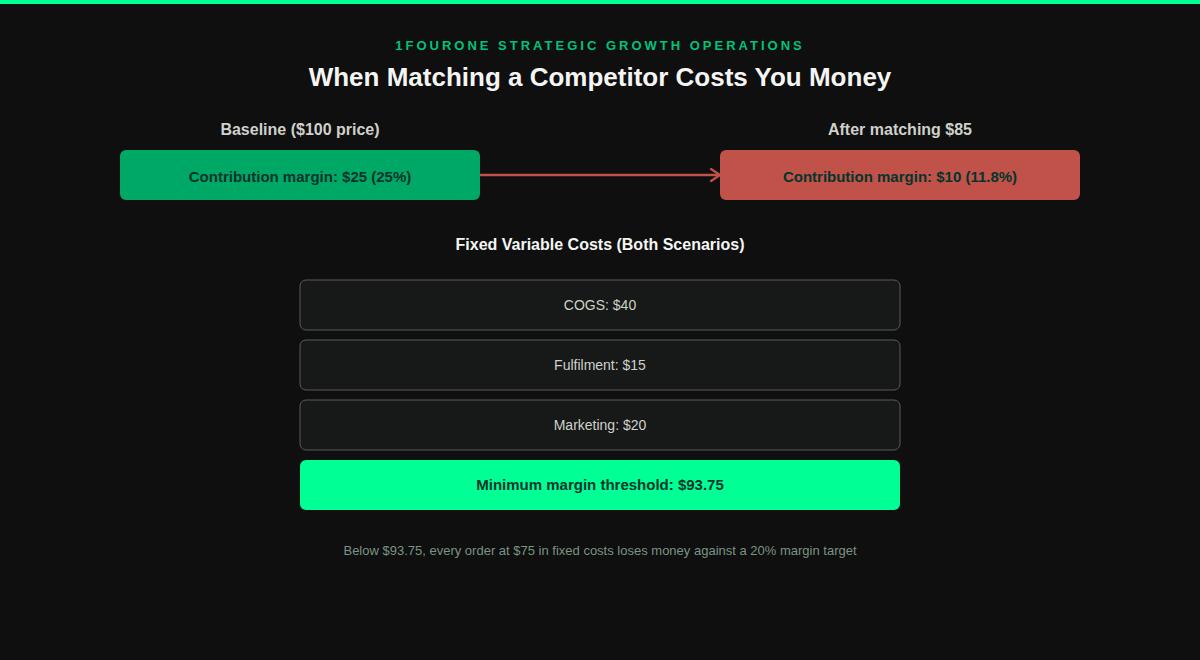
Consider a standard retail scenario for a consumer electronics product. The baseline retail price is set at $100. The fully loaded cost of goods sold, which includes the factory price and inbound freight, is $40. The variable fulfilment costs, including picking, packing, and outbound shipping, add $15.
Finally, the variable marketing cost to acquire the customer is $20. In this baseline scenario, your total variable costs are $75, leaving a healthy contribution margin of $25, or 25%. That 25% is your starting point before any competitor moves.
Now imagine a competitor aggressively drops their price to $85. If a basic repricing tool matches this price, your revenue falls to $85, but your variable costs remain fixed at $75. Your contribution margin shrinks to just $10, which represents an unsustainable 11.8% margin. If your business requires a 20% margin to cover fixed overheads like salaries and technology software, matching the competitor guarantees a financial loss on every order.
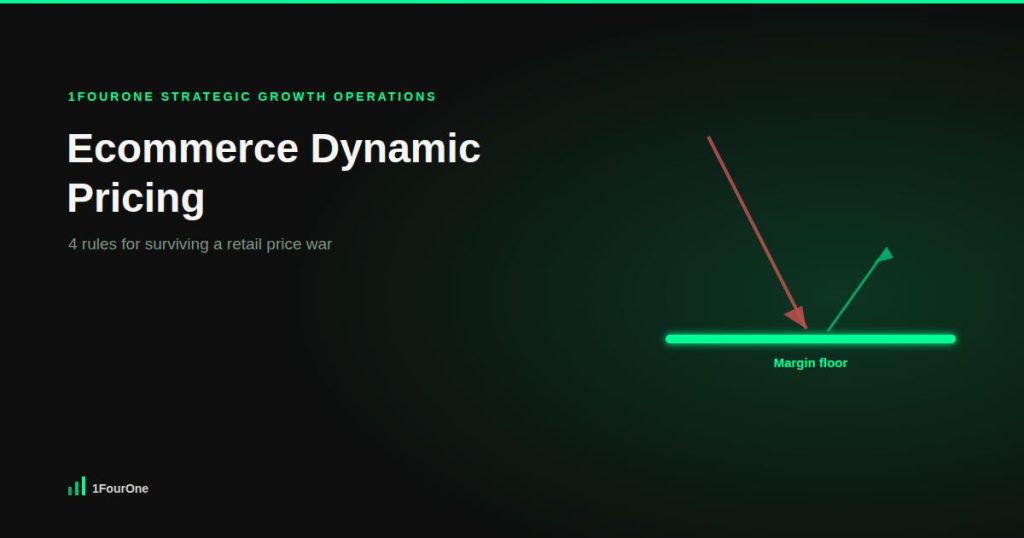
To prevent this, you must calculate the exact floor price required to maintain your operational health. To maintain a 20% margin against $75 of fixed variable costs, the minimum margin threshold works out to $93.75. By setting $93.75 as your floor in your pricing software, the system will track the competitor’s price down to that exact point and then stop. You surrender the unprofitable sales to your rival and preserve your capital.
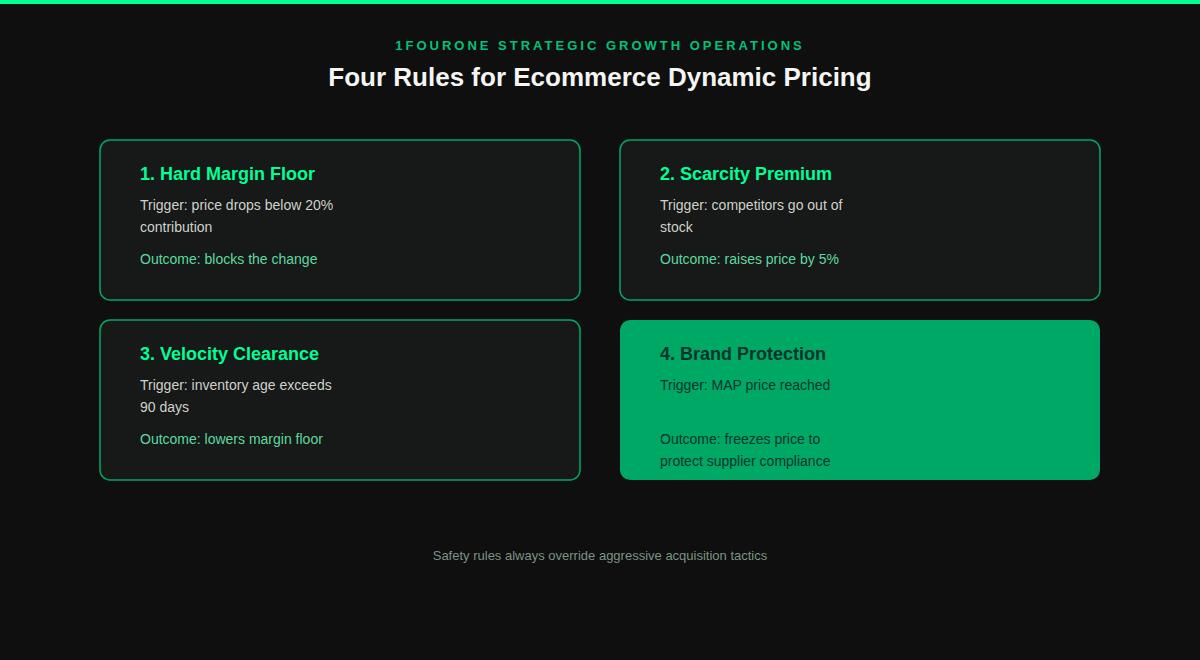
Once you understand your financial baselines, you must translate them into explicit rules for your software to follow. A working ecommerce dynamic pricing setup acts as automated guardrails, ensuring that every price adjustment aligns with your broader commercial strategy. A well-structured system relies on hierarchical logic, where safety metrics always override aggressive acquisition tactics.
The most important rule is the absolute floor set by your minimum margin threshold, as calculated above. However, you should also implement rules based on inventory velocity and stock age. If a product has been sitting in your warehouse for 90 days, the holding costs begin to erode your potential profit. In this scenario, you might program the system to relax the margin constraints slightly to accelerate the sell-through rate and free up cash flow.
| Pricing rule type | Operational trigger | Strategic outcome |
|---|---|---|
| Hard margin floor | Price drops below 20% contribution | Blocks the change to prevent net losses |
| Scarcity premium | Competitors go out of stock | Increases price by 5% to capture high demand |
| Velocity clearance | Inventory age exceeds 90 days | Lowers the margin floor to accelerate sales |
| Brand protection | MAP (minimum advertised price) reached | Freezes price to maintain supplier compliance |
It is equally important to define which competitors you actually want to monitor. Matching prices against a massive marketplace is often a losing battle for an independent retailer, and it is a different fight from a retail price war against a direct, comparable rival. Instead, you should configure your rules to track only direct, equivalent competitors, a process best informed by a regular competitive market share analysis.
While algorithmic adjustments can protect your margins mathematically, they carry a significant psychological risk. Consumers are increasingly aware of automated pricing tactics and often react negatively when they feel manipulated. According to operational guidelines published by McKinsey regarding dynamic pricing, businesses must balance mathematical yield management with consumer perception to avoid long-term reputational damage, which is exactly where a poorly governed margin protection strategy tends to fail.
This trust deficit is particularly damaging for businesses that rely on high repeat purchase rates. If a loyal customer buys a product on Tuesday, only to see the price drop by 15% on Thursday due to an automated rule, their perception of the brand is instantly damaged. The short-term margin gain from the initial sale is completely offset by the loss of their future lifetime value.
To mitigate this risk, transparency and consistency are vital. If you must adjust prices frequently, restrict those aggressive movements to specific clearance categories or gated loyalty portals rather than your primary storefront. Make sure your customer service team is empowered to offer immediate price adjustments or store credit to recent buyers who complain about sudden drops, since that single interaction often decides whether the relationship survives the price change.
Ultimately, a sustainable margin protection strategy requires a balance between mathematical optimisation and human psychology. Retaining a loyal customer who trusts your pricing integrity is always more profitable than squeezing an extra dollar out of a single transaction.
The primary risk is a race to the bottom where two competing algorithms continuously undercut each other until both businesses are selling at a severe loss. This is entirely preventable by configuring strict margin floors before turning the system on.
For most independent retailers, updating prices once a day is sufficient to remain competitive without causing customer whiplash. High-frequency updates multiple times a day are usually only necessary during major promotional events like Black Friday.
Generally, no. Giant marketplaces operate on an entirely different logistical model and can absorb losses that would bankrupt a smaller retailer. Compete on service, bundled value, and customer experience rather than trying to match their lowest absolute price.
Yes. While most people associate the term with discounting, properly configured ecommerce dynamic pricing will automatically raise your prices when your competitors run out of stock, allowing you to capture maximum margin during periods of high demand.
Maintain price stability on your core, premium products and restrict aggressive algorithmic changes to older inventory or highly commoditised accessories. Consistent, transparent communication about your value proposition also helps insulate your brand equity from price sensitivity.
MAP, or minimum advertised price, is a supplier-imposed floor that protects the manufacturer’s brand across every retailer that sells it. A margin protection strategy is broader: it covers your own internal contribution margin specifically, which can sit well above or even sometimes below a supplier’s MAP depending on your own cost structure.
Managing pricing manually through spreadsheets is no longer viable for growing businesses, but deploying an algorithm without strategic boundaries is equally dangerous. To protect your financial health, you need a system that respects your true unit economics and defends your brand equity. Without these guardrails, your revenue growth will inevitably come at the expense of your profitability.
1FourOne specialises in auditing and structuring complex retail pricing models. We map your fully loaded costs, calculate your true contribution margins, and help you design the precise ecommerce dynamic pricing rules needed to defend your market position. We transition your team away from reactive discounting and build a resilient margin protection strategy that prioritises sustainable cash flow over short-term volume.
Stop allowing your competitors to dictate your financial outcomes in the next retail price war. Contact our Growth Intelligence team to audit your current margin architecture and engineer a pricing strategy that protects your enterprise value.
Get your competitive audit in 48 hours and see exactly where your revenue is leaking.
Get Your Audit →