A Reorder Point Set in June Is Already Wrong by the Time Q4 Freight Congestion Hits

Executing a data-driven seasonal inventory demand forecasting protocol is the most critical operational adjustment an established digital retailer can deploy to eliminate peak-period stockout leaks and prevent costly post-holiday overstock liabilities. Many mid-market e-commerce brand operators manage peak seasonal purchasing using simple historical averages, completely failing to account for supplier lead-time volatility and promotional demand acceleration. Miscalculating stock depth before major sales events forces warehouses into expensive emergency reorders or leaves popular SKUs depleted during high-intent shopping windows. Transitioning to a dynamic seasonal forecasting model enables growth teams to optimise safety buffer depth, protect marketing spend efficiency, and preserve compounding customer lifetime value assets.
E-commerce enterprises frequently suffer severe financial losses during peak trading quarters due to static inventory reordering models. During high-volume promotional windows like Q4, customer order velocity scales rapidly while international supply chains experience severe transit delays and port congestion. When a retail brand relies on unadjusted historical reorder points, warehouse safety buffers are exhausted long before replacement shipments arrive, leading to widespread stockout notices across flagship product lines.
Operating a storefront with depleted inventory during peak shopping seasons creates a compounding financial penalty across a corporate balance sheet. As digital ad campaigns continue bidding aggressively during peak promotional periods, driving prospective buyers to out-of-stock product pages burns media capital without generating sales revenue. High-intent shoppers forced to leave empty-handed defect directly to direct competitors, causing a permanent loss of immediate gross profit and future repeat purchases.
To establish a resilient retail enterprise, commercial executives must treat seasonal inventory planning as an integrated financial risk management protocol. Understanding how supplier lead times expand during peak quarters allows supply chain and marketing teams to establish dynamic safety stock buffers. Shifting from static reordering rules to predictive seasonal forecasting ensures that high-velocity SKUs remain fully stocked throughout peak commercial windows.
Building a defensible digital retail model requires far deeper operational visibility than simple annual sales targets can provide. Incorporating predictive demand modelling into your broader growth intelligence matrix enables commercial teams to align warehouse holding depth with active promotional calendars. By calculating historical campaign conversion lifts alongside real-time supplier transit metrics, supply chain managers can set precise reorder schedules for every product category. This analytical oversight prevents businesses from locking up capital in stagnant post-peak inventory.
Maintaining steady inventory availability throughout peak commercial seasons also directly supports your paid customer acquisition strategy. Acquiring cold prospective buyers during competitive ad auction windows becomes highly unprofitable if inventory shortages prevent shoppers from completing their orders or receiving packages on schedule. Protecting long-term customer lifetime value metrics requires ensuring that stock availability matches marketing demand, enabling acquired customer cohorts to experience reliable service delivery.
Validating seasonal inventory governance against established empirical business research underscores its commercial importance. Published research by the Harvard Business Review confirms that increasing customer retention rates by 5% scales overall corporate profits by 25% to 95%. This empirical baseline demonstrates why satisfying peak seasonal demand builds customer brand trust, generating the reliable cash flow required to support sustainable business expansion.
| Seasonal Demand Layer | Primary Operational Vulnerability | Seasonal Forecasting Action |
|---|---|---|
| Supplier Lead-Time Expansion | Factory slowdowns and freight port congestion delays | Expanding purchase order lead windows by dynamic volatility factors. |
| Promotional Sales Surges | Rapid SKU depletion during planned ad events | Modelling safety buffer depth around historical campaign conversion lifts. |
| Post-Peak Inventory Overhang | Excess holding costs on unsold seasonal merchandise | Implementing post-holiday bundle liquidation protocols immediately. |
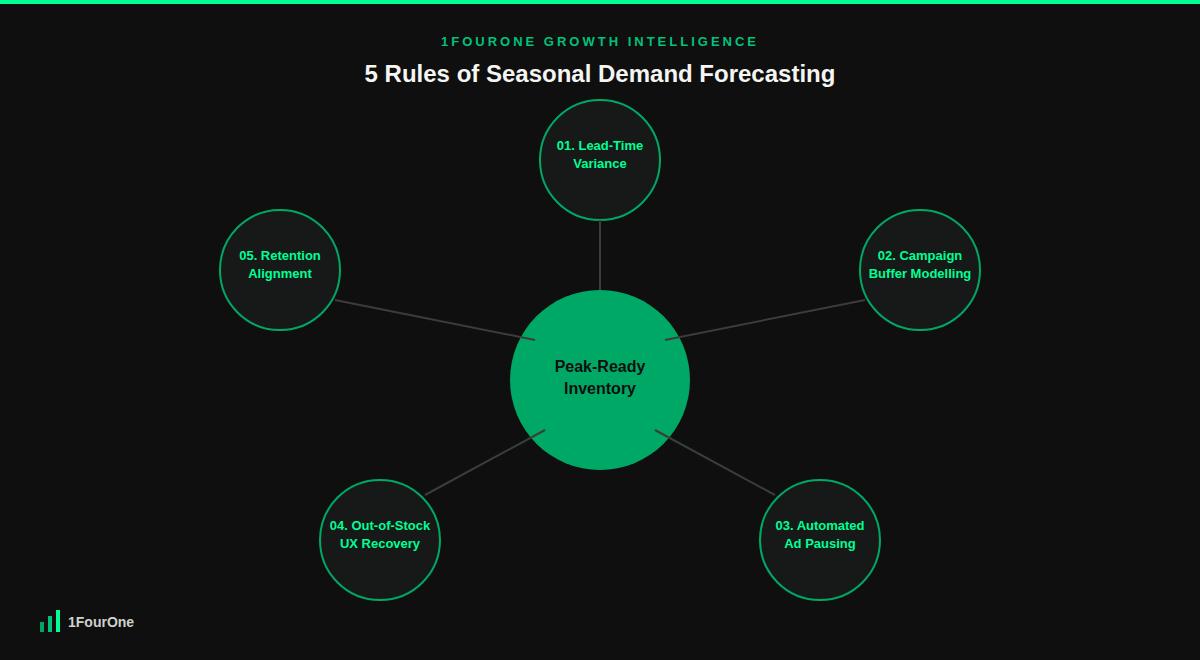
To systematically prevent stockouts and optimise working capital during peak trading windows, your commercial team must institutionalise a structured seasonal inventory demand forecasting framework across all distribution channels. This operational approach replaces static reorder formulas with dynamic, promotional-aligned demand modelling. The following five rules provide a repeatable methodology to audit inventory requirements, protect marketing spend efficiency, and preserve net contribution margins.
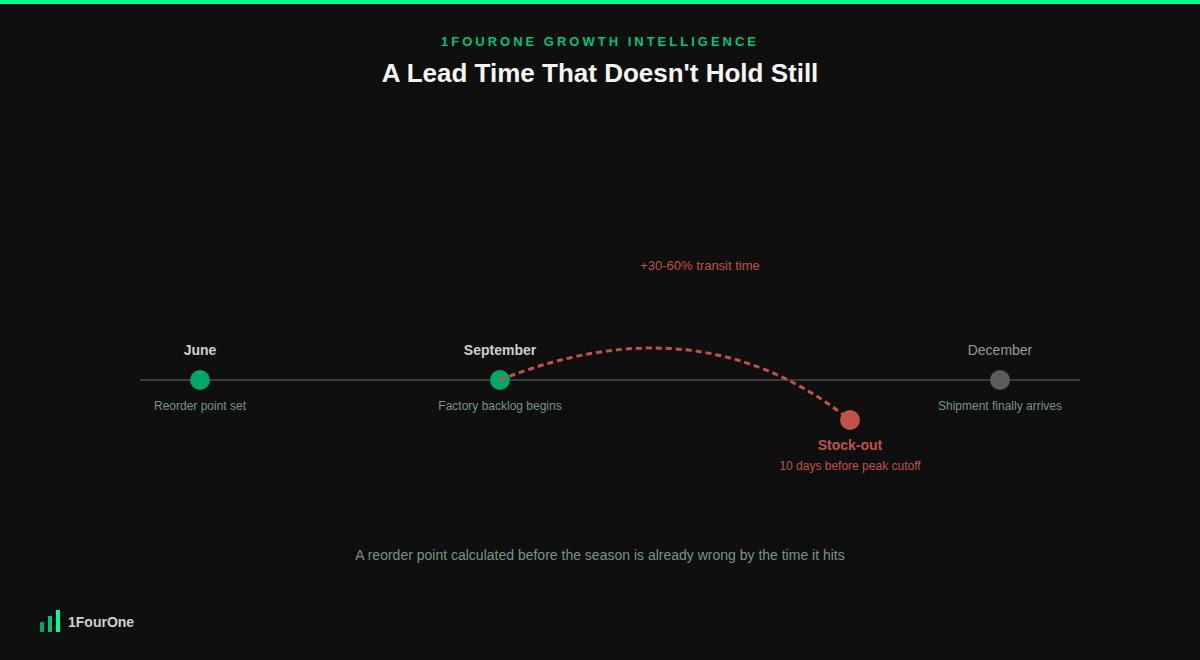
The primary cause of peak-season inventory stockouts is assuming supplier production and transit lead times remain stable throughout the year. During high-demand quarters, manufacturing factories face order backlogs, while freight carriers experience severe space constraints and shipping delays. Failing to adjust purchase order timing for these seasonal delays causes replacement inventory to arrive long after peak commercial windows have closed.
To prevent shipment arrival delays, calculate historical supplier lead-time inflation across previous peak seasons and expand purchase order lead windows accordingly. Integrate these dynamic lead-time variables with inventory rules from our operational guide on inventory allocation strategy rules. Advanced purchase order scheduling ensures factory shipments arrive at regional warehouses before peak customer promotional campaigns begin.
Estimating seasonal inventory requirements using only organic baseline sales velocity leads to severe inventory shortages when aggressive paid ad campaigns launch. Marketing promotions, influencer partnerships, and price discounts drive sharp spikes in traffic and conversion rates, accelerating SKU depletion rates. Supply chain teams must model safety buffer requirements around planned promotional activities.
Collaborate with marketing teams to map planned ad spend increases and expected conversion rate lifts for every category. Adjust safety stock calculations to accommodate predicted promotional demand surges while incorporating dynamic pricing rules from our strategic guide on ecommerce dynamic pricing strategy. Aligning buffer stock with planned campaign spend prevents unexpected stockout events during high-volume ad pushes.
Allowing digital ad campaigns to continue spending budget on SKUs that are out of stock or near depletion is a major operational leak that destroys campaign returns. When an ad click leads prospective buyers to a landing page displaying an out-of-stock notice, paid customer acquisition capital is wasted instantly. Commercial teams must connect warehouse inventory feeds directly to digital ad accounts.
Configure automated ad platform scripts to pause specific ad groups or campaign keywords when warehouse stock for a target SKU drops below safety levels, such as 5 units. As outlined in our strategic guide on competitor ad audit 5 rules, eliminating ad spend waste on unfulfillable items protects campaign returns. Automatically pausing ads during inventory drops preserves marketing budget for fully stocked product categories.
When unexpected demand surges cause a temporary stockout despite dynamic buffer modelling, displaying a blunt, unhelpful out-of-stock message drives prospective buyers to leave the site immediately. High-intent shoppers encountering dead ends exit the storefront to find alternative suppliers. Development teams must build high-utility out-of-stock user experiences that capture buyer interest and preserve conversion opportunities.
Replace generic out-of-stock labels with back-in-stock notification forms, clear restock ETA dates, and intelligent recommendations for available alternative products. As documented in our operational guide on how to reduce checkout abandonment tactics, offering alternative purchase options preserves shopper engagement. Capturing buyer contact details for automated restock alerts enables your team to re-engage interested customers as soon as new inventory arrives.
Evaluating peak seasonal inventory success based purely on initial transaction volume ignores the long-term impact on repeat customer retention. If returning buyers attempt to place replenishment orders during peak periods only to find their preferred products out of stock, their repeat purchasing habits are disrupted. Operations teams must monitor inventory depth across SKUs that drive backend customer retention strategy programs.
Track stock availability metrics for core subscription items and repeat replenishment products throughout peak commercial windows. To keep this monitoring anchored in a genuine quality standard rather than internal guesswork, benchmark your post-purchase satisfaction tracking against the international guidelines in ISO 10004:2018. Incorporate process parameters from our framework on predictive churn audit rules to identify customer accounts at risk of churning due to delivery delays or inventory shortages. Maintaining steady stock coverage on high-repeat products preserves customer retention rates and protects long-term lifetime value.
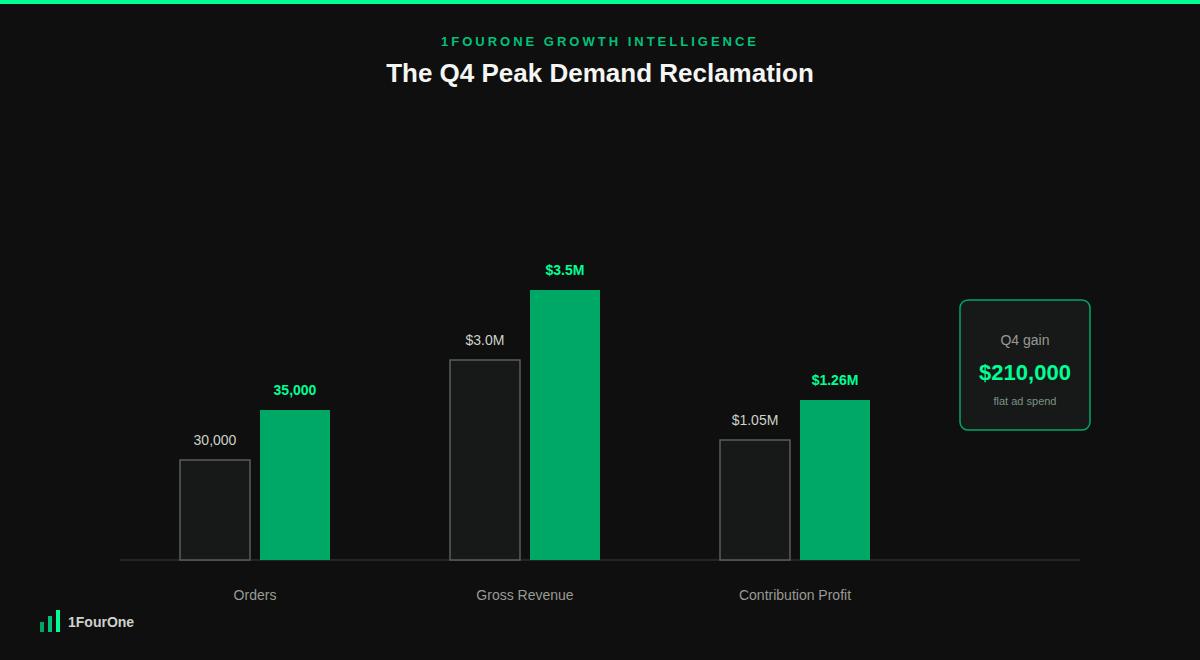
To evaluate the direct commercial impact of a structured seasonal forecasting protocol, let us examine an established digital retailer generating $3,000,000 in baseline gross sales across 30,000 orders ($100 Average Order Value) during Q4 peak trading. Baseline variable expenses total $65 per order ($35 COGS, $15 fulfilment and shipping, $15 marketing spend), resulting in $1,950,000 in total variable expenses. This setup leaves a baseline net contribution profit of $1,050,000 ($3,000,000 gross sales minus $1,950,000 variable costs), yielding a 35.0% contribution margin.
Reviewing historical seasonal performance uncovers a severe lead-time failure: operating on unhedged static reorder points causes the store to miscalculate supplier transit delays during peak shipping weeks. High-demand flagship SKUs stock out 10 days before peak promotional cutoff dates, causing 5,000 unfulfilled orders ($500,000 in lost gross sales). Out of these frustrated buyers, 3,500 defect to competitors (permanent lost demand = $122,500 in lost gross margin at 35%), while $35,000 in paid media spend is wasted driving traffic to out-of-stock landing pages.
The brand’s growth operations team deploys a dynamic seasonal inventory demand forecasting model to fix these supply chain leaks. They expand purchase order lead windows based on rolling supplier transit volatility, model buffer stock depth around planned campaign conversion lifts, and implement automated ad-pausing scripts when warehouse stock hits safety limits. These structural improvements eliminate inventory shortages and protect campaign budgets.
This operational alignment transforms Q4 commercial performance. Peak stockout events are completely eliminated, allowing the storefront to capture 100% of peak demand (35,000 completed orders = $3,500,000 in gross sales). Wasted paid ad spend on out-of-stock pages drops to $0, while campaign spend efficiency remains protected throughout the peak promotional window.
The financial return from this seasonal forecasting program is immediate and highly profitable. Gross sales scale from $3,000,000 up to $3,500,000 across 35,000 orders. Total variable expenses rise proportionally to $2,275,000 (35,000 orders at $65). However, eliminating $35,000 in wasted ad spend reduces variable costs to $2,240,000.
Net contribution profit expands from $1,050,000 up to $1,260,000 ($3,500,000 gross revenue minus $2,240,000 variable expenses), securing a $210,000 net Q4 contribution profit reclamation ($175,000 recovered gross margin plus $35,000 saved ad spend) on a completely flat marketing acquisition budget.
E-commerce brands should finalize peak Q4 purchase orders 120 to 180 days before planned promotional events, depending on overseas manufacturing lead times and ocean freight transit schedules. Finalizing purchase orders early provides factory production buffers, protects shipping container availability, and ensures products arrive at regional warehouses before peak logistics congestion begins.
Supplier lead times routinely expand by 30% to 60% during peak global shopping seasons due to factory manufacturing backlogs, port congestion, customs clearance delays, and carrier capacity limits. Failing to account for these expanded transit windows results in late inventory arrivals that miss peak promotional opportunities entirely.
Baseline safety stock protects against routine demand fluctuations and minor supplier transit delays during standard operating periods. Seasonal buffer stock is a dynamic, temporary inventory layer that seasonal inventory demand forecasting adds on top of that baseline, designed specifically to absorb sharp promotional demand surges and major lead-time volatility during high-volume sales seasons.
Marketing and supply chain teams can coordinate by establishing weekly promotional planning meetings, sharing promotional calendars, and aligning ad spend budgets with real-time inventory balances. Integrating warehouse management software with ad account management rules ensures marketing promotions are scaled only on fully stocked product categories.
Excess seasonal inventory remaining after peak trading should be cleared immediately through targeted post-holiday bundles, private VIP clearance sales, or secondary B2B liquidation channels. Clearing excess seasonal stock quickly recovers working capital and eliminates ongoing warehouse storage fees before product value degrades.
Allowing unhedged seasonal stockouts to waste ad spend and alienate peak shopping traffic is an expensive operational failure that degrades retail profitability. At 1FourOne, we eliminate supply chain leaks by deploying disciplined seasonal inventory demand forecasting that protects stock availability and maximises net contribution cash flow. Contact our growth operations team today to secure a data-driven inventory audit tailored for your business.
Get your competitive audit in 48 hours and see exactly where your revenue is leaking.
Get Your Audit →