The 14-Day Warning Sign Most Retailers Miss Before Losing a Customer

Executing a proactive predictive churn audit is the most critical operational adjustment an established e-commerce brand can deploy to protect net profitability when customer acquisition costs scale unsustainably across paid networks. Many mid-market retail enterprises focus all strategic energy on top-of-funnel conversion metrics, completely ignoring the silent margin decay that occurs when existing customer cohorts abandon the brand. Failing to systematically diagnose the operational trigger points that precede customer attrition introduces immense risk to your cash flow, destroying compounding revenue gains before they can stabilise. Transitioning to a data-driven retention intelligence model allows growth teams to identify early behavioural friction, preserve historical client investments, and isolate system leaks before they compromise the corporate balance sheet.
E-commerce operations frequently tolerate a high baseline of customer loss, treating attrition as an inevitable cost of doing business in a crowded digital marketplace. This passive perspective ignores the structural flaws within the post-purchase experience that actively drive consumers away. When a brand fails to audit the precise timelines and interaction drops that signal decreasing engagement, they remain trapped in a costly cycle of customer replacement. This continuous churn forces marketing teams to expand acquisition budgets simply to maintain a flat revenue profile.
Relying on lagging financial indicators like monthly active user counts or simple unsubscribe volumes prevents you from spotting attrition risks early enough to intervene. True cohort decay occurs silently over weeks, as micro-changes in consumer behaviour telegraph a loss of affinity long before a final account deletion or cart abandonment event occurs. If a premium segment reduces its historical purchase frequency or stops opening core communication assets, the underlying revenue baseline is already fracturing. Identifying these behavioural shifts requires systematic data monitoring across the entire post-purchase journey.
To insulate your transactional pipeline from these hidden leaks, you must establish an operational framework that treats retention as a strict engineering discipline, the same growth intelligence rigour applied to acquisition. Forcing your teams to track customer satisfaction metrics against formal global protocols ensures your health scoring remains objective and free from internal bias. By constructing an explicit measurement architecture, you can catch segment vulnerabilities early, deploy targeted operational fixes, and protect your unit economics from sudden retention drops.
Pouring capital into paid channels while your core retention infrastructure remains unoptimised is an expensive strategic error that dilutes your blended media efficiency. While executing a precise competitor ad audit is vital to eliminate front-end traffic waste, those hard-earned historical gains are entirely lost if your backend funnel remains a leaky sieve. Reclaiming media efficiency requires an equal commitment to plugging the operational gaps that cause high-value cohorts to abandon your digital storefront after a single transaction.
The long-term viability of an e-commerce enterprise is directly dependent on its capability to steadily compound asset value over time. Comprehensive data analytics published by the Harvard Business Review confirms that improving customer retention rates by 5% increases corporate profits by 25% to 95%. This mathematical reality highlights why shifting focus toward a disciplined customer retention strategy delivers a far higher return on capital than chasing volatile, unhedged paid traffic streams, and why treating retention as a genuine marketing spend efficiency lever, not just a customer service function, changes the underlying capital allocation decision entirely.
Achieving this operational efficiency demands that your growth teams integrate their backend data structures cleanly to build a single source of truth. As detailed in our framework for ecommerce first party data strategy, capturing clean, owned consumer signals allows you to construct highly accurate predictive models. Weaponising these direct behavioural insights ensures your team can deploy highly relevant communication paths that engage dropping segments exactly when their purchase intent begins to falter.
| Audit Vector | Early Behavioural Signal | Operational Intervention |
|---|---|---|
| Engagement Velocity | 30-day drop in account login or profile interaction frequency | Triggers a targeted value-add content path off paid channels. |
| Purchase Recency Gap | Transaction delay exceeding 1.5 times the historical cohort average | Deploys an automated, personalised utility incentive to restore habits. |
| Fulfilment Friction | Multiple delivery delays or consecutive customer service tickets | Initiates a proactive corporate service mitigation protocol before next billing. |
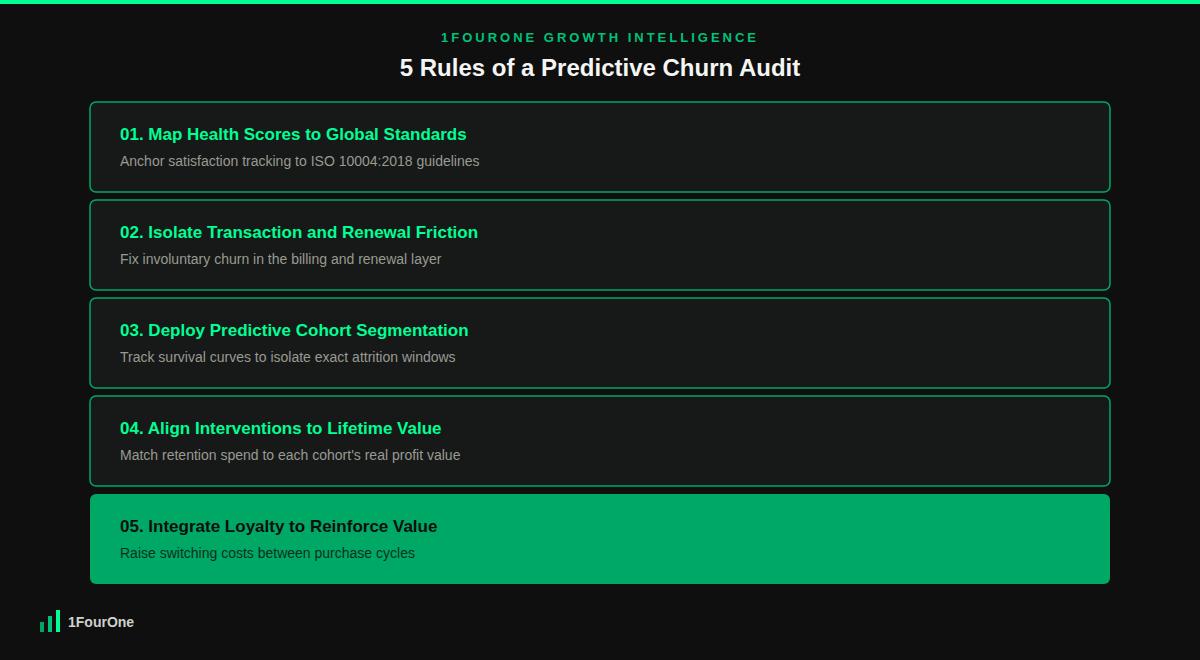
To systematically maximise your cohort revenue and eliminate backend capital leaks, your operations team must institutionalise this methodology with discipline. This process shifts your retention focus from reactive, defensive discounting to disciplined, proactive data rules. The following five rules provide a repeatable framework to map behavioural risks, optimise communication timing, and protect customer lifetime value.
Constructing an effective predictive model requires an objective baseline definition of customer satisfaction that remains consistent across all product segments. Your growth teams must establish a unified customer health scoring index that aggregates behavioural data, support interactions, and survey feedback into a single metric. To guarantee empirical rigour, this scoring architecture must align directly with the structural processes defined in ISO 10004:2018 quality management guidelines.
Standardising your satisfaction tracking against these international frameworks prevents your team from relying on subjective staff assumptions or skewed internal surveys. When a customer’s aggregated health score falls below your pre-determined quality threshold, the system must automatically flag that account for human review or automated mitigation. This systematic tracking ensures you catch cohort decay while you still possess the operational runway to alter the consumer’s trajectory.
A significant volume of customer churn is entirely involuntary, driven by technical friction points in the payment and account management interfaces rather than a loss of brand affinity. Your technical teams must execute a continuous audit of the checkout path to identify configuration errors that disrupt automated billing cycles. As documented in our guide on reduce checkout abandonment tactics, engineering a friction-free payment journey is mandatory to protect transaction completion rates.
Apply this technical scrutiny to your subscription renewal sequences, checking for card expiration handling, payment gateway timeouts, and broken retry logic. If your system triggers harsh, automated system cancellation notices the millisecond a billing attempt fails, you are actively manufacturing churn. Rebuild your subscription layer to incorporate intelligent dunning cadences, automated card updater tools, and proactive renewal reminders to eliminate unnecessary transactional leaks completely.
Treating your entire customer database as a single, uniform block makes it impossible to design highly targeted retention campaigns. Your data engineering team must split your historical transactional data into precise, time-based cohorts grouped by their initial month of acquisition. Track the survival curve of each cohort to isolate the exact operational windows where customer drop-offs historically spike across your product catalogue.
If your analytical models indicate that 18% of buyers drop off exactly between day 60 and day 90, a major structural hurdle exists during their second billing cycle. Armed with this predictive intelligence, you can deliberately place proactive engagement assets right before this historical drop window occurs. This targeted approach allows you to address consumer friction points before they transform into a permanent loss of account revenue.
Not all customer churn carries an identical financial impact on your retail balance sheet. Spending excessive customer service resources or offering deep margin-eroding discounts to preserve unprofitable, low-intent buyers is a misallocation of corporate capital. Your predictive churn audit framework must automatically cross-reference all risk alerts with your internal customer lifetime value calculations to guide retention investment decisions.
When a customer in your top revenue tier shows early signs of behavioural decay, your operations team must execute high-touch, premium intervention tactics immediately. For low-margin tiers, rely entirely on scalable, automated messaging paths that do not consume manual corporate resources. This strict financial filtering ensures that your retention spend remains completely proportional to the long-term profit value of the specific customer cohort.
To successfully prevent consumers from drifting toward rival market alternatives, you must actively incentivise ongoing brand engagement between purchase cycles. A premier defence against cohort decay is constructing a structured rewards system that provides clear, tangible utility for sustained account activity. Growth teams should reference our comprehensive framework on loyalty program design to engineer digital reward environments that drive repeat purchase habits.
Your loyalty architecture should automatically reward consumers for non-transactional actions, such as complete profile creation, product review submission, and regular engagement with owned content channels. Transforming the brand relationship from a series of isolated transactions into an active, value-add partnership reduces a competitor’s capability to capture your market share, and locks in customer lifetime value across your core accounts.
To evaluate the direct financial return of this structured programme, let us examine an established mid-market e-commerce subscription operation. In the baseline scenario, the brand manages a stable cohort of exactly 10,000 active monthly subscribers, with each account paying a fixed recurring fee of $50 per month. This baseline operational state generates a steady gross recurring revenue figure of exactly $500,000 per month.
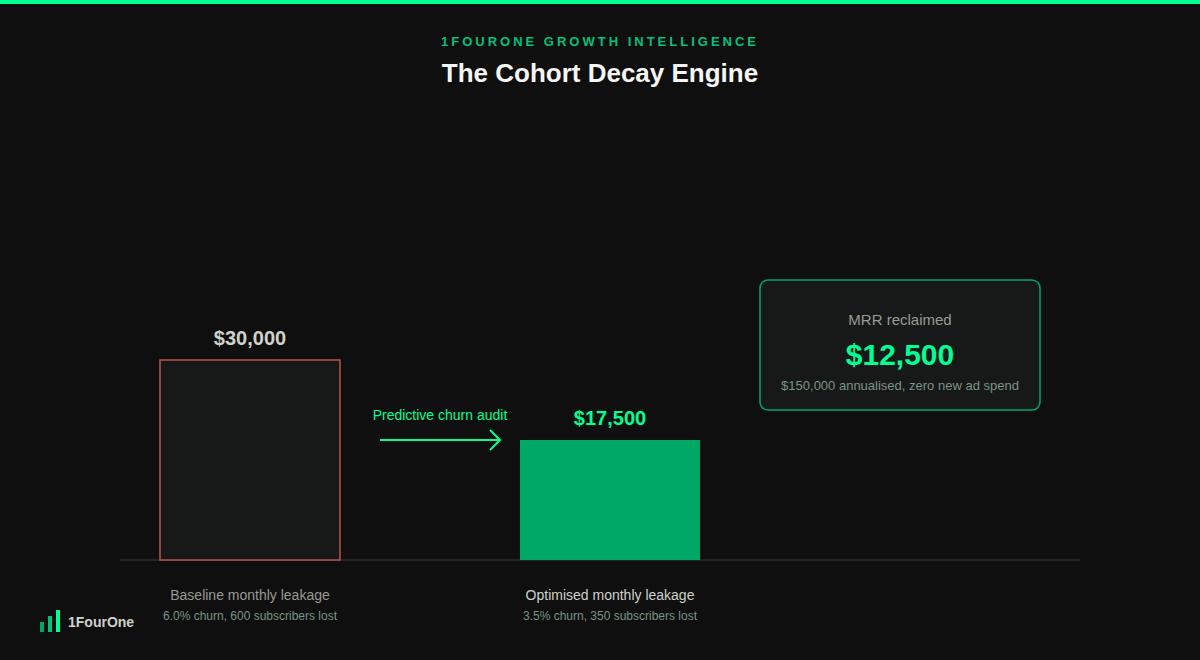
Reviewing the historical performance database highlights that the business suffers from a painful baseline monthly churn rate of 6.0%. This metric means that in a single standard month, the digital store loses exactly 600 active subscribers (10,000 baseline subscribers multiplied by 0.06). This attrition translates directly into an immediate revenue leakage of $30,000 in monthly recurring revenue (600 lost subscribers multiplied by the $50 monthly fee) before any new acquisition occurs.
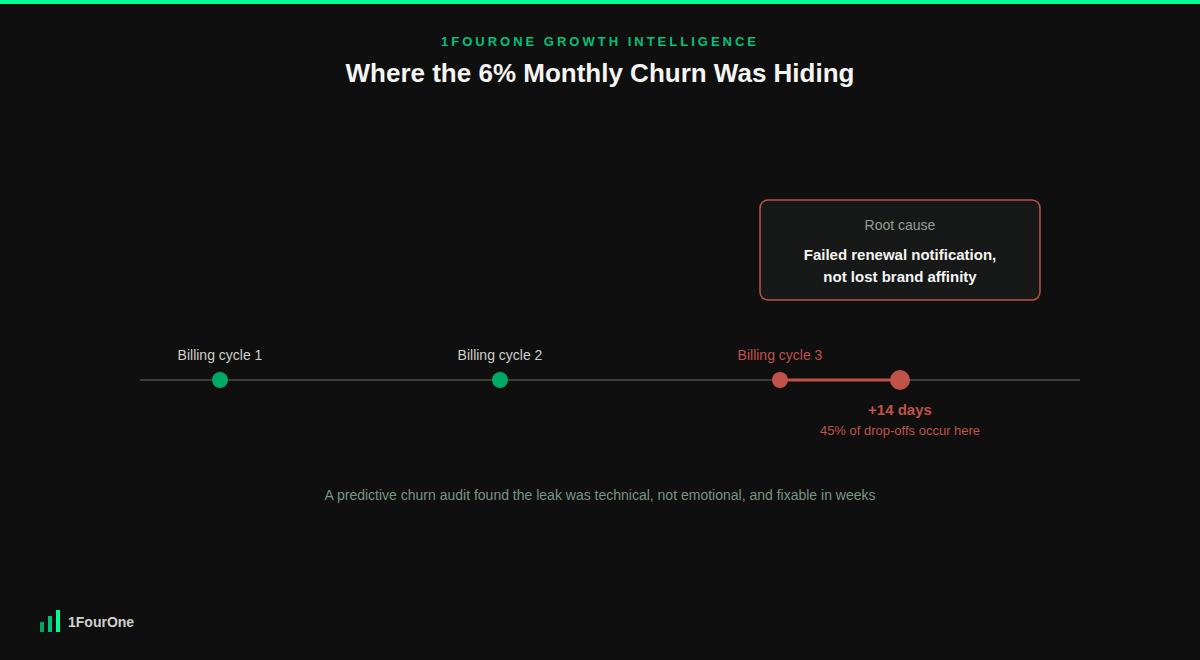
The brand’s growth operations team reviews this ongoing drain and deploys a rigorous audit to identify the precise structural trigger points causing the losses. The data analysis uncovers a severe operational bottleneck: over 45% of the drop-offs occur exactly 14 days after the third billing cycle completes. The audit tracks this leakage down to a technical failure in the legacy billing system, which sends confusing, automated renewal failures instead of processing standard credit updates.
The engineering team quickly resolves this technical friction by restructuring the automated dunning cadences, adding predictive card validation APIs, and introducing targeted value-add reminders right before the critical 90-day mark. Because these structural fixes directly eliminate the operational confusion surrounding the renewal layer, the store’s monthly churn rate drops from the baseline of 6.0% down to an efficient 3.5%. The total marketing spend required to sustain the platform remains completely flat.
Applying this optimised 3.5% churn rate to the existing customer base changes the monthly cohort dynamics completely. The volume of monthly subscriber drop-offs drops from the baseline of 600 down to exactly 350 accounts (10,000 active subscribers multiplied by 0.035). Consequently, the monthly recurring revenue leakage is cut down from the historical baseline of $30,000 down to exactly $17,500 (350 accounts multiplied by the $50 subscription fee).
The financial impact of this operational alignment is immediate and highly profitable. By implementing data-driven structural changes to fix the identified billing leak, the brand reclaims exactly $12,500 in monthly recurring revenue ($30,000 baseline leak minus $17,500 optimised leak). This predictive churn audit saves the business exactly $150,000 in annualised recurring revenue on a completely flat customer acquisition budget.
Voluntary churn occurs when a consumer consciously decides to cancel their account or stop buying your products due to poor satisfaction, pricing changes, or rival marketing plays. Involuntary churn is a technical failure that occurs when a customer’s subscription drops due to expired credit cards, system communication timeouts, or unoptimised payment gateway loops. A structured audit treats both issues as separate engineering projects requiring custom technical fixes.
By connecting your post-purchase behavioural insights directly to your paid marketing dashboards, your media buyers can identify which ad angles deliver long-term value and which ones generate immediate drop-offs. If a specific digital campaign boasts low acquisition costs but yields buyers with rapid cohort decay, its budget should be reallocated. This alignment ensures your marketing capital is spent entirely on high-retaining customer segments.
Offering immediate, aggressive price cuts the moment an account show signs of lower activity is an unoptimised strategy that damages your average order value metrics. Instead, your initial intervention cadences should focus on value-add utility, such as personalised product guides, loyalty point reminders, or customer service check-ins. Reserve financial margin adjustments as a final, high-tier option for your most profitable customer cohorts.
You can construct a functional predictive framework by tracking simple, high-impact behavioural data like last login date, support email frequency, and time elapsed since the last transaction. Focus your early optimisation sprints on setting up clean, owned data capture mechanisms across your core checkouts and customer portals. As your repository expands over a few months, you can introduce more granular cohort segmentation models safely.
Macro behavioural health scoring rules should undergo a comprehensive validation review every calendar quarter to ensure your weights remain aligned with changing consumer habits. However, your automated systems must update individual account scores in real time based on daily site interactions and support tickets. This continuous calculation ensures your growth team can deploy preventative marketing assets before a customer reaches the permanent attrition zone.
Allowing unmonitored cohort decay to quietly drain your hard-earned digital retail margins is an expensive operational failure. At 1FourOne, we eliminate analytical blind spots by deploying comprehensive predictive churn audit frameworks that protect your customer lifetime value and maximise backend cash flow. Contact our retention operations team today to secure a data-driven performance blueprint engineered directly for your brand.
Get your competitive audit in 48 hours and see exactly where your revenue is leaking.
Get Your Audit →