Two Warehouses, One Blind Spot: The Cost of Guessing Where to Stock Inventory

Executing a data-driven inventory allocation strategy is the most effective operational adjustment a multi-channel e-commerce business can deploy to reduce holding costs and eliminate cross-shipping penalties when scaling across regional distribution networks. Many digital retail brand operators focus exclusively on marketing customer acquisition, completely ignoring the severe capital leaks caused by misaligned warehouse stock levels. Imbalanced inventory positioning forces fulfilment centers to ship orders across long distances, inflating delivery surcharges and delaying delivery timelines. Transitioning to a predictive stock distribution model allows growth teams to protect contribution margins, optimise working capital, and maintain consistent delivery standards across every geographic customer region.
Multi-location retail operations frequently suffer from invisible profit drains caused by imbalanced stock allocation across regional warehouses. When a brand expands from a single centralised fulfilment node to multiple regional facilities, managing inventory splits becomes complex. Without predictive regional demand forecasting, high-demand SKUs frequently run out of stock in one facility while sitting idle in another, forcing expensive cross-node order routing.
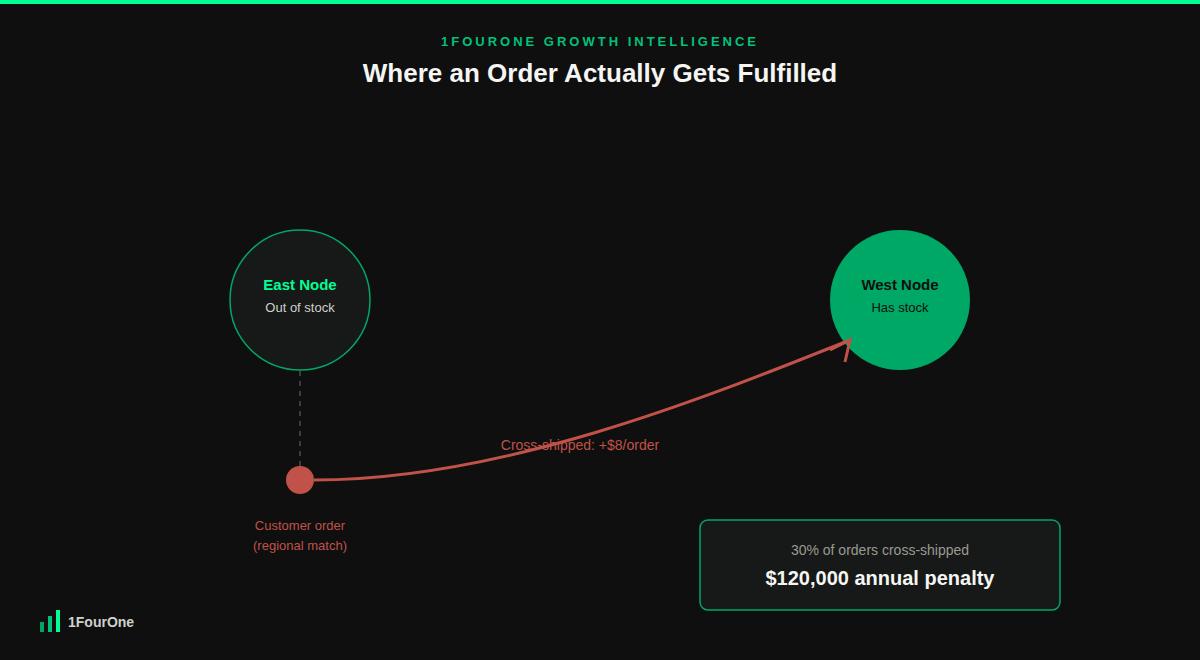
Operating an unhedged inventory distribution setup creates significant financial friction across a retail balance sheet. When a local warehouse lacks stock for a customer order, the fulfilment system routes the shipment from a distant regional node. This cross-shipping split increases shipping surcharges, adds extra handling fees, and extends delivery timeframes. The resulting fulfilment cost inflation directly erodes contribution margins, turning otherwise profitable customer orders into low-margin or loss-making transactions.
To establish a resilient multi-node operation, executives must align inventory placement with real-time regional purchasing patterns. Understanding local demand density for specific product categories enables supply chain teams to position safety stock closer to target customer groups. Shifting from reactive stock rebalancing to predictive allocation ensures that orders are fulfilled from the nearest distribution node, cutting delivery expenses and protecting operating cash flow.
Building a sustainable digital retail enterprise requires far deeper operational visibility than top-line sales reporting can supply. Incorporating inventory holding costs and fulfilment friction into your broader growth intelligence matrix enables operations teams to evaluate the true net margin of every product line. By tracking regional stock turn rates alongside customer location density, managers can optimise inventory carrying levels without risking stockouts. This analytical oversight prevents businesses from tying up working capital in stagnant inventory.
Relying heavily on front-end paid customer acquisition becomes unprofitable if backend fulfilment inefficiencies drain order margins. Acquiring high-intent customer traffic only to deliver poor post-purchase shipping experiences leads to account churn and negative brand sentiment. Protecting long-term customer lifetime value metrics requires ensuring that stock availability matches marketing demand across every regional territory, preventing stockouts during major campaign pushes, and that every paid customer acquisition dollar is backed by a fulfilment network capable of actually delivering on the promise made in the ad.
Validating inventory parameters against established empirical business benchmarks is essential to preserve long-term enterprise value. Published research by the Harvard Business Review confirms that increasing customer retention rates by 5% scales overall corporate profits by 25% to 95%. This empirical baseline shows why maintaining local stock availability to fulfill delivery promises protects repeat purchase habits, providing the stable cash flow needed to fund sustainable business operations.
| Fulfilment Vulnerability | Primary Cost Leak | Allocation Optimisation Action |
|---|---|---|
| Regional Stock Imbalance | Cross-shipping surcharges from distant facilities | Rebalancing safety stock based on regional order density. |
| Excess Safety Stock | High working capital lockup and holding costs | Implementing dynamic buffer stock calculations by SKU. |
| Uncoordinated Ad Spending | Driving ad traffic to out-of-stock warehouse regions | Syncing ad account geolocation rules with regional stock levels. |
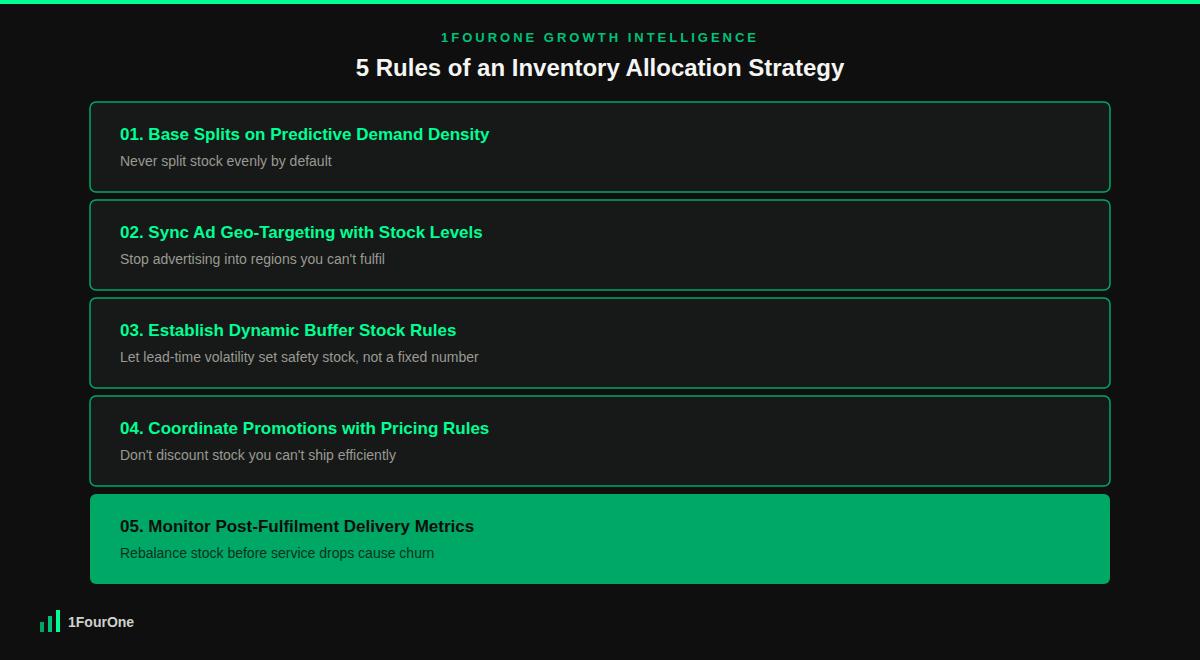
To systematically eliminate fulfilment friction and reduce inventory holding costs, your supply chain team must institutionalise a structured inventory allocation strategy across all distribution nodes. This operational framework replaces static buffer stock formulas with dynamic, regional demand forecasting. The following five rules provide a repeatable methodology to optimise stock distribution, protect marketing spend efficiency, and improve fulfilment margins.
The foundation of any effective inventory allocation strategy is allocating initial stock inventory based on historical and predicted regional order density rather than equal percentage splits across warehouses. Splitting inventory evenly across facilities regardless of regional sales distribution leads to stockouts in high-volume regions and excess holding costs in slower facilities. Analysing historical delivery addresses enables supply chain teams to align inventory depth with geographic demand.
To structure accurate stock splits, calculate the percentage of total order volume originating from each geographic region for every major SKU category. Allocate initial purchase orders according to these regional ratios, maintaining a small centralised reserve buffer for unexpected demand spikes. This predictive allocation ensures that high-velocity items sit near their primary customer clusters, minimizing shipping distances and reducing delivery costs.
Promoting products in geographic regions where local warehouse stock is depleted is a common operational oversight that damages media spend efficiency. When regional inventory runs out, continuing to run localised digital ads forces orders to be fulfilled from distant nodes, incurring cross-shipping fees that destroy campaign profitability. Marketing teams must coordinate campaign geo-targeting rules with real-time stock availability.
Your technical team should integrate warehouse inventory databases directly with ad platform location targeting rules. As detailed in our strategic guide on competitor ad audit 5 rules, optimising campaign parameters around operational strengths prevents wasted ad spend. This automated integration automatically dials down ad bids in regions experiencing stock depletion, directing marketing capital toward locations with healthy local inventory levels and protecting your overall marketing spend efficiency in the process.
Maintaining fixed safety stock levels year-round leads to excess holding costs during slow periods and inventory shortages during peak promotional events. Fixed buffer stock calculations ignore supplier lead time variations and seasonal demand spikes. Supply chain teams must implement dynamic safety stock formulas that adapt to supplier reliability and order velocity changes.
Structure your buffer stock calculations to update automatically based on supplier lead time trends, historical demand variance, and upcoming marketing promotions. Coordinating stock replenishment rules with product lifecycle parameters, as outlined in our operational guide on product lifecycle management rules, prevents over-ordering maturing inventory. Dynamic buffer management maintains optimal product availability while freeing up working capital.
Running aggressive promotional campaigns on inventory lines that are unevenly distributed across facilities can quickly create fulfilment bottlenecks. If an unexpected demand surge depletes local stock in one facility, remaining orders must be shipped from secondary nodes, absorbing the promotional gross margin in shipping surcharges. Commercial teams must align promotional offers with regional stock availability.
Your commercial operations team should integrate promotional engines with real-time regional inventory balances. As outlined in our strategic breakdown of ecommerce dynamic pricing strategy, aligning pricing rules with supply chain constraints prevents margin compression. This integration enables regional pricing adjustments or localised promotional offers that stimulate demand specifically where excess inventory resides.
Evaluating inventory allocation success based solely on warehouse handling costs ignores the major commercial impact of delivery speeds on customer retention. Delayed shipments caused by cross-facility routing degrade customer satisfaction, increase support ticket volume, and lower repeat purchase rates. Operations teams must monitor delivery timelines alongside fulfilment expenses.
Track order delivery times, cross-shipping frequencies, and post-delivery satisfaction scores across every geographic region. To maintain rigorous operational standards, align your post-fulfilment quality tracking with the international guidelines in ISO 10004:2018. The same discipline that protects the front end, covered in our guide on reduce checkout abandonment tactics, needs to extend all the way through delivery, since a customer who churns over a late shipment represents lost customer lifetime value regardless of how smoothly their checkout went. Incorporating process parameters from our framework on predictive churn audit rules ensures you identify fulfilment friction early, allowing you to rebalance stock before service drops cause customer churn.
To evaluate the direct commercial impact of a structured inventory allocation program, let us examine an established e-commerce business operating two regional fulfilment centers (East and West) holding $2,000,000 in total inventory. Annual holding costs average 20% ($400,000 annually). Annual sales reach $5,000,000 across 50,000 orders ($100 Average Order Value), with baseline COGS totaling $3,000,000 ($60 per unit).
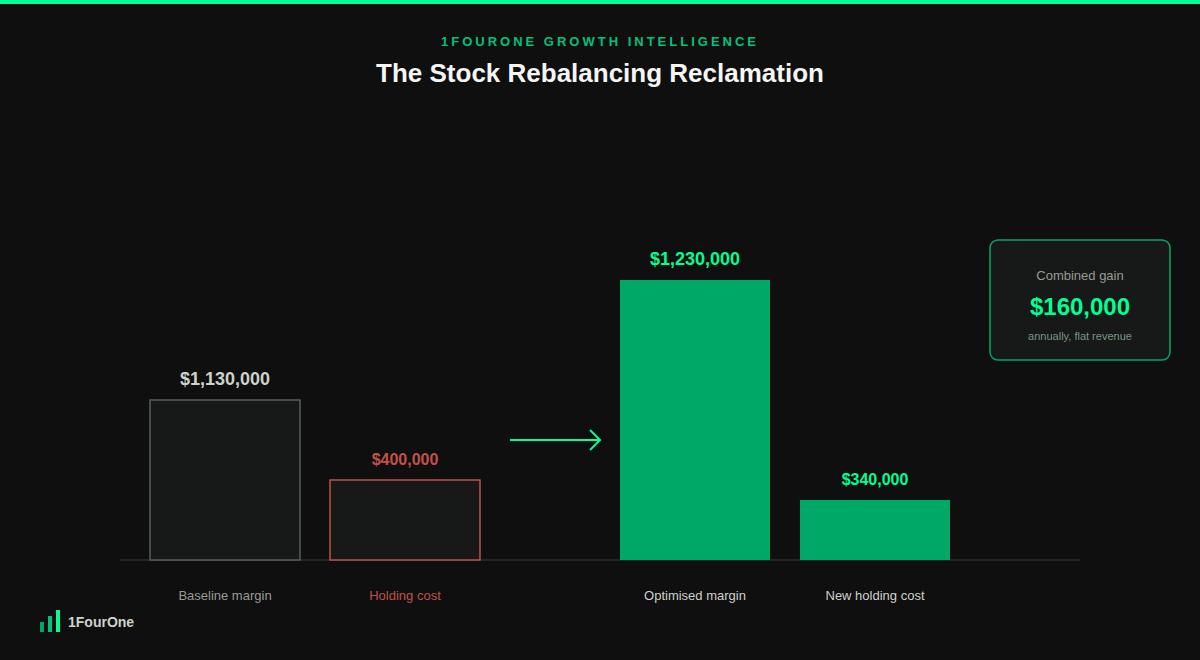
Reviewing fulfilment performance reveals a major cost leak: poor stock placement causes 30% of orders (15,000 orders) to be cross-shipped from the wrong regional warehouse, adding $8 per order in extra freight surcharges ($120,000 annual cross-shipping penalty). Total baseline variable fulfilment costs equal $870,000 ($15 per order standard fulfilment × 50,000 = $750,000, plus $120,000 cross-shipping fees). This setup leaves a net contribution margin of $1,130,000 ($5,000,000 sales minus $3,000,000 COGS minus $870,000 fulfilment costs).
The brand’s growth operations team implements a predictive inventory allocation strategy to address these fulfilment leaks. They rebalance initial stock splits using historical regional order density data, integrate real-time warehouse inventory feeds with ad account location targeting rules, and set up dynamic buffer stock formulas. These structural supply chain improvements ensure products sit in the correct regional nodes before customer orders are placed.
This stock rebalancing program alters the fulfilment financial profile significantly. Cross-shipping frequency drops from 30% down to 5% (2,500 orders), cutting cross-shipping penalties from $120,000 down to $20,000 ($100,000 net fulfilment savings). Total variable fulfilment expenses drop from $870,000 to $770,000. Additionally, localised stock positioning reduces regional safety stock requirements by 15%, lowering total inventory carrying costs from $400,000 down to $340,000 ($60,000 annual holding cost savings).
The financial return from this inventory optimisation program is immediate and highly sustainable. With sales volume remaining steady at $5,000,000 across 50,000 orders, net contribution margin scales from $1,130,000 up to $1,230,000 ($5,000,000 sales minus $3,000,000 COGS minus $770,000 fulfilment costs). The business achieves a $100,000 contribution profit reclamation, plus $60,000 in direct inventory holding cost savings, providing $160,000 in combined annual financial gains on identical sales volume.
Expand to multiple fulfilment nodes when your regional order volume in a distant geographic market is large enough to offset the additional fixed holding costs of carrying split safety stock. If cross-country shipping surcharges and delivery delays in a specific region exceed the incremental carrying costs of stocking a local facility, adding a regional fulfilment node is the natural next step in your inventory allocation strategy, improving both margins and delivery speeds.
Splitting inventory across multiple facilities can increase aggregate safety stock requirements if managed using static buffer formulas. However, implementing dynamic buffer stock calculations based on lead time variance and regional demand density minimises total stock lockup. Using centralised backup stock reserves for slow-moving SKUs while localizing high-velocity items maintains safety coverage without bloating inventory value.
For new product launches lacking historical SKU data, allocate initial inventory splits using category-level regional demand ratios or overall customer geographic distribution. Maintain a conservative initial stock split across regional facilities, holding a larger percentage in a primary centralised warehouse. As early order data accumulates during the launch phase, adjust regional replenishment transfers dynamically to match actual demand patterns.
Automating allocation requires real-time integration between your order management system, inventory management platform, warehouse management systems, and advertising ad platform APIs. These connected data feeds ensure that regional stock balances automatically update order routing rules, trigger replenishment transfers, and adjust ad account location targeting without requiring manual data entry.
Prevent split-shipment cross-shipping by implementing order routing logic that evaluates total fulfilment cost before assigning warehouse nodes. The system can prioritize fulfilling the order from the node holding the majority of items, or suggest complementary local substitutes during checkout. Alternatively, setting minimum stock thresholds for frequently co-purchased product pairs ensures bundle items remain co-located.
Allowing misaligned inventory splits to inflate fulfilment costs and lock up working capital is an expensive operational failure that degrades retail profitability. At 1FourOne, we eliminate supply chain leaks by deploying structured inventory allocation strategies that optimise stock positioning, protect paid customer acquisition spend from being wasted on out-of-stock regions, and maximise net cash flow. Contact our growth operations team today to secure a data-driven inventory audit tailored for your business.
Get your competitive audit in 48 hours and see exactly where your revenue is leaking.
Get Your Audit →