The $80,000 Hiding in Your Shipping and Returns Costs

Executing a structured retail margin protection strategy is the most critical operational adjustment a mid-market e-commerce business can deploy to preserve contribution margins when input costs and ad auction fees scale simultaneously. Many digital retail brands focus all strategic energy on expanding gross revenue totals, completely ignoring the silent variable cost leaks that erode net operating profits. Failing to systematically audit fulfilment expenses, promotional discounts, and media spend efficiency introduces severe financial fragility into a corporate balance sheet. Transitioning to a strict, unit-level margin governance model allows growth teams to plug hidden cash drains, stabilise bottom-line cash flow, and protect operating profits across every product category.
Mid-market e-commerce operations frequently celebrate top-line revenue expansion without analysing the underlying cost structure required to generate those sales. When gross transaction volumes increase, executive teams often assume that enterprise profitability is improving proportionally. However, if variable expenses like shipping surcharges, return handling fees, and digital ad bids scale faster than gross revenue, overall profitability contracts. Operating without strict variable cost controls exposes a retail business to severe cash flow compression.
Relying on aggregate financial statements to evaluate commercial health obscures critical product-level profit leaks. Standard income statements summarize performance across an entire store, masking specific inventory lines or customer cohorts that generate net losses. When media spend is expanded across unmonitored product categories, a business can easily end up subsidising unprofitable order volumes. This lack of granular visibility directly compromises your marketing spend efficiency, driving up expenses while squeezing contribution margins.
To establish a resilient operational model, retail executives must evaluate profitability at the individual unit level. Understanding the exact variable costs attached to every completed order allows growth teams to identify margin erosion before it compromises cash reserves. Shifting from broad top-line revenue tracking to disciplined unit-level accounting ensures that marketing budgets are allocated only to product lines that deliver positive contribution margins.
Building a defensible digital retail business requires far deeper analytical rigor than simple sales reporting can provide. Incorporating unit-level profitability analysis as a core pillar of your growth intelligence framework allows operations teams to isolate the exact drivers of net cash flow. By mapping variable fulfilment costs, payment processing fees, and ad acquisition bids against gross product margins, managers can establish clear profit floors for every campaign. This operational clarity prevents businesses from expanding unviable sales channels.
Relying heavily on paid customer acquisition to sustain transaction volume becomes increasingly dangerous as media auction costs rise across major ad networks. Brands that fail to optimise their backend unit economics frequently absorb net losses on initial customer orders in the hope of recovering profits on future purchases. Protecting customer lifetime value metrics across your core segments requires ensuring that every acquired customer cohort moves toward profitability within a predictable timeframe, rather than draining working capital, which is exactly the discipline covered in our guide on predictive churn audit rules.
Validating your operational cost structure against empirical business benchmarks is essential for long-term survival. Historical research published by the Harvard Business Review proves that increasing customer retention rates by 5% scales overall corporate profits by 25% to 95%. This empirical baseline shows why protecting net contribution margins on repeat transactions delivers substantial compounding returns, providing the stable cash flow needed to fund sustainable business operations.
| Variable Cost Layer | Primary Operational Leak | Margin Governance Action |
|---|---|---|
| Product Fulfilment | Unhedged express shipping surcharges and packaging waste | Enforcing minimum order thresholds for subsidised delivery. |
| Customer Returns | Unmonitored restocking labour and reverse logistics costs | Implementing restocking fees on high-return product categories. |
| Media Acquisition | Bidding on low-margin inventory without profit caps | Setting dynamic bidding limits aligned with product contribution margins. |
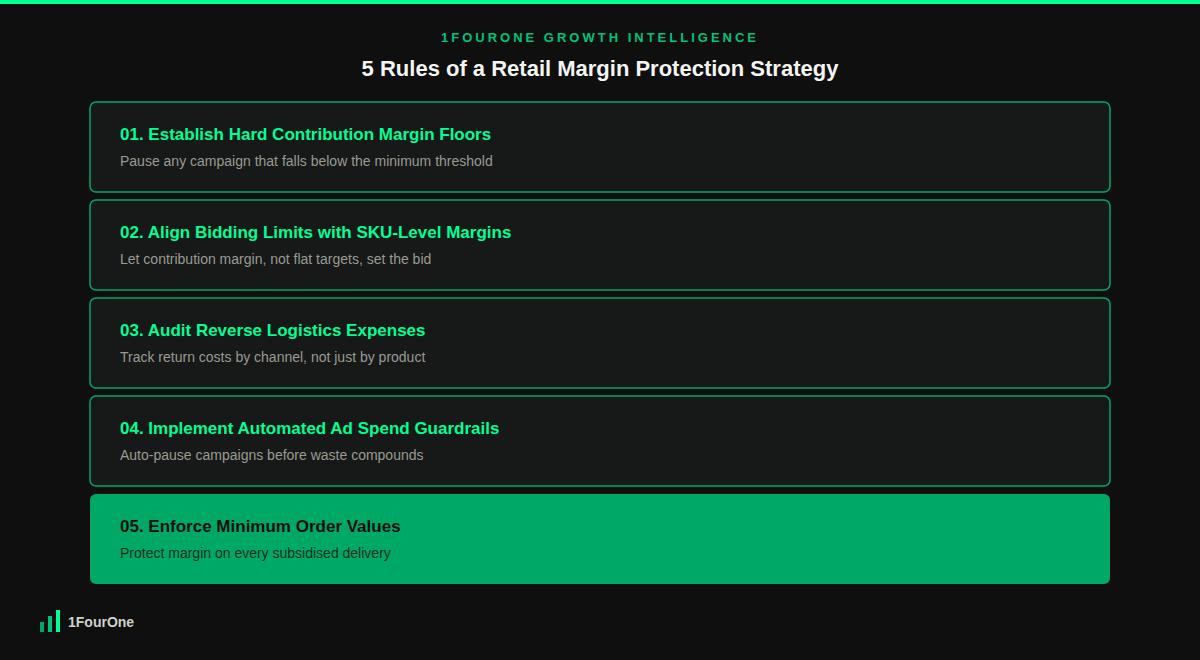
To systematically eliminate variable cost leaks and safeguard your net operating income, your operations team must institutionalise a disciplined retail margin protection strategy across all sales channels. This operational framework replaces reactive cost-cutting with structured, data-driven margin controls. The following five rules provide a repeatable methodology to audit unit economics, optimise media spend efficiency, and build compounding corporate cash flow.
The foundation of effective margin governance is establishing explicit profit thresholds that every product line and promotional campaign must satisfy. Allowing marketing teams to run ad campaigns on inventory with thin gross margins often leads to net losses once shipping, pick-and-pack labour, and payment gateway fees are deducted. Institutionalising a retail margin protection strategy across all active product lines ensures that every marketing campaign operates above a strict profit floor.
To implement this control, calculate the fully loaded variable cost for every SKU in your catalogue, accounting for COGS, inbound freight, pick-pack labour, merchant fees, and estimated return costs. Subtract this total variable cost from the net retail price to establish the true contribution margin available for marketing. The same formal measurement discipline that ISO 10004:2018 sets out for monitoring customer satisfaction applies equally well here: campaigns promoting items that fall below your minimum contribution threshold must be paused or restructured, ensuring ad capital is directed exclusively toward high-margin inventory.
Deploying flat acquisition cost targets across a broad product catalogue is a common operational mistake that causes severe media spend waste. A high-margin product bundle can easily absorb a higher customer acquisition cost while remaining profitable, whereas a low-margin single item might generate a net loss under the exact same bid structure. Media buyers must adjust ad account targets based on real-time inventory contribution margins.
Your growth team should integrate inventory margin data directly with your ad account bidding structures to adjust target return metrics dynamically. As outlined in our strategic breakdown of ecommerce dynamic pricing strategy, coordinating commercial pricing parameters with automated media bidding prevents spend allocation to unprofitable items. This same margin-aware logic should inform your broader acquisition channel prioritisation decisions, ensuring your marketing spend efficiency targets remain protected even as inventory levels and promotional offers fluctuate.
Product returns represent one of the fastest-growing variable cost drains in modern e-commerce, severely eroding net contribution margins if left unmonitored. Beyond the immediate loss of retail revenue, processing a return involves freight costs, inspection labour, repackaging expenses, and potential inventory write-downs. Failing to account for category-specific return rates leads to an overestimation of campaign profitability.
Your operations team must track return rates and associated processing costs by specific product category and customer acquisition source. If a specific marketing channel yields high sales volume but abnormal return rates, its net contribution margin is significantly lower than front-end analytics suggest. Adjust your target acquisition costs for those channels accordingly, and implement clear return policies or restocking fees on high-return product categories to protect overall profitability.
Manual media management often fails to catch sudden auction spikes or technical landing page errors before substantial budget is wasted. If an ad campaign continues spending heavily while a landing page experiences broken checkout scripts or out-of-stock notices, marketing efficiency collapses instantly. Deploying growth intelligence tools to monitor real-time contribution metrics provides automated guardrails that protect ad budgets from unexpected operational failures.
Configure automated scripts within your advertising accounts to pause campaigns instantly if conversion rates drop below historical baselines or if inventory levels fall below safety thresholds. Cross-referencing your ad platform performance against competitor activity strengthens this system further. As detailed in our operational guide on competitor ad audit 5 rules, tracking rival promotional changes allows you to adjust bids proactively when auction competition threatens campaign profitability, protecting the customer lifetime value you have already invested in acquiring.
Offering free or subsidised shipping on low-value orders is a primary cause of margin compression in retail operations. When shipping and handling fees represent a large percentage of total order value, the gross margin generated by a small purchase is completely wiped out by fulfilment costs. Establishing clear minimum order thresholds for free delivery protects your unit economics on smaller purchases.
Structure your checkout flow to encourage customers to add complementary items to their cart to qualify for free delivery options. Implementing predictive product recommendations and threshold progress indicators increases average order value while covering fulfilment overheads. As outlined in our strategic guide on how to reduce checkout abandonment tactics, presenting clear shipping thresholds reduces checkout friction while preserving net margins on every shipped package.
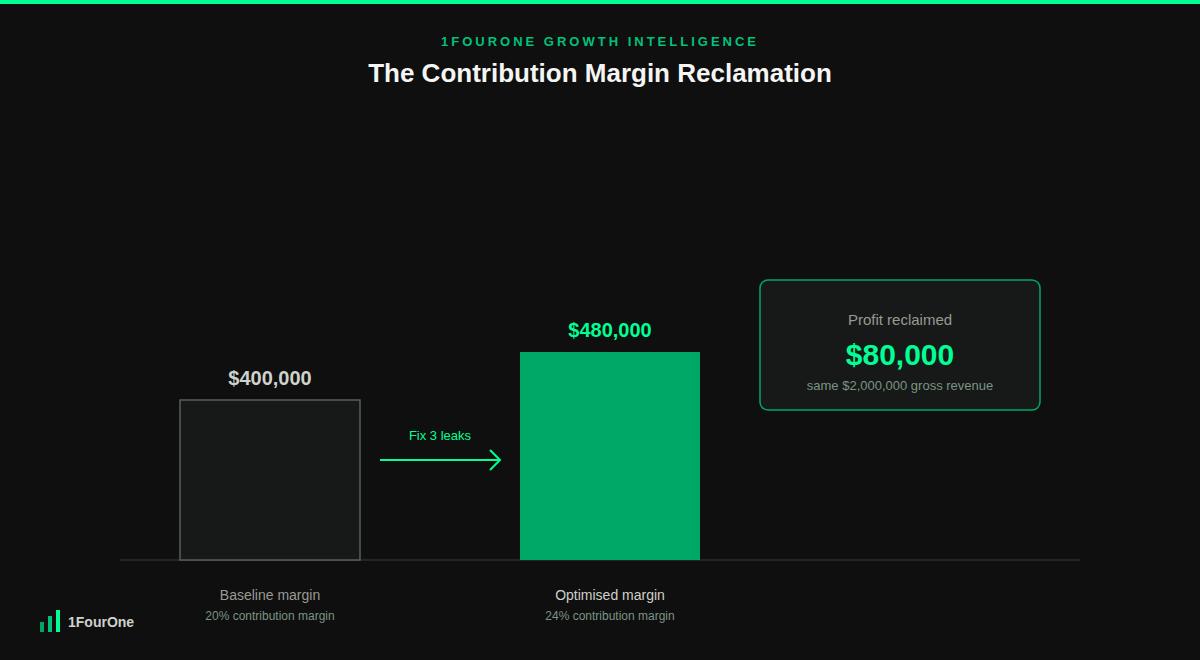
To evaluate the direct commercial impact of a structured margin protection program, let us examine an established mid-market fashion retailer generating $2,000,000 in annual gross revenue across 20,000 orders ($100 Average Order Value). Under the baseline scenario, total variable expenses equal $1,600,000 ($80 per unit), consisting of $800,000 in Cost of Goods Sold ($40/unit), $300,000 in fulfilment and shipping ($15/unit), and $500,000 in marketing spend ($25/unit). This setup leaves a baseline net contribution margin of $400,000 ($20 per unit, or a 20.0% contribution margin).
Reviewing the unit-level accounting reveals three major operational cost leaks: unhedged shipping discounts ($5 per order leak across 5,000 discounted orders = $25,000), unmonitored return processing overheads ($10 per return leak across 2,000 returns = $20,000), and non-incremental ad spend on low-margin SKUs ($35,000). These hidden cost leaks total $80,000 annually, quietly eroding net operating profits despite healthy top-line transaction volumes.
The brand’s growth operations team implements a comprehensive retail margin protection strategy to plug these cost drains. They adjust free shipping thresholds to eliminate unhedged freight subsidies, institute restocking fees on high-return product categories to cover reverse logistics labour, and deploy automated bidding guardrails that pause paid ad spend on low-margin inventory lines. These structural cost controls eliminate variable waste without impacting overall sales volume.
This operational alignment reduces total annual variable costs from $1,600,000 down to $1,520,000 ($80,000 in variable cost savings). With annual gross revenue remaining completely stable at $2,000,000 across the same 20,000 orders, net contribution margin scales from $400,000 (20.0%) up to $480,000 (24.0%). The business achieves an $80,000 profit reclamation derived entirely from fixing variable cost leaks on a flat top-line revenue base.
The financial return from this margin protection program is immediate and highly sustainable. Without requiring additional paid customer acquisition spend or increasing retail prices, the brand expands its net contribution profit by $80,000 annually ($480,000 optimised margin minus $400,000 baseline margin). This 20.0% increase in net contribution profit expands operating cash flow, providing reliable internal capital to fund future business growth securely.
Gross margin reflects revenue remaining after subtracting direct product costs like manufacturing and inbound freight from net sales. Contribution margin provides a more comprehensive view of profitability, subtracting all variable expenses, including pick-and-pack labour, outbound shipping, payment processing fees, and direct marketing spend, from net revenue. Tracking contribution margin ensures you evaluate the true profitability of every order.
Calculate fully loaded variable cost by adding product COGS, inbound freight, packaging materials, pick-and-pack fulfilment labour, merchant processing fees, outbound shipping costs, and estimated return handling expenses for a specific order. Subtracting this total variable cost from net order revenue yields the true contribution dollar amount available to cover fixed operating overheads and generate net profit.
Raising shipping thresholds can increase cart drop-offs slightly if implemented without clear messaging or relevant product add-ons. However, presenting transparent threshold progress indicators and recommending affordable add-on items helps customers reach free shipping targets naturally. The resulting increase in average order value and shipping cost recovery far outweighs micro-drops in overall conversion rate.
Unit-level contribution margins should be updated automatically whenever component costs change, such as supplier price adjustments, shipping rate increases, or merchant fee updates. Establishing automated data feeds between your ERP, fulfilment software, and marketing analytics panels ensures your bidding guardrails and pricing rules reflect current operational costs, preventing accidental spend on unviable items.
High transaction volume on low-margin items can be deceptive if those sales fail to cover their fully loaded variable costs and marketing expenses. If a high-volume product generates negative contribution dollars, scaling its ad spend simply increases net operating losses. Reallocate marketing capital toward higher-margin inventory or restructure the low-margin product as part of a higher-value bundle to restore profitability.
Allowing unmonitored variable cost leaks to erode your net operating profits is an expensive operational failure that threatens business viability. At 1FourOne, we eliminate financial blind spots by deploying comprehensive margin protection frameworks that plug cost drains and maximize net profitability. Contact our growth operations team today to secure a data-driven unit economics audit tailored for your business.
Get your competitive audit in 48 hours and see exactly where your revenue is leaking.
Get Your Audit →