How to Stop Guessing Which Marketing Channel Actually Works

Executing a structured acquisition channel prioritisation model is the baseline requirement for mid-market e-commerce operators seeking to defend their net contribution margins from escalating advertising auction inflation. As paid media landscapes grow increasingly volatile and ad platforms restrict data tracking protocols, relying on a single traffic source introduces unacceptable structural vulnerabilities into a retail balance sheet. Brands that blindly direct capital into channels without validating real unit economics frequently subsidise unprofitable customer cohorts at the expense of sustainable growth. Transitioning to an objective, multi-channel framework allows retail executives to identify immediate capital leaks, stabilise their customer acquisition costs, and allocate media spend based on real transactional data.
Mid-market retail enterprises often fall into a hazardous operational routine by over-indexing on a single paid acquisition platform. When an ad account delivers historical success, management teams treat that performance as a permanent baseline. This operational complacency exposes the business to extreme platform dependencies, where a sudden algorithm update or policy shift can instantly erase profitability. A 2024 industry survey of over 150 retail marketing leaders found that brands running three or more acquisition channels were 73% more likely to report a higher return on ad spend than brands concentrated on one or two.
Failing to apply algorithmic scrutiny to your performance metrics leads to distorted financial reporting. Standard advertising dashboards rely on heavily biased attribution models engineered to claim credit for organic consumer behaviour. When your internal marketing teams accept these platform-reported metrics at face value, they end up expanding budgets on campaigns that fail to drive incremental transactions. This common error dilutes capital and directly reduces your overall marketing spend efficiency.
To break out of this loop, retail operators must implement clear data governance practices that separate platform data from true commercial outcomes. Evaluating your acquisition ecosystem through an objective lens highlights exactly where marketing capital is creating real customer value and where it is being wasted on repetitive ad impressions.
A sophisticated strategy requires deeper operational insights than simple top-line traffic summaries can provide. True growth intelligence relies on a deep understanding of multi-channel consumer pathways, cross-platform audience overlap, and historical customer lifetime value. By analysing these complex interaction layers, growth teams can determine which traffic channels provide stable margins and which ones merely generate hollow conversion volumes.
Evaluating every competitor acquisition channel within your immediate market segment also exposes unserved audience demand. Mapping where your direct rivals spend their primary media budgets allows you to identify valuable placement gaps and content opportunities that they are currently ignoring. If your top competitors saturate standard social feeds, a clear strategic window opens to focus on programmatic search, content syndication, or strategic affiliate partnerships.
To achieve this level of operational transparency, your growth teams must look beyond basic customer acquisition costs and analyse post-purchase retention behaviour. A high-volume traffic channel that initially appears efficient may deliver customers with abnormally high return rates or zero repeat purchase intent. Documenting these structural anomalies across your entire media mix allows you to build a highly disciplined acquisition architecture that supports long-term retail viability.
| Channel Archetype | Primary Strategic Role | Primary Efficiency Metric |
|---|---|---|
| Paid Performance Search | Capturing existing high-intent transactional demand | In-channel incremental return on ad spend (iROAS) |
| Paid Social Media | Generating cold audience awareness and interest | First-touch customer acquisition cost (CAC) |
| Programmatic Affiliate | Securing low-risk, performance-linked conversions | Net contribution margin per partner transaction |
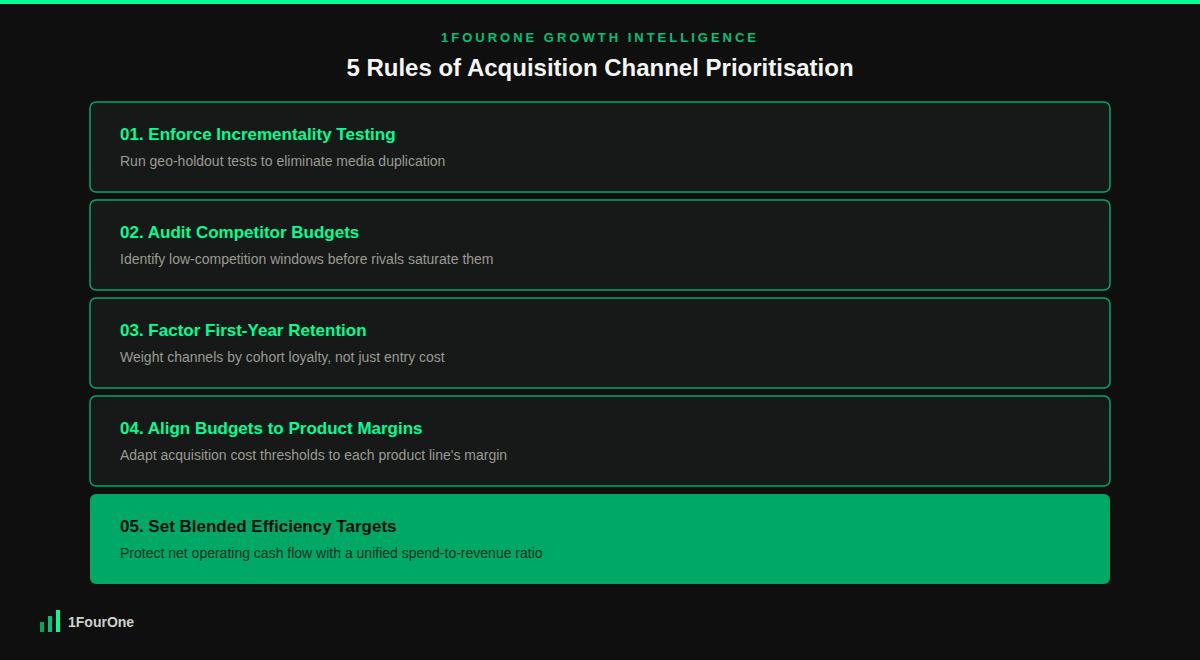
To systematically maximise your media capital returns, your operations team must adopt a rigorous acquisition channel prioritisation methodology. This process shifts your focus from subjective channel preferences to strict, data-driven rules. The following five rules provide a repeatable framework to audit channel incrementality, eliminate media waste, and protect your commercial retail margins.
The primary source of media waste in mid-market retail is paying for transactions that would have occurred naturally without paid intervention. Platforms frequently claim attribution for existing brand loyalists who simply clicked an ad out of convenience on their path to purchase. To isolate this operational issue, you must run regular geo-holdout tests and lift studies to measure true channel incrementality. If a paid customer acquisition channel fails to generate clear, measurable lift above your organic baseline, its budget must be reallocated immediately.
This is not a theoretical risk. A landmark field experiment at eBay found that brand-keyword paid search ads delivered no measurable short-term benefit, because the shoppers clicking them were already intending to buy and would have found eBay through organic search regardless. Isolating these non-incremental transactions protects your media capital from being drained by repetitive ad networks. This disciplined approach ensures that every dollar of media spend actively generates new market demand rather than overpaying for existing audience behaviour.
Operating a media mix without analysing rival placement strategies leaves your ad accounts vulnerable to sudden bidding spikes. Your growth operations team must perform regular competitor analysis to identify which networks your direct rivals are prioritising. Isolating a competitor acquisition channel receiving heavy capital investment lets your team spot high-cost auction environments early, and tilt your media mix toward lower-competition entry points.
This systematic review must be executed using verified ad transparency frameworks. As documented in our operational guide on competitor ad audits, tracking the creative velocity and longevity of rival campaigns reveals exactly where their budgets are converting best. Use this information to find overlooked marketing channels where you can publish tailored brand assets without entering expensive bidding wars against well-capitalised market participants.
Evaluating channel performance purely on immediate front-end conversion metrics introduces significant long-term risk into an e-commerce balance sheet. A traffic source that delivers exceptionally low front-end acquisition costs often yields buyers with poor retention rates and high refund frequencies. Your acquisition channel prioritisation model must link your front-end media dashboards directly to your back-end transactional database to track first-year retention performance by traffic origin.
If a specific advertising network boasts a low customer acquisition cost but fails to generate repeat purchases within twelve months, its long-term commercial value is highly questionable. Conversely, a channel with a higher entry cost that delivers loyal, high-margin cohorts must receive higher priority in your capital mix.
Different product categories within your e-commerce inventory carry vastly different margin profiles due to manufacturing variances, logistics overheads, and return rates. A major operational error is applying a generic, uniform cost target across all marketing campaigns regardless of the underlying product being advertised. To achieve true marketing spend efficiency, your media budgets must adapt dynamically to the exact contribution margins of individual product lines.
When advertising inventory with thin margins, you must lower your maximum acquisition cost thresholds and prioritise low-cost organic or retention channels. For high-margin, exclusive product bundles, your team can safely increase acquisition bids to capture maximum market volume. This programmatic alignment prevents your paid marketing spend from consuming your entire net profit.
This technical balancing act must be treated as a core element of your overarching pricing framework. As detailed in our strategic breakdown of ecommerce dynamic pricing, adjusting commercial structures in response to shifting market conditions requires real-time coordination with your acquisition media buyers.
Relying solely on single-channel metrics can obscure systemic capital leaks within your broader digital infrastructure. To maintain absolute control over your financial performance, growth operations teams must track a unified, blended media efficiency ratio alongside specific platform data. This metric compares your total combined advertising spend directly against your total gross retail revenue over identical periods to establish a clear corporate benchmark.
A healthy blended efficiency ratio ensures that your overall digital marketing investments remain proportional to your real commercial output. If individual platform dashboards report positive metrics while your blended efficiency ratio steadily declines, your system is suffering from attribution duplication or severe margin erosion. Setting strict blended targets keeps your team focused on protecting net operating cash flow.
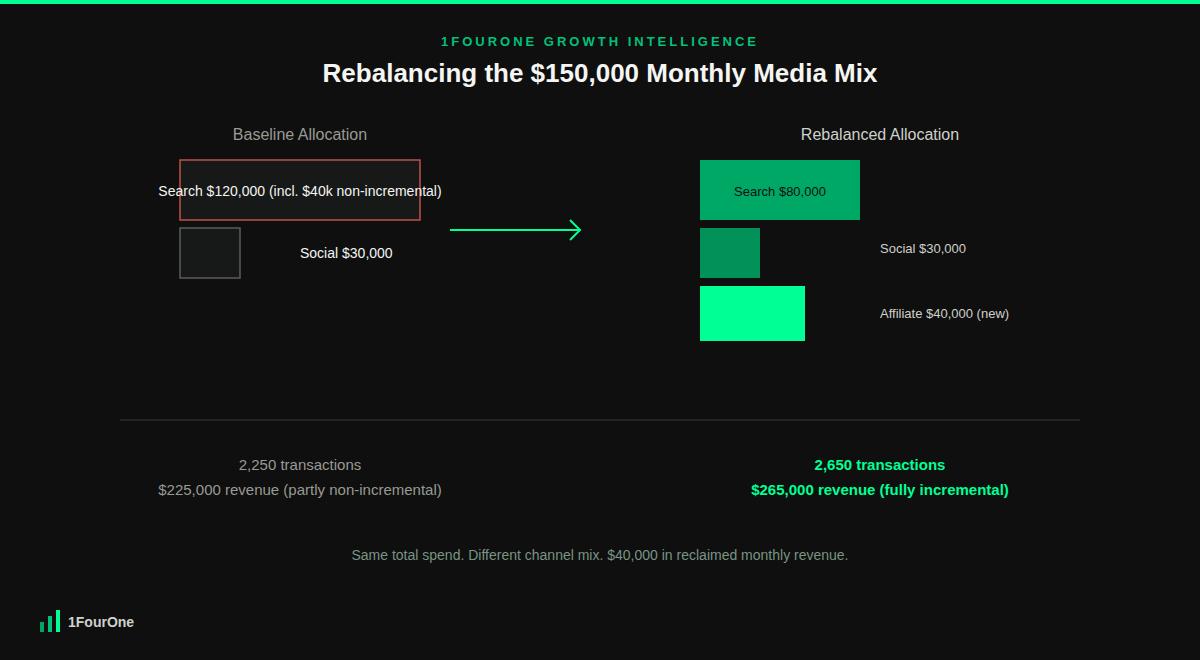
To evaluate the commercial impact of a structured channel prioritisation sprint, let us examine an established mid-market e-commerce brand operating with a fixed monthly marketing spend of $150,000. In the baseline scenario, the brand allocates $120,000 to Paid Performance Search and $30,000 to Paid Social Media. This unhedged allocation generates exactly 60,000 unique monthly site sessions from search at an average cost of $2.00, and 30,000 sessions from social media at a cost of $1.00.
Under this baseline setup, the Paid Performance Search channel achieves an in-platform conversion rate of 3.0%, yielding exactly 1,800 transactions (60,000 sessions multiplied by 0.03). The Paid Social Media channel reports an in-platform conversion rate of 1.5%, delivering exactly 450 transactions (30,000 sessions multiplied by 0.015). Combined, the two channels report a baseline total of 2,250 transactions, which generates $225,000 in gross monthly revenue based on a fixed average order value of $100.
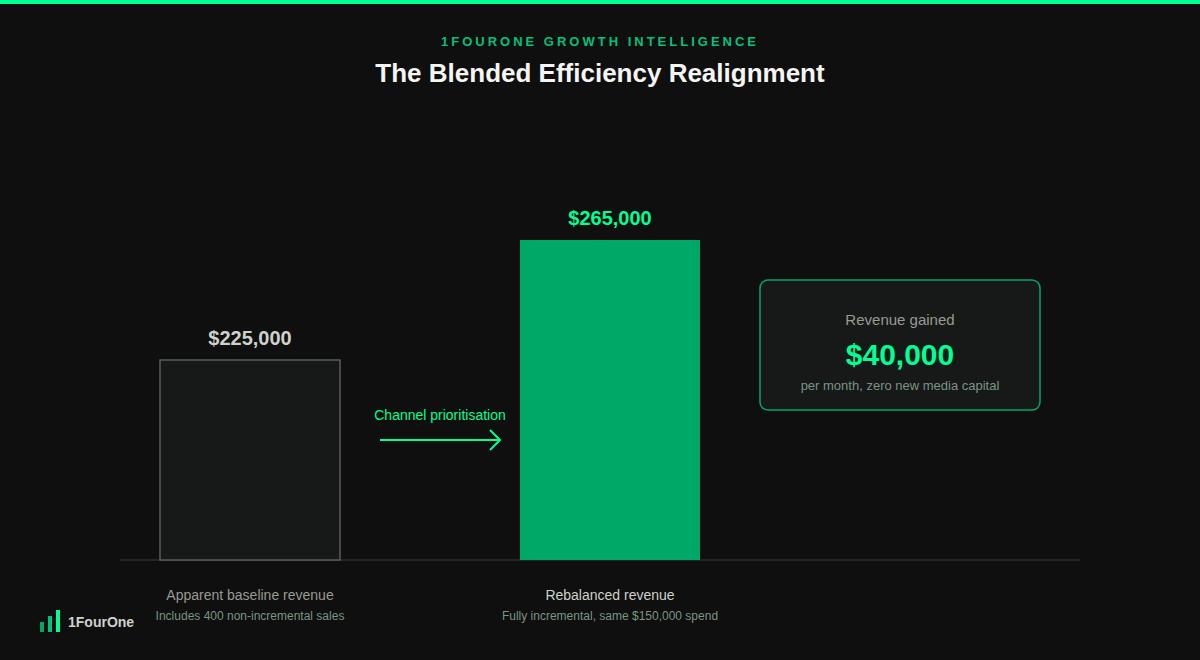
This baseline scenario produces an apparent blended return on ad spend of 1.50 ($225,000 revenue divided by $150,000 spend). However, a deep data audit reveals a massive capital leak: 400 of the transactions claimed by the search channel were non-incremental brand terms that would have converted naturally via organic listings. The real, incremental transaction volume from the search investment is only 1,400.
The growth team executes a comprehensive channel prioritisation program to fix this media duplication. They slash the non-incremental search budget by $40,000, reducing total search spend to $80,000, which keeps 40,000 high-intent generic sessions ($80,000 divided by $2.00). They reallocate that $40,000 into a programmatic affiliate partner program, while keeping the paid social media investment flat at $30,000. The total monthly marketing spend remains completely unchanged at exactly $150,000.
The rebalanced media mix alters the traffic and conversion architectures completely. The search channel now generates 1,200 purely incremental transactions (40,000 sessions multiplied by 0.03). The paid social media channel remains stable at 450 transactions. The newly activated affiliate partner channel uses the reallocated $40,000 to drive high-performing referral placements, achieving an average acquisition cost of $40 per transaction, which delivers exactly 1,000 new customer transactions ($40,000 divided by $40).
By eliminating attribution duplication and prioritising a highly efficient performance channel, the brand scales its total transaction volume from the baseline of 2,250 up to exactly 2,650 monthly transactions (1,200 search + 450 social + 1,000 affiliate). With the average order value remaining steady at $100, the rebalanced gross monthly revenue climbs to exactly $265,000. This strategic realignment increases monthly revenue by $40,000 without requiring a single dollar of additional marketing capital.
The most reliable method to track true lift is deploying localised geo-holdout tests across distinct, comparable geographic territories. By completely pausing paid media visibility in specific regions while maintaining steady spending in your primary markets, you can directly measure the organic transactional baseline. This focused testing structure isolates non-incremental media spend without disrupting your broader national performance pipelines.
To avoid dangerous platform dependencies, mid-market retail operations should maintain at least three active, independent customer acquisition channels. A well-built foundational mix includes a high-intent search capture network, a scalable audience discovery channel, and a low-risk performance option like an affiliate program. This diversified structure insulates your conversion pipeline from sudden platform changes or algorithm shocks.
High-margin, low-volume channels should be prioritised as premium conversion paths within your broader media portfolio. Instead of forcing budget expansion into these specialised networks, which typically degrades efficiency, keep their funding capped at their natural saturation points. Use the high cash flow they generate to fund testing loops in larger, high-volume customer acquisition channels.
Tracking a macro blended efficiency target does not mean ignoring granular, platform-specific conversion data. Your digital media buyers must continue to review specific ad performance to refine copy hooks and creative assets within individual accounts. The blended efficiency ratio simply acts as an executive financial guardrail to ensure that combined platform expenditures translate into real net operating profits.
While tactical ad copy adjustments should be reviewed bi-weekly based on current competitor analysis, macro capital reallocations should occur on a strict quarterly schedule. Adjusting your core media distribution too frequently prevents platform machine-learning models from optimising their targeting delivery. Reviewing data on a quarterly basis provides the necessary statistical significance to execute profitable strategic pivots.
Allowing unbalanced, single-channel dependencies to compromise your retail contribution margins is an expensive operational failure. At 1FourOne, we eliminate digital media waste by applying rigorous acquisition channel prioritisation frameworks that uncover hidden capital leaks and improve traffic performance. Contact our growth operations team today to secure a comprehensive, data-driven channel audit built for your brand.
Get your competitive audit in 48 hours and see exactly where your revenue is leaking.
Get Your Audit →