Three Resellers Undercut Your Price by 18%. Your Own Store Lost 30% of Its Orders
Executing a disciplined MAP compliance monitoring retail strategy is the most essential operational adjustment a scaling brand manufacturer can deploy to prevent unauthorised price undercutting, resolve marketplace channel conflict, and protect direct-to-consumer gross margins. Many retail brand operators expand wholesale distribution without enforcing strict pricing guardrails, completely failing to monitor third-party seller behaviour across online marketplaces. Allowing unauthorised distributors to discount flagship products below minimum advertised price thresholds degrades brand equity and directly suppresses conversion rates on owned sales channels. Transitioning to an automated MAP monitoring model enables growth teams to eliminate rogue seller undercutting, protect marketing spend efficiency, and build compounding cash flow.
Brand manufacturers expanding across multi-channel distribution networks frequently face severe margin degradation caused by unmonitored wholesale price erosion. When a brand sells inventory to wholesale stockists, third-party marketplace merchants, or regional distributors, individual sellers often attempt to capture quick sales volume by lowering advertised online prices below agreed minimums. This unauthorised price cutting triggers widespread price perception issues across search engines and shopping feeds.
Operating a direct-to-consumer storefront alongside non-compliant wholesale partners introduces severe financial risk to your digital acquisition strategy. High-intent prospective buyers who arrive on your owned site via paid search ads frequently perform quick price comparisons across external marketplaces. If unauthorised stockists list your flagship SKUs below official retail prices, shoppers abandon your checkout funnel to buy from third-party sellers. Your business absorbs the upfront ad acquisition cost while losing the high-margin direct sale.
To establish a defensible commercial retail model, executive teams must treat Minimum Advertised Price compliance as a core financial control. Monitoring external marketplace seller listings continuously allows commercial operations to identify non-compliant accounts and enforce contractual pricing rules quickly. Shifting from passive wholesale relationships to active MAP enforcement ensures that direct-to-consumer conversion rates remain protected against rogue reseller undercutting.
Building a scalable retail brand requires far deeper operational control than simple wholesale volume tracking can provide. Incorporating automated MAP compliance monitoring into your broader growth intelligence matrix enables commercial teams to measure price stability across every external distribution node. By linking web-scraping price intelligence software directly to authorised distributor records, managers can identify price policy violations in real time. This operational oversight prevents unauthorised price discounting from eroding direct-to-consumer margins.
Maintaining strict price parity across authorised channels also directly supports your paid customer acquisition programs. When unauthorised marketplace sellers undercut your advertised prices, your paid search and shopping ads experience lower click-through and conversion performance, driving up effective customer acquisition costs. Enforcing MAP compliance restores cross-channel price integrity, ensuring that every dollar of paid customer acquisition spend generates optimal return across primary marketing channels.
Validating MAP compliance initiatives against established empirical business research underscores its commercial importance. Published research by the Harvard Business Review confirms that increasing customer retention rates by 5% scales overall corporate profits by 25% to 95%. This empirical baseline demonstrates why preserving brand value and direct customer relationships through price policy enforcement protects long-term customer lifetime value, generating the stable cash flow required to support business growth.
| Channel Violation Tier | Seller Infringement Type | MAP Enforcement Action |
|---|---|---|
| Authorised Wholesale Accounts | Promotional discounting below agreed MAP policy limits | Issuing formal cure notices and temporarily pausing wholesale shipments. |
| Unauthorised Marketplace Resellers | Selling diverted inventory on third-party shopping platforms | Executing legal cease-and-desist notifications and IP infringement claims. |
| Automated Price Matching Engines | Algorithmic price undercut cascades across competing sites | Enforcing price stabilisation with primary retail partners to break loops. |
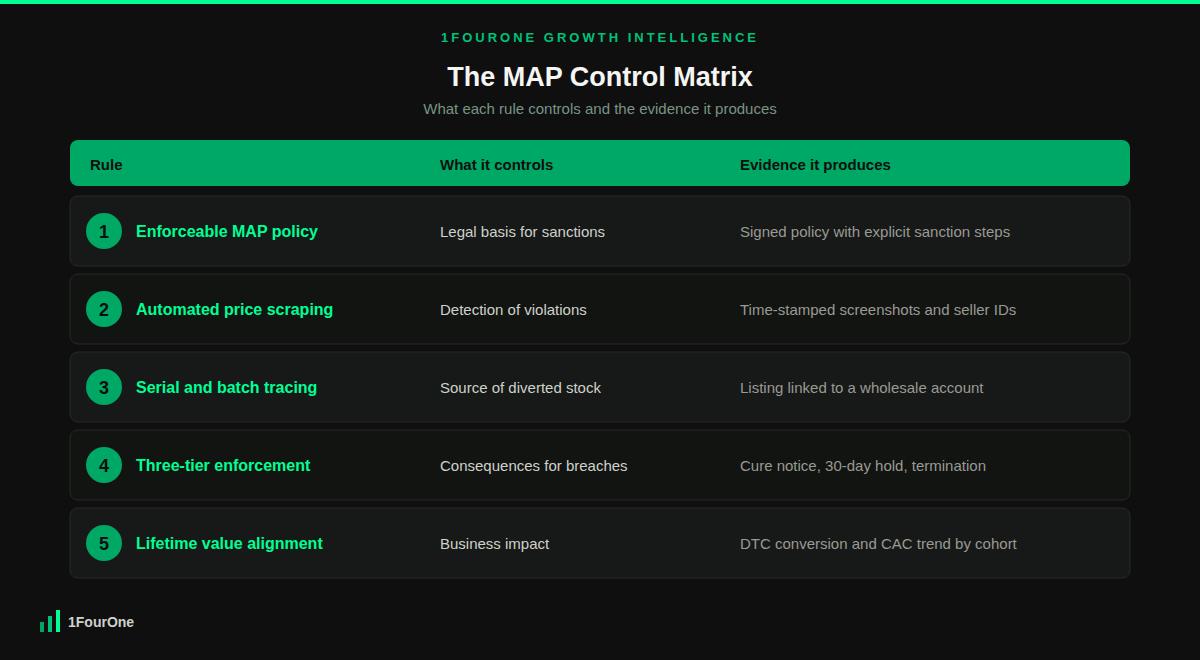
To systematically eliminate unauthorised seller undercutting and protect direct-to-consumer gross margins, your commercial team must institutionalise a structured MAP compliance monitoring retail protocol across all distribution agreements. This operational framework replaces reactive wholesale auditing with automated price monitoring and legal enforcement workflows. The following five rules provide a repeatable methodology to audit reseller compliance, protect marketing spend efficiency, and preserve brand equity.
The foundation of effective channel governance is drafting legally sound Minimum Advertised Price policy documentation that clearly defines compliance requirements and enforcement consequences. Generic or informal pricing agreements fail to provide the legal framework necessary to penalise non-compliant wholesale buyers. Clear MAP policies define exactly what constitutes an advertised price violation across digital channels.
Draft explicit MAP policy documentation that covers public website listings, shopping feed prices, banner ads, and digital cart displays. Align these legal parameters with wholesale supply rules from our operational guide on inventory allocation strategy rules. Defining clear, graduated enforcement steps, such as written warnings, inventory holds, and permanent account termination, provides the authority required to maintain channel discipline.
Relying on manual website checks or customer complaints to identify MAP violations leaves your brand vulnerable to widespread price erosion. Unauthorised sellers frequently adjust prices during night hours or weekends to evade detection while capturing high search volume. Commercial teams must implement automated price intelligence software to monitor digital marketplaces continuously.
Deploy web-scraping software to monitor SKU pricing across major marketplaces, shopping comparison engines, and wholesale websites every hour. Integrate these scraping tools with dynamic commercial pricing workflows, as outlined in our strategic guide on ecommerce dynamic pricing strategy. Automated intelligence platforms capture time-stamped screenshots and seller IDs, providing undeniable evidence for rapid enforcement action.
Unauthorised marketplace merchants often source inventory through wholesale diversion, purchasing stock from legitimate distributors under the guise of bulk orders and reselling it online. When non-compliant sellers mask their merchant identities on third-party platforms, identifying the source of diverted inventory becomes difficult. Operations teams must establish inventory tracking mechanisms to pinpoint supply leaks.
Implement serialised product tracking or unique batch codes across wholesale shipments, linking specific product lots directly to individual wholesale buyer accounts. As detailed in our strategic guide on competitor ad audit 5 rules, tracking supply sources helps maintain channel control. Test-purchasing discounted items from unauthorised sellers allows you to inspect serial numbers and identify the wholesale account leaking inventory.
Failing to enforce published MAP policy penalties consistently when violations occur signals to the wholesale market that your pricing guardrails are unenforced. Allowing non-compliant sellers to operate without penalty encourages other distributors to lower their prices to stay competitive, creating a downward price spiral. Commercial managers must execute immediate enforcement protocols upon detecting violations.
Establish a strict 3-tier enforcement workflow: issue an automated cure notice upon first offense, suspend wholesale ordering privileges for 30 days upon second offense, and permanently terminate supply agreements upon third offense. As documented in our operational guide on how to reduce checkout abandonment tactics, maintaining channel price stability protects core conversion rates. Consistent enforcement demonstrates commitment to protecting authorised retail partners.
Evaluating wholesale channel success based purely on bulk order volume ignores the long-term damage unauthorised discounting inflicts on direct-to-consumer customer retention. When prospective buyers observe inconsistent pricing across channels, brand trust declines, and customers delay purchases until they find the lowest available price point. Operating teams must prioritise brand protection over short-term wholesale volume.
Monitor customer acquisition costs and direct-to-consumer conversion rates alongside wholesale reseller compliance metrics. Incorporate process parameters from our framework on predictive churn audit rules to track how price stability influences repeat purchase habits across direct customer cohorts. To confirm that stable pricing is translating into satisfied customers, benchmark your post-purchase satisfaction tracking against the international guidelines in ISO 10004:2018. Protecting brand pricing integrity across all channels maintains customer trust and maximises long-term customer lifetime value.
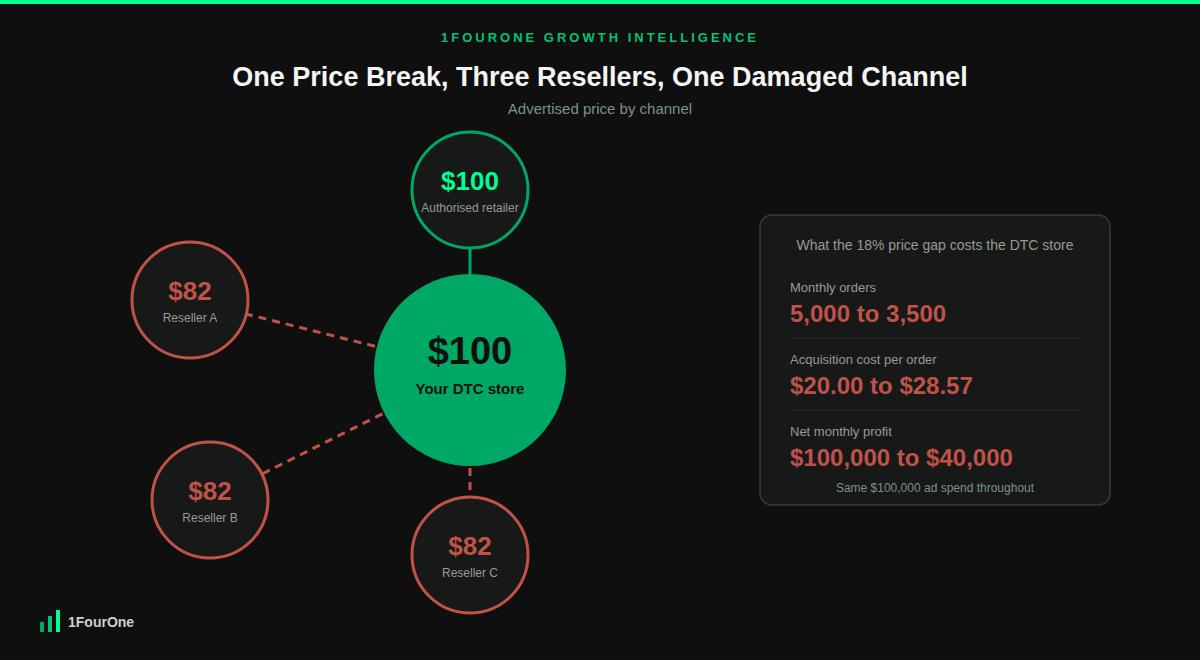
To evaluate the direct commercial return of a MAP compliance monitoring retail program, let us examine an established brand manufacturer generating $500,000 per month in direct-to-consumer (DTC) storefront revenue across 5,000 orders ($100 Average Order Value). Under the baseline operational state, the DTC channel operates at a 40% net contribution margin before paid media ($200,000 gross margin). Paid digital marketing acquisition spend totals $100,000 per month ($20 acquisition cost per order), leaving a baseline net monthly DTC contribution profit of $100,000 ($200,000 gross profit minus $100,000 ad spend).
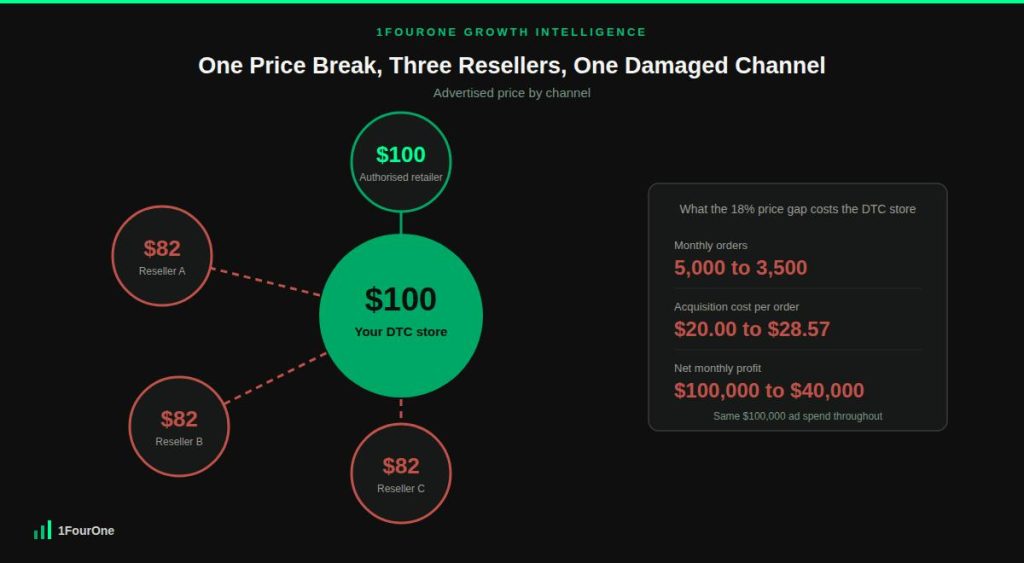
Reviewing cross-channel sales uncovers a major channel conflict failure: three unauthorised wholesale distributors quietly break MAP policy on third-party online marketplaces, discounting flagship SKUs from $100 down to $82. High-intent prospective buyers visiting the DTC storefront perform price comparisons and abandon checkout to purchase discounted marketplace items. This unauthorised undercutting causes DTC conversion rates to drop by 30%, contracting monthly DTC order volume from 5,000 down to 3,500 orders ($350,000 gross DTC revenue). Meanwhile, paid media ad spend remains fixed at $100,000, inflating DTC acquisition costs from $20 to $28.57 per order.
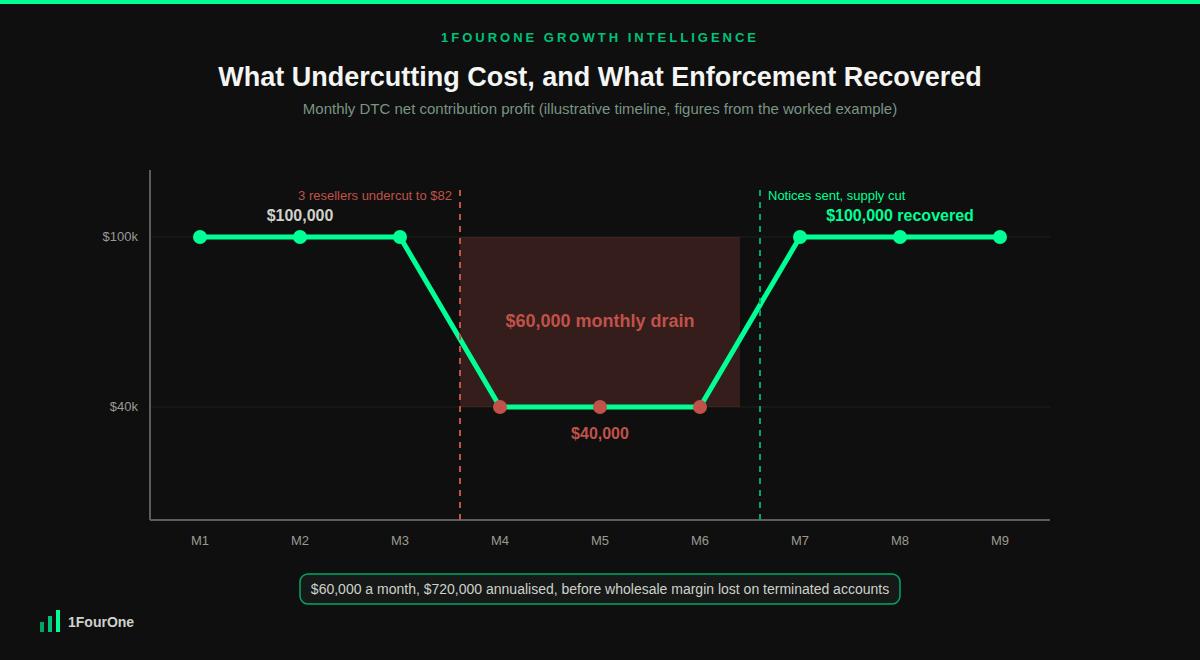
The resulting financial leak is severe: DTC gross profit contracts to $140,000 (3,500 orders × $40 unit margin). Subtracting the fixed $100,000 marketing spend leaves a diminished net monthly DTC contribution profit of $40,000 ($140,000 gross profit minus $100,000 ad spend). That is a $60,000 monthly margin drain directly caused by unmonitored reseller price cutting.
The brand’s growth operations team deploys an automated MAP compliance monitoring retail strategy to resolve this conflict. They implement automated price scraping software, execute test purchases to trace serial batch codes back to the three non-compliant wholesale buyers, issue formal cease-and-desist notices, and permanently terminate wholesale supply to those accounts.
This channel enforcement action eliminates marketplace price undercutting completely, restoring price parity across all retail channels. Direct-to-consumer conversion rates fully recover, returning monthly DTC order volume to 5,000 orders ($500,000 gross DTC revenue) and restoring DTC gross profit back to $200,000 ($40 × 5,000 orders).
The financial return from this MAP compliance program is immediate and highly sustainable. On flat $100,000 paid media spend, net monthly DTC contribution profit recovers from $40,000 back to $100,000, securing an immediate $60,000 monthly net profit reclamation ($720,000 annualised cash flow expansion) derived entirely from strict channel compliance enforcement without increasing marketing spend.
Two limits on this example are worth stating plainly. It isolates the DTC channel and assumes conversion recovers in full once undercutting stops. Terminating three wholesale accounts also removes the wholesale margin those accounts contributed, so the real net gain is $60,000 minus that lost margin, and the case for enforcement weakens if those accounts earned $60,000 a month or more. Calculate each distributor’s contribution before enforcing, and treat the sums above as the upside rather than a guaranteed result.
A Minimum Advertised Price policy is a legal agreement established by a brand manufacturer that defines the lowest price distributors, wholesalers, and retailers can publicly display when advertising the brand’s products online or in print. While MAP policies regulate advertised prices in marketing channels, they allow resellers to determine final checkout transaction prices independently where legally permitted.
Automated price scraping tools detect MAP policy violations by continuously monitoring product listings, search engine shopping feeds, marketplace product pages, and digital promotional banners across specified retail websites. The software extracts advertised prices, records time-stamped screenshots, identifies seller profile names, and alerts brand managers immediately when an advertised price drops below the defined MAP threshold.
MAP policies regulate only the advertised price displayed in public marketing channels, leaving the reseller free to negotiate final point-of-sale transaction prices with buyers. Resale price maintenance attempts to mandate the actual final selling price, which faces strict legal scrutiny under antitrust laws in many jurisdictions. A properly drafted MAP policy focuses strictly on advertised promotional prices to maintain legal compliance. Rules on minimum pricing differ by country, so confirm your policy with local competition-law counsel before publishing it to distributors.
Unauthorised sellers typically obtain inventory through wholesale diversion, purchasing genuine products in bulk from authorised distributors, liquidators, or international markets at heavy wholesale discounts and reselling them online. Implementing serialised product tracking and batch coding allows manufacturers to trace test-purchased items back to the original wholesale account leaking stock.
Upon discovering a MAP violation, a brand should immediately capture time-stamped evidence of the listing, verify seller identity, and issue an official written cure notice referencing the MAP policy agreement. If the seller fails to restore compliant pricing within the specified timeframe, the brand should enforce policy sanctions, including pausing wholesale shipments or terminating supply agreements.
Allowing unauthorised reseller price undercutting to erode direct-to-consumer margins and damage brand trust is an expensive operational failure that degrades retail profitability. At 1FourOne, we eliminate channel margin leaks by deploying a disciplined MAP compliance monitoring retail framework that protects brand pricing and maximises net cash flow. Contact our growth operations team today to secure a data-driven channel audit tailored for your business.
Get your competitive audit in 48 hours and see exactly where your revenue is leaking.
Get Your Audit →