Product Lifecycle Management: 3 Proven Rules for Success
Product lifecycle management is often treated as a peripheral administrative task, handled by junior inventory planners using basic spreadsheets. This is a critical error. Your product catalogue is the primary engine of your cash flow, and failing to manage its health is equivalent to ignoring the engine health of a vehicle. A bloated catalogue of slow-moving items ties up vital capital that could be used for growth, marketing, or infrastructure investment.
Retailers frequently fall into the trap of adding new items to their range without ever systematically removing the old ones. Over time, this leads to a fragmented catalogue where high-margin items are buried under a mountain of underperforming stock. This complexity makes your site harder to navigate, increases your warehousing costs, and dilutes the focus of your marketing team.
To scale efficiently, you must adopt a rigorous framework for evaluating the profitability and relevance of every SKU you carry. This article details the financial mechanics of managing a product range and explains how to turn your catalogue into a high-performance asset that drives consistent revenue growth.
A catalogue that grows without a disciplined exit strategy eventually suffers from diminishing returns. As you add more products, the operational burden of managing that range increases exponentially. You need more warehouse space, more time for quality control, and more complex marketing collateral. Each additional item carries a hidden cost that is rarely accounted for in the initial launch phase.
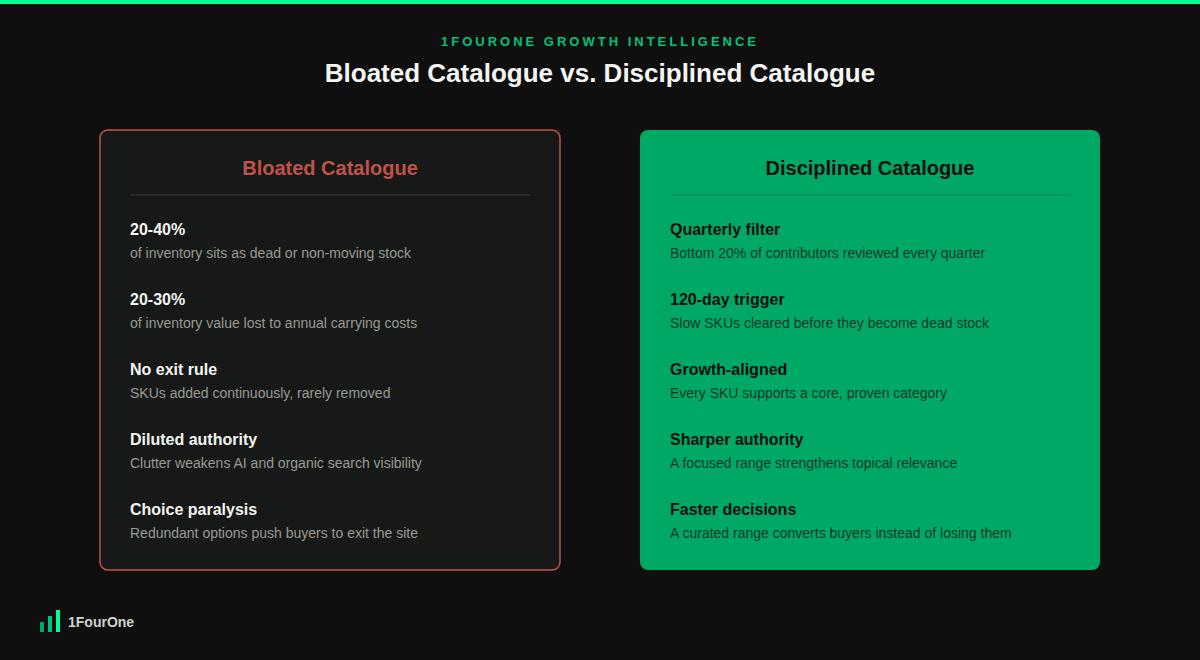
This complexity also impacts your search visibility. When your store contains hundreds of low-performing items, you are effectively watering down your site’s topical authority. Search engines struggle to identify your core value proposition when your catalogue is a mix of high-intent products and irrelevant clutter. This is a direct obstacle to maintaining the AI search visibility needed to capture modern buyers.
The cost is not abstract. Retail inventory carrying costs, which cover warehousing, insurance, taxes, and the opportunity cost of tied-up capital, typically run to 20-30% of average inventory value every year. A catalogue padded with slow-moving SKUs is not a growth asset. It is a recurring expense that quietly compounds against your margin.
Finally, a cluttered range confuses the customer. When a user lands on a site with too many redundant options, they often experience choice paralysis and exit the site entirely. By simplifying your range and focusing only on the items that drive the highest value, you make the decision-making process easier, faster, and more profitable for your business.
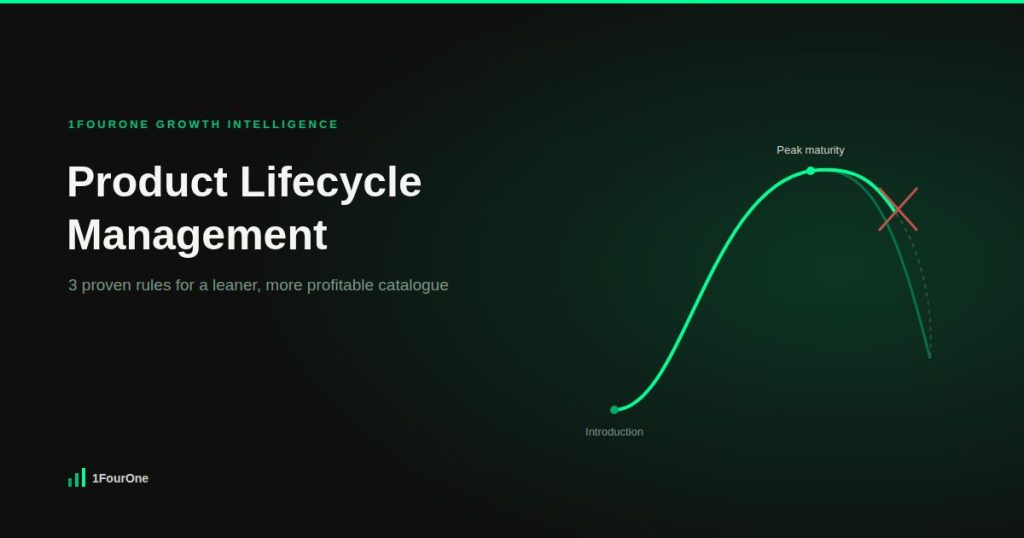
Every product follows a predictable financial arc. In the introduction phase, your margins are typically lower due to initial setup costs and the expense of educating the market. During the growth phase, you see the peak of your return on investment as awareness builds and demand outstrips your initial expectations.
However, the maturity and decline phases are where most retailers struggle. In maturity, the market reaches saturation, and your acquisition costs for each new sale increase. By the time a product reaches the decline phase, it is likely becoming a drain on your profitability. The goal of product lifecycle management is to identify the tipping point between maturity and decline before the product begins to cost you more than it earns.
This is not a marginal problem. A peer-reviewed retail operations study found that 20-40% of inventory held by general retail and manufacturing businesses is classified as non-moving or dead stock at any given time. If close to a third of your range fits that description, product lifecycle management is not a housekeeping task. It is one of the largest untapped sources of cash in your business.
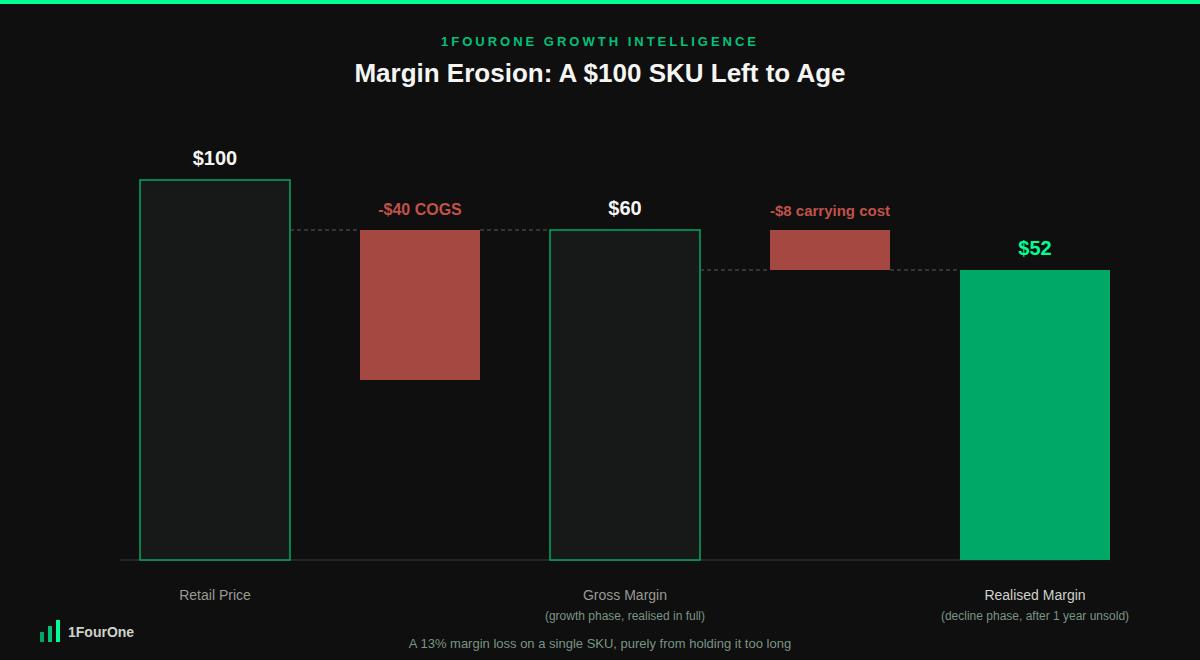
Consider a worked example of margin erosion. A SKU has a landed cost of $40 and a retail price of $100, giving a gross margin of $60 per unit before any holding costs. During the growth phase, the SKU sells within weeks of arrival, so carrying costs are close to zero and the full $60 margin is realised. In the decline phase, the same unit sits in the warehouse for a full year before it sells.
At the low end of the 20-30% annual carrying cost range, that single unit now costs $8 in storage, insurance, and tied-up capital before it even reaches the customer, cutting its realised margin from $60 to $52. That is a 13% margin loss on a single SKU purely from holding it too long. Multiply that erosion across a few hundred ageing SKUs, each carrying a similar or larger holding cost, and the true scale of the problem becomes clear. This is capital your business could otherwise be redeploying into new product development or paid acquisition.
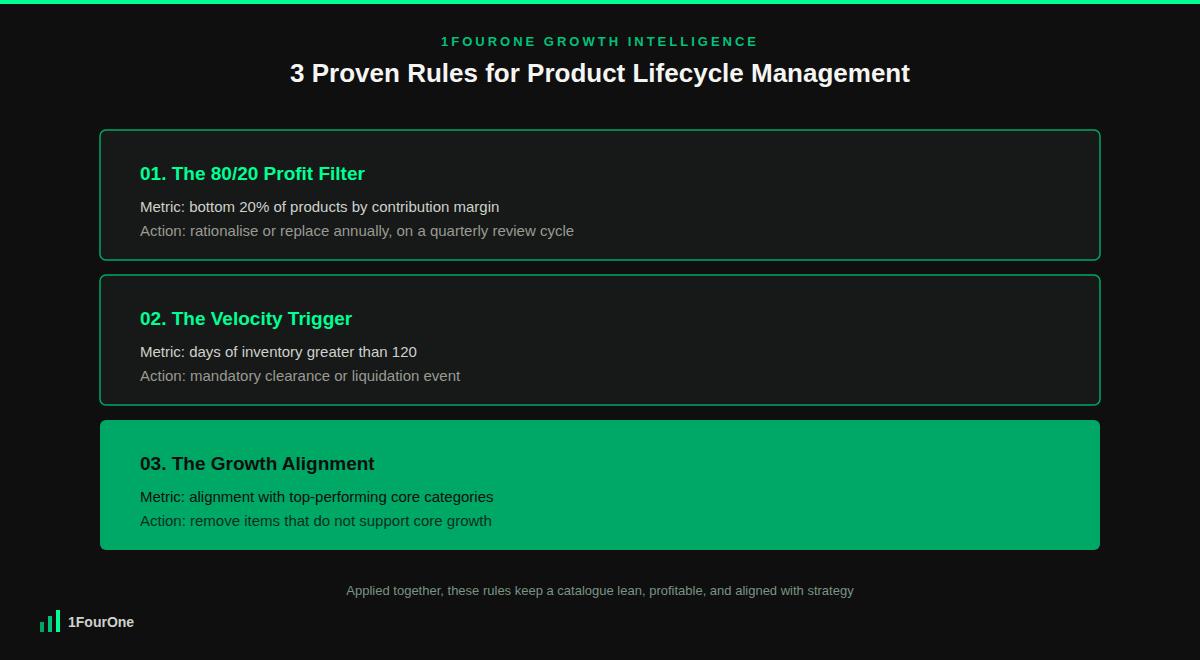
To master this discipline, you must implement strict rules that take the emotion out of your merchandising decisions. These 3 proven rules ensure that your catalogue remains lean, profitable, and aligned with your business goals:
| Rule | Operational Metric | Strategic Action |
|---|---|---|
| The 80/20 Profit Filter | Bottom 20% of contributors | Rationalise or replace these items annually. |
| The Velocity Trigger | Days of inventory > 120 | Mandatory clearance or liquidation event. |
| The Growth Alignment | Alignment with top categories | Remove items that do not support core growth. |
First, apply the 80/20 profit filter. Analyse your sales data to identify the bottom 20% of your products by contribution margin. If these products do not serve a specific strategic purpose, such as supporting a bundle, you must rationalise them. This process, product portfolio rationalization, should run as a scheduled quarterly exercise rather than an occasional clean-up.
Second, establish a strict velocity trigger. If an item does not reach a minimum turnover rate within 120 days, it is a liability, not a long-term bet. Third, ensure every new item in your range supports your core growth. If a product does not fit your primary niche, do not add it to your catalogue simply because it is on-trend elsewhere.
Your customers are the most reliable source of information for improving your product range. By integrating a systematic customer feedback loop, you can turn qualitative sentiment into quantitative product decisions. This is a core component of building an effective first-party data strategy. Instead of guessing what your buyers want, you use their own words to refine your selection.
Analyse the search queries from your site search logs to identify gaps in your catalogue. If users are consistently searching for a variation of a product you do not stock, you have a validated opportunity to expand. Simultaneously, look at return data to understand why specific items are failing to meet customer expectations. High return rates for a specific SKU are a primary indicator that the product is approaching the end of its lifecycle.
This integration also helps you identify new trends before they become mainstream. By monitoring the specific feature mentions in your customer support tickets, you build a genuinely data-driven product development pipeline instead of relying on guesswork or seasonal trend reports. This turns your customer service team into an extension of your product development function.
When you formalise this process, you replace anecdotal merchandising decisions with a repeatable, data-driven product development discipline. A single support ticket is an anecdote; a hundred tickets flagging the same missing feature or unmet need is a signal you can act on with confidence. Treat your customer feedback loop as a standing input to every quarterly range review, not a folder of complaints only opened when something breaks.
Inventory optimization is always a balance between cash flow and service levels. If you carry too much stock, you erode your margins; if you carry too little, you lose sales to out-of-stock events. The key to balancing these two forces is using predictive analytics to forecast demand based on historical patterns and current market trends.
You must prioritise availability for your top-performing products. These are the items that define your brand and generate the bulk of your profit. For these high-value items, it is often safer to err on the side of caution and hold slightly more stock than you think you need. Conversely, for lower-performing or seasonal items, adopt a just-in-time approach to minimise the risk of overstock.
You can also use your pricing strategy to adjust demand dynamically. If your inventory of a specific item is becoming too high, trigger a temporary price adjustment to accelerate the sell-through rate. If your inventory is low, increase the price slightly to throttle demand and protect your margin. This is the ultimate integration of ecommerce dynamic pricing and inventory management.
Most mid-market retailers cannot run this level of inventory optimization from a spreadsheet alone. Dedicated inventory management software that models demand at the SKU level will flag a turnover problem weeks before a manual quarterly review would catch it. For most established retailers, the cost of the right tooling is recovered within a single clearance cycle.
A comprehensive portfolio review should happen at least once every quarter. This ensures that you are constantly pruning underperforming items and making room for new growth opportunities.
If a product has low volume but high customer loyalty, keep it as a prestige SKU. Just ensure it does not take up excessive space or tie up too much capital.
Liquidation is often better if you need the space and capital immediately. Discounting is only a viable strategy if you have the margin capacity to absorb the cut without damaging your brand’s price perception.
Pilot new items in limited quantities before committing to a large order. Use pre-orders or limited releases to gauge actual consumer interest before you invest your capital.
By aggressively removing underperforming stock, you reduce your storage requirements, insurance costs, and the time spent managing dead inventory. This has a direct, positive impact on your net profitability.
Seasonal SKUs need an adjusted version of the velocity trigger rather than exemption from it. Measure turnover against the length of the selling season, not a fixed 120-day window, since a swimwear line is not expected to sell through in January. Once the season closes, apply the same clearance discipline as any other ageing stock so it does not carry into next year as dead weight.
Maintaining a bloated catalogue is a silent tax on your growth. It consumes your capital, complicates your logistics, and confuses your customers. 1FourOne provides the rigour needed to rationalise your portfolio, ensuring that every SKU you carry contributes meaningfully to your total brand profitability. We identify the inefficiencies that are holding your business back and provide the roadmap to a leaner, higher-performing catalogue.
We audit your sales velocity, margin contribution, and inventory holding costs to identify the items that are actively harming your performance. We help you design a lifecycle roadmap that prioritises growth and protects your cash flow. Product lifecycle management done properly is not about carrying fewer products; it is about carrying only the products that earn their place. This is product portfolio rationalization delivered as a repeatable quarterly process, not a one-off clean-up.
Stop allowing low-performing inventory to drain your growth potential. Contact our Growth Intelligence team to baseline your portfolio and engineer a catalogue that maximises your enterprise value.
Get your competitive audit in 48 hours and see exactly where your revenue is leaking.
Get Your Audit →