Moving the Free Shipping Line From $50 to $95 Added $106,000 a Month in Profit
Executing a data-driven free shipping threshold optimisation strategy is the most impactful operational adjustment a digital retail enterprise can deploy to elevate average order values, cover variable freight expenses, and protect net contribution margins across high-volume checkout funnels. Many online brand operators set arbitrary free shipping qualification limits based on competitor benchmarks, completely failing to calculate how fulfilment costs interact with median cart values. Offering unhedged free shipping on low basket sizes forces retail businesses to absorb freight costs on thin-margin orders, eroding net cash flow. Transitioning to a mathematically calculated free shipping threshold enables growth teams to drive basket expansion, protect marketing spend efficiency, and build compounding operating profit.
Modern e-commerce enterprises frequently suffer from severe margin compression caused by unexamined shipping promotion rules. While offering free shipping is an effective tactic to boost checkout conversion rates, setting qualification limits too low creates a silent cash flow leak across your storefront. When a store provides free shipping on orders that sit below true break-even basket sizes, variable freight surcharges and pick-pack labour consume the majority of gross profit generated by the order.
Managing an online storefront without aligning shipping incentives to median order values introduces structural vulnerability across a corporate balance sheet. Single-item buyers take advantage of low qualification limits to complete small orders without adding complementary items to their carts. As parcel delivery fees and carrier fuel surcharges increase, absorbing freight costs on small transactions compresses overall contribution margins, leaving minimal operating profit to cover fixed overheads.
To establish a resilient commercial enterprise, retail executives must evaluate shipping incentives as a dynamic basket expansion mechanism. Understanding the mathematical relationship between median order value, product gross margins, and carrier delivery costs allows growth teams to calibrate qualification limits accurately. Shifting from arbitrary shipping limits to disciplined threshold engineering ensures that free shipping promotions expand basket sizes rather than draining operating profits.
Building a scalable digital retail operation requires far deeper analytical rigour than surface-level checkout conversion tracking can supply. Incorporating shipping threshold modelling into your broader growth intelligence matrix enables commercial teams to measure how qualification limits influence net contribution dollars per session. By evaluating cart value distribution curves alongside freight expense recovery, managers can set qualification targets that incentivise multi-item purchases. This analytical oversight prevents businesses from subsidising unprofitable shipping volume.
Optimising shipping qualification levels also directly supports your paid customer acquisition strategy. When shipping limits successfully expand average order values, net contribution dollars per transaction increase substantially. This expanded margin buffer allows media buyers to maintain competitive bidding in paid advertising auctions without generating net order losses, protecting customer acquisition efficiency across primary marketing channels.
Validating shipping promotion rules against established empirical business research underscores its commercial importance. Published research by the Harvard Business Review confirms that increasing customer retention rates by 5% scales overall corporate profits by 25% to 95%. This empirical baseline demonstrates why protecting net contribution margins on initial orders preserves financial stability, generating the liquid cash flow required to support long-term customer relationships and business expansion.
| Threshold Alignment Layer | Primary Operational Vulnerability | Threshold Engineering Action |
|---|---|---|
| Low Baseline Qualification | Absorbing freight surcharges on single-item orders | Setting free shipping limits 25% to 35% above median cart value. |
| Static Cart Experience | Shoppers failing to notice required spend gaps | Deploying dynamic cart progress bars with real-time spend targets. |
| Catalogue Add-On Gap | Lack of low-cost impulse items near checkout | Integrating 1-click cart drawer add-ons priced matching spend gaps. |
To systematically eliminate freight margin leaks and elevate average order values, your commercial team must institutionalise a structured free shipping threshold optimisation framework across all digital checkout funnels. This operational approach replaces static shipping rules with dynamic, cart-value aligned incentive mechanics. The following five rules provide a repeatable methodology to audit shipping limits, protect marketing spend efficiency, and expand net contribution margins.
The primary foundation of effective shipping threshold engineering is calculating qualification limits using median cart values rather than mean average order value. Mean order value metrics are often skewed upward by high-value outlier transactions, disguising the true median order size of standard buyers. Setting free shipping limits based on mean order values results in qualification targets that fail to motivate the majority of shoppers.
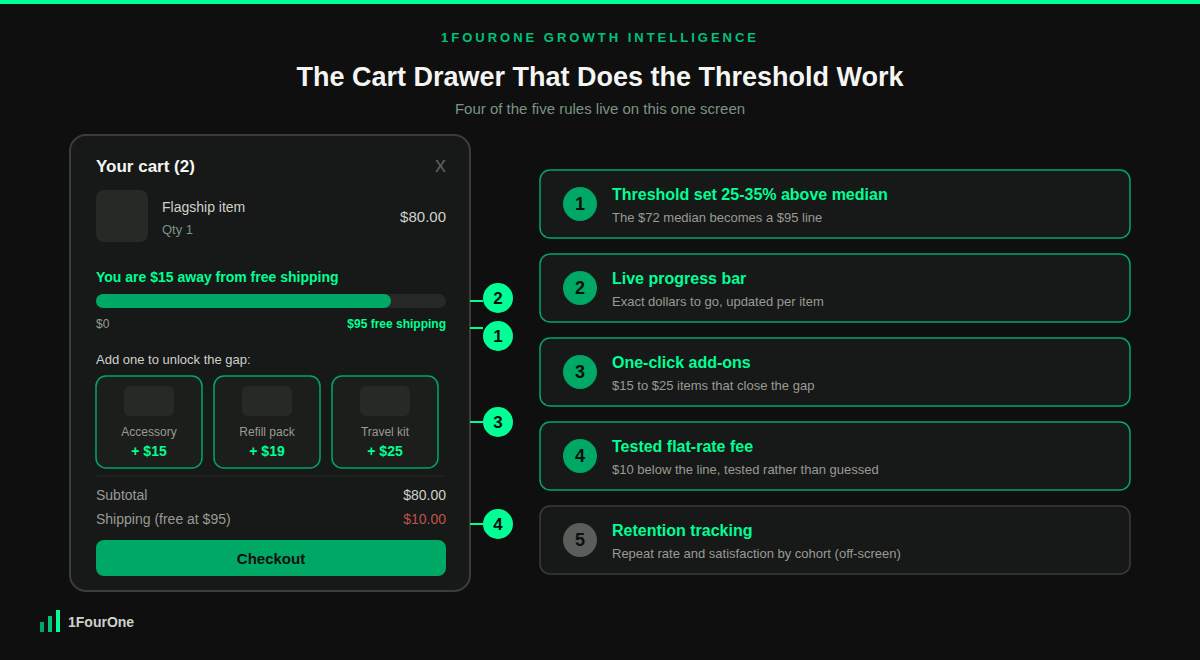
Calculate your true median cart value across recent transactions and position your free shipping threshold 25% to 35% higher. Integrate these threshold parameters with inventory rules from our operational guide on inventory allocation strategy rules. Setting qualification targets slightly above median basket size creates an achievable spend target that motivates buyers to add an additional item to qualify for free shipping.
Requiring shoppers to calculate their remaining spend requirement mentally to earn free shipping introduces checkout friction that causes abandoned carts. If a buyer does not know how many additional dollars are required to earn free delivery, they are unlikely to return to catalogue pages to browse for add-on products. Storefront design teams must provide visual clarity within the cart drawer.
Integrate dynamic progress bars inside cart drawers that display real-time visual progress and exact dollar amounts needed to earn free shipping. Syncing checkout displays with dynamic commercial pricing rules, as outlined in our strategic guide on ecommerce dynamic pricing strategy, maintains clear pricing communication. Visual progress bars guide shoppers smoothly toward qualification thresholds, building the repeat-purchase habits that raise customer lifetime value.
Displaying a shipping progress bar without providing immediate, relevant product recommendations to bridge the spend gap causes user frustration. If a shopper needs $15 to earn free shipping but the store features only $50 flagship items, the buyer cannot easily reach the threshold without doubling their cart spend, leading to cart abandonment. Merchandising teams must offer complementary impulse items near checkout.
Feature low-cost, high-margin accessories directly below the cart progress bar, allowing buyers to add items to their cart with a single click. As detailed in our strategic guide on competitor ad audit 5 rules, evaluating market positioning helps refine add-on choices. Offering relevant impulse items priced to match common spend gaps accelerates basket expansion and lifts the return on every dollar of paid customer acquisition spend.
Offering free shipping above a target threshold requires establishing clear shipping fee structures for orders that fall below the qualification mark. Setting flat-rate shipping fees too high causes cart abandonment, while setting fees too low encourages buyers to pay the small fee rather than adding items to hit the free shipping tier. Pricing teams must test flat-rate shipping price sensitivity.
Implement dynamic testing on flat-rate shipping fees for sub-threshold orders to identify the price point that maximises basket expansion while recovering freight overheads. As documented in our operational guide on how to reduce checkout abandonment tactics, balancing shipping incentives preserves checkout velocity. Calibrating flat-rate fees encourages buyers to hit the free shipping threshold while ensuring sub-threshold orders generate shipping revenue to offset carrier costs.
Evaluating shipping threshold performance based purely on initial average order value expansion ignores the long-term impact on repeat customer behaviour and cohort satisfaction. Setting qualification thresholds too high can create checkout friction for returning buyers who prefer placing quick, single-item orders. Operations teams must monitor repeat purchase rates alongside initial basket expansion metrics.
Track 90-day repeat order velocity and customer satisfaction scores across customer cohorts subject to different shipping qualification rules. Align post-purchase satisfaction tracking with international quality management guidelines in ISO 10004:2018. Incorporating process parameters from our framework on predictive churn audit rules ensures threshold adjustments protect long-term customer relationships and customer lifetime value.
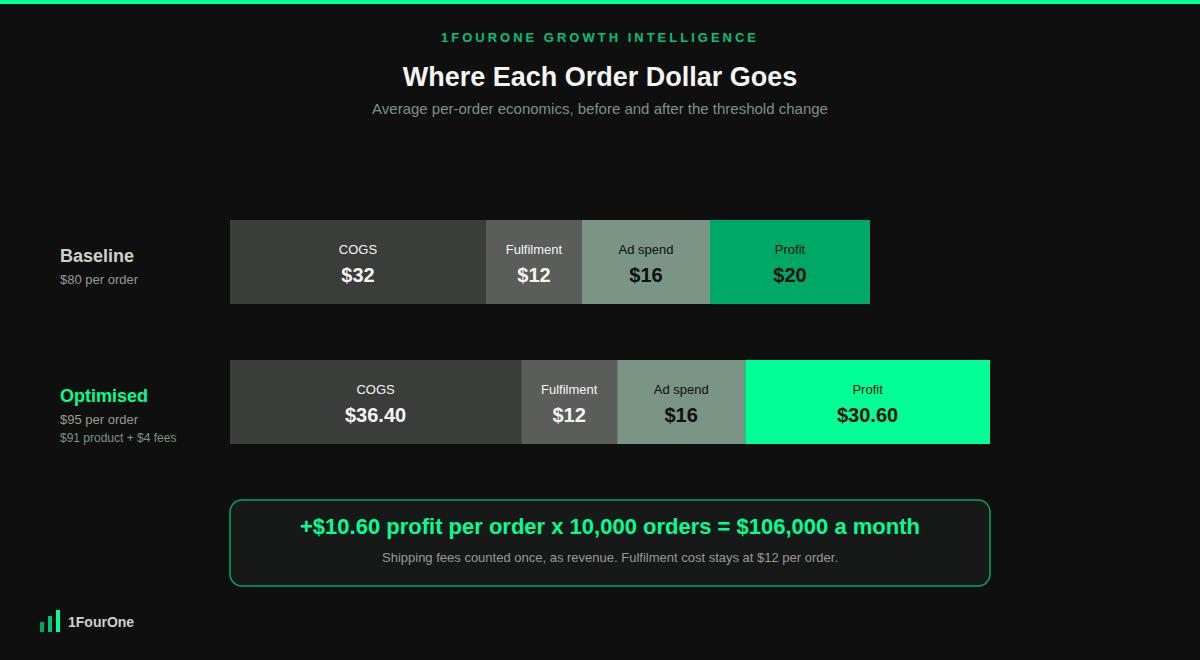
To evaluate the direct commercial return of a free shipping threshold optimisation sprint, let us examine an established digital retailer processing 10,000 orders per month at a baseline Average Order Value of $80 ($800,000 gross monthly revenue). Under the baseline operational setup, the store offers free shipping on all orders over $50, resulting in 85% of transactions (8,500 orders) qualifying for free shipping. Average variable freight and pick-pack cost is $12 per order ($120,000 total monthly fulfilment expense).
Product COGS averages 40% of order value ($32 per order, or $320,000 in total), and paid media ad spend totals $160,000 ($16 customer acquisition cost per order). Baseline net monthly contribution profit is $200,000 ($800,000 revenue minus $320,000 COGS minus $120,000 fulfilment minus $160,000 ad spend).
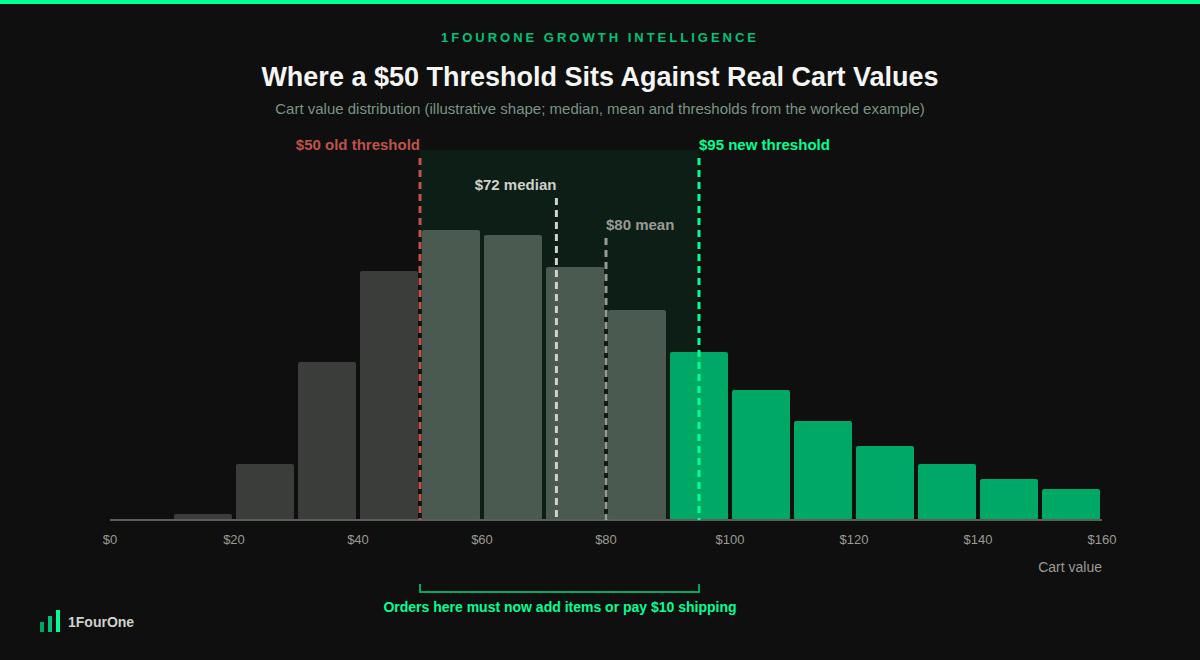
Reviewing cart analytics uncovers a major threshold misalignment leak: median order value sits at $72, well below the $80 mean AOV. The low $50 free shipping limit allows single-item buyers ($60 basket) to earn free delivery without expanding their carts. A $60 order earns $36 in gross profit at a 40% COGS rate, so after the business absorbs $12 in freight only $24 remains to cover a $16 acquisition cost.
The brand’s growth operations team executes a data-driven free shipping threshold optimisation program. They calculate the new threshold mathematically at $95 (the $72 median cart value plus roughly 30%, rounded to a clean price point), install a dynamic cart drawer progress bar displaying real-time spend requirements, and feature 1-click impulse accessories priced between $15 and $25 directly inside the cart drawer.
This threshold realignment alters checkout performance metrics significantly. 6,000 buyers expand their carts from $80 to $105 to reach the new $95 free shipping level ($630,000 gross revenue; COGS expands to $42 per order, or $252,000 in total). Meanwhile, 4,000 buyers opt to pay a flat $10 shipping fee on an average $70 basket ($280,000 product sales plus $40,000 collected shipping revenue = $320,000 total channel revenue; COGS is $28 per order, or $112,000 in total).
The financial return from this threshold optimisation is immediate and highly profitable. Average product basket value rises from $80 to $91, and total gross monthly revenue scales from $800,000 up to $950,000, made up of $910,000 in product sales ($630,000 + $280,000) and $40,000 in collected shipping fees. Combined product COGS totals $364,000 ($252,000 + $112,000), and carrier fulfilment expenses remain flat at $120,000 (10,000 orders × $12).
On flat $160,000 paid media spend, net monthly contribution profit expands from $200,000 up to $306,000 ($950,000 revenue minus $364,000 COGS minus $120,000 fulfilment minus $160,000 ad spend). That is a $106,000 monthly net profit reclamation ($1,272,000 annualised cash flow expansion) on a completely flat marketing acquisition budget.
Three assumptions sit beneath these figures. The example assumes 6,000 of 10,000 shoppers reach the new threshold, which depends on the add-on offers working, and it holds order volume flat even though shoppers now pay $10 on baskets that previously shipped free. It also ignores any shipping fees collected on the 1,500 baseline orders under $50. The result has a wide margin for error, since each fee-paying order contributes about $40 before ad spend, so the program would still break even if roughly 2,650 of those orders were lost.
Calculate the optimal free shipping threshold by determining the median cart value across recent transactions, then positioning the threshold 25% to 35% above that median figure. Ensure the required basket increase covers average order COGS and carrier fulfilment fees, leaving additional net contribution profit per order.
Increasing the free shipping threshold may cause a minor decrease in initial checkout conversion rate if introduced without cart drawer optimisation. However, pairing higher thresholds with visual progress bars and 1-click impulse add-on recommendations typically increases average order value sufficiently to generate higher overall net contribution profit per visitor session.
Mean average order value is calculated by dividing total revenue by total order count, a figure that can be skewed by rare high-value purchases. Median cart value represents the midpoint of all transactions, where half of all carts sit below and half sit above. Using median cart value provides an accurate baseline for setting achievable free shipping targets.
High-margin accessories, consumable replenishment items, travel-sized products, protective cases, and utility add-ons work best as cart drawer recommendations. Add-on items should carry retail price points that match typical spend gaps ($10 to $25) and require minimal purchasing consideration from buyers.
During peak promotional periods, shipping thresholds should be evaluated alongside promotional discounts to prevent margin erosion. If deep product discounts are offered, raising free shipping thresholds or requiring higher basket minimums ensures orders retain sufficient gross margin to cover carrier fulfilment expenses.
Allowing low, unhedged shipping thresholds to erode net contribution margins and subsidise small orders is an expensive operational failure that restricts retail profitability. At 1FourOne, we eliminate fulfilment margin leaks by deploying a disciplined free shipping threshold optimisation framework that expands order values and maximises net cash flow. Contact our growth operations team today to secure a data-driven checkout audit tailored for your business.
Get your competitive audit in 48 hours and see exactly where your revenue is leaking.
Get Your Audit →