A Transaction Record Tells You What They Bought. It Doesn’t Tell You Why.
Executing a structured first party data enrichment strategy is the most critical operational adjustment an established digital retailer can deploy to maintain precision audience targeting as browser privacy changes restrict third-party tracking signals. Many mid-market e-commerce brands collect basic transaction records, completely failing to capture the underlying consumer preferences, usage habits, and category affinities that drive long-term purchasing decisions. Relying on shallow transactional data limits your ability to segment customer cohorts effectively, driving up customer acquisition costs and degrading campaign returns. Transitioning to an active profile enrichment model enables growth teams to capture clean, zero-party consumer preferences, refine ad platform lookalike signals, and build highly personalised lifecycle marketing programs.
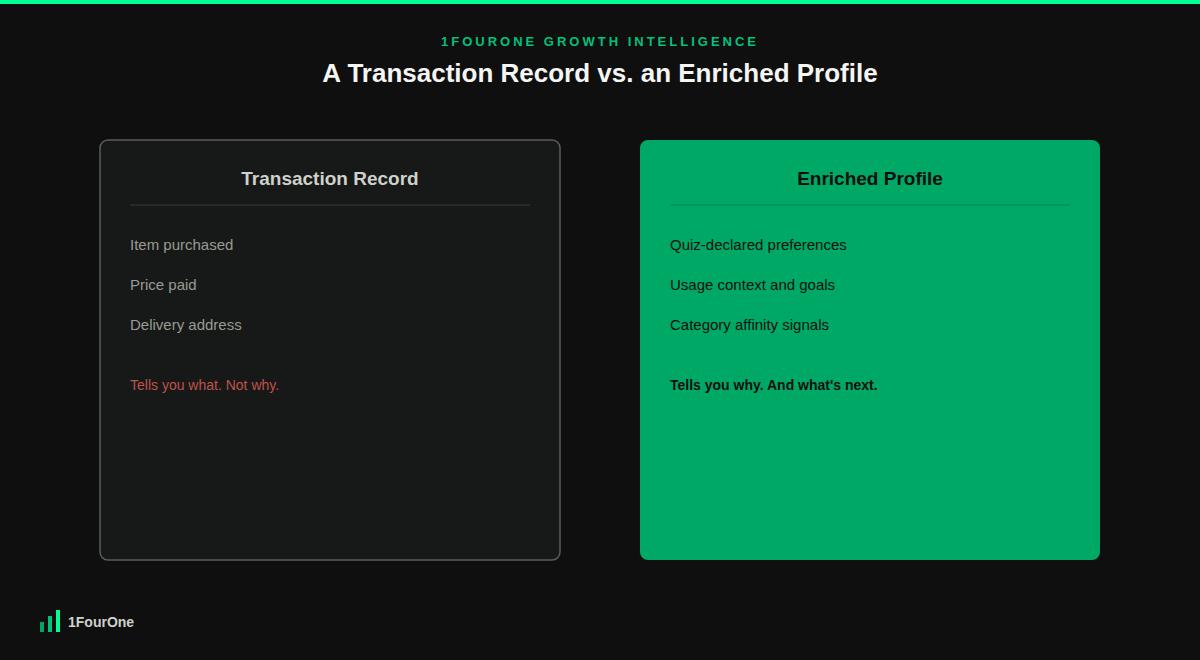
Modern e-commerce operations frequently suffer from poor audience targeting caused by an over-reliance on basic transaction logs. Standard order histories record what a customer bought, the price paid, and the delivery destination, but they reveal nothing about why the customer selected that specific product or what complementary items they intend to purchase next. Operating without granular consumer preference data forces marketing teams to deliver generic promotional campaigns that fail to resonate with distinct audience sub-segments.
Managing a digital store without active profile enrichment creates severe inefficiencies across paid customer acquisition channels. When advertising networks are fed basic, un-enriched conversion signals, their machine-learning bidding algorithms struggle to distinguish between one-off bargain hunters and high-value brand loyalists. This lack of signal depth leads to diluted lookalike audience models, forcing media buyers to spend higher amounts to find qualified buyers. Over time, this analytical blind spot compresses gross margins and increases acquisition friction.
To establish a defensible commercial advantage, e-commerce executives must actively collect explicit consumer preference signals throughout the customer journey. Gathering zero-party data points directly from shoppers during browsing and post-purchase interactions provides the context required to personalise commercial offers accurately. Shifting from passive order logging to proactive profile enrichment ensures that marketing campaigns deliver highly relevant product recommendations that maximise basket sizes and lifetime value.
Building a resilient e-commerce business requires far deeper analytical capability than top-line order volumes can supply. Incorporating profile enrichment metrics into your broader growth intelligence matrix enables commercial teams to map customer intent against long-term purchasing behaviour. By combining explicit preference inputs with historical order frequencies, analysts can construct predictive LTV models that identify high-value customer cohorts early in their lifecycle. This operational clarity prevents businesses from misallocating marketing resources to unprofitable customer groups.
Capturing enriched first-party signals directly also protects your marketing spend efficiency against external platform data loss. As web browsers restrict third-party tracking cookies and mobile operating systems restrict cross-app identification, owned consumer data profiles become your primary source of targeting intelligence. Uploading enriched, high-value customer audience lists to advertising networks improves event match quality scores, allowing bidding algorithms to locate ideal prospects efficiently.
Validating profile enrichment initiatives against established business research highlights their commercial impact. Published research by the Harvard Business Review confirms that increasing customer retention rates by 5% scales overall corporate profits by 25% to 95%. This empirical baseline shows why using enriched preference data to deliver timely, relevant repeat offers protects customer retention rates, generating the stable cash flow required to support sustainable business expansion.
| Enrichment Layer | Data Capture Mechanism | Operational Personalisation Goal |
|---|---|---|
| Pre-Purchase Intent | Interactive product finder quizzes and style surveys | Guiding cold traffic to ideal SKUs to boost checkout conversion. |
| Post-Purchase Context | Onboarding surveys and usage preference forms | Tailoring post-purchase communications to specific customer goals. |
| Behavioural Affinity | Server-side category browsing and search tracking | Triggering dynamic category recommendations based on active intent. |
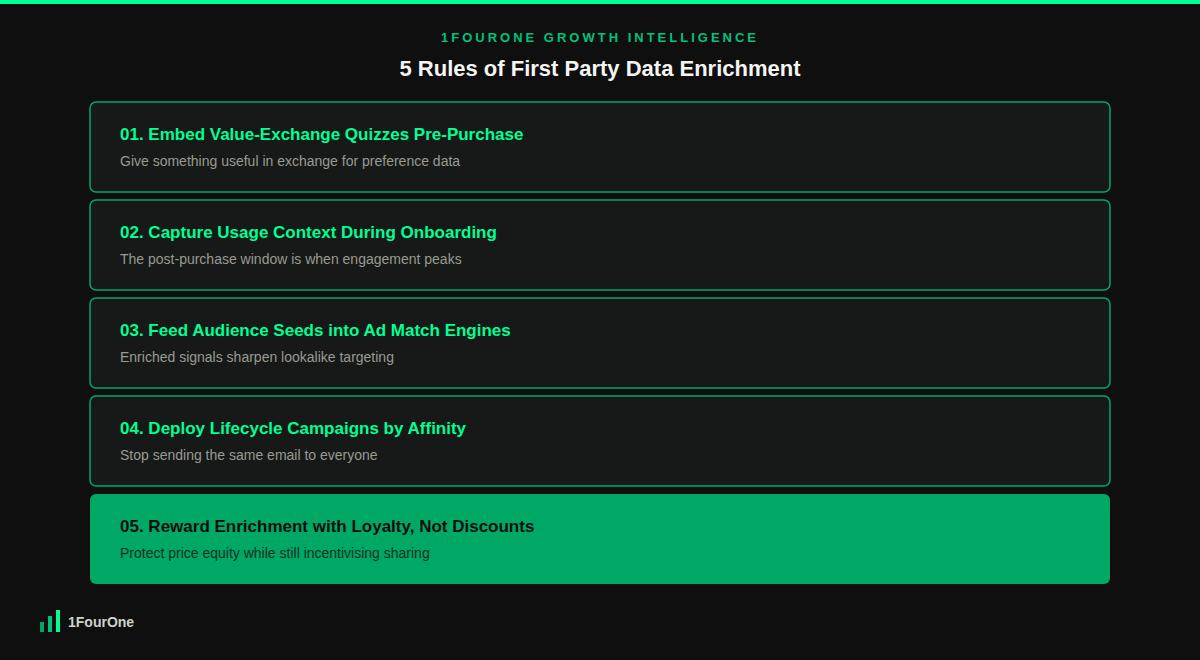
To systematically deepen customer profile intelligence and eliminate wasted media spend, your commercial team must institutionalise a structured first party data enrichment strategy across all customer touchpoints. This operational framework replaces static list building with active, value-exchange data collection. The following five rules provide a repeatable methodology to capture preference signals, improve ad platform targeting, and elevate customer lifetime value.
The most effective method for gathering granular consumer preference data from new visitors is offering interactive product finder quizzes during early site browsing. Expecting shoppers to fill out lengthy static registration forms without offering immediate value yields low completion rates and poor data quality. Designing interactive diagnostic tools provides visitors with tailored product recommendations while capturing critical preference signals for your database.
Structure your diagnostic quizzes to capture key purchasing parameters, such as specific product preferences, usage environments, or budget limits, within three to five simple steps. Integrate these interactive inputs directly with your customer relationship management platform and your broader ecommerce first party data strategy infrastructure. Capturing these explicit signals on first-time visitors ensures you can deliver highly relevant follow-up offers that increase checkout conversion rates.
The period immediately following an order confirmation represents a prime opportunity to collect contextual data about how a customer intends to use their purchased item. While shoppers are awaiting delivery, their brand engagement remains high, making them willing to complete brief post-purchase onboarding surveys. Asking targeted questions about their experience level or secondary preferences provides valuable insights for lifecycle marketing.
Deploy post-purchase surveys on order confirmation pages or within initial order tracking emails to capture usage context without adding checkout friction. As detailed in our operational guide on how to reduce checkout abandonment tactics, keeping the primary payment flow completely frictionless while positioning survey requests on post-checkout screens preserves conversion velocity. To keep this feedback loop genuinely useful rather than a box-ticking exercise, benchmark your survey design against the international guidelines in ISO 10004:2018. Using this post-checkout feedback allows your lifecycle team to tailor subsequent product guides to the buyer’s exact needs.
Collecting enriched customer data provides limited value if those signals remain isolated inside email marketing databases. To maximise paid customer acquisition efficiency and protect marketing spend efficiency across every campaign, your data team must structure enriched customer profiles into segmented audience seeds and sync them directly with advertising platform APIs. Feeding high-value, enriched audience lists to ad networks enhances their algorithmic targeting capabilities.
Segment your customer database by specific category affinity, lifetime value tiers, and product usage patterns, creating specialised audience seeds for ad platform syncs. As outlined in our strategic guide on competitor ad audit 5 rules, using high-quality internal audience signals protects your campaigns from ad auction inflation. Supplying ad networks with enriched audience data enables their machine-learning models to generate accurate lookalike audiences that convert at lower costs.
Sending uniform, non-segmented promotional emails to your entire customer database is an unoptimised practice that increases unsubscribe rates and degrades brand engagement. Once a customer profile is enriched with explicit category preferences, your lifecycle marketing tools must automatically filter promotional content based on those preference tags. Delivering highly targeted offers ensures that customers receive recommendations relevant to their specific interests.
Configure automated email and SMS workflows to dynamic content blocks that adjust based on saved profile attributes. Incorporate parameters from our framework on predictive churn audit rules to identify when high-value enriched cohorts show declining interaction frequency. Automated replenishment reminders and category-specific cross-sells delivered at optimal intervals drive higher repeat purchase rates while preserving subscriber trust.
Offering blanket discount codes in exchange for survey completion or profile enrichment is an unoptimised tactic that erodes product gross margins. Offering flat price concessions for basic information conditions customers to expect discounts, lowering brand price equity. Instead, structure profile enrichment incentives through a margin-backed loyalty program that rewards data sharing with non-cash value perks or loyalty points.
Design your loyalty architecture to award bonus points or exclusive access perks when customers complete secondary profile surveys, submit product reviews, or update their category preferences. Consult our operational guide on loyalty program design to structure non-discount incentives that encourage ongoing engagement while protecting net contribution margins. Rewarding profile enrichment through loyalty points deepens brand engagement without sacrificing unit economics.
To evaluate the direct commercial impact of a structured profile enrichment program, let us examine an established digital retailer spending $200,000 per month on paid social ads targeting broad, un-enriched audience pools. Under the baseline operational state, the brand achieves a $100 blended Customer Acquisition Cost (CAC), acquiring 2,000 new customers per month ($200,000 media spend divided by 2,000 buyers). On-site conversion rate is 2.0% across 100,000 monthly sessions ($2.00 Cost Per Session). Initial Average Order Value (AOV) is $120 with a 40% gross margin ($48 gross profit per order).
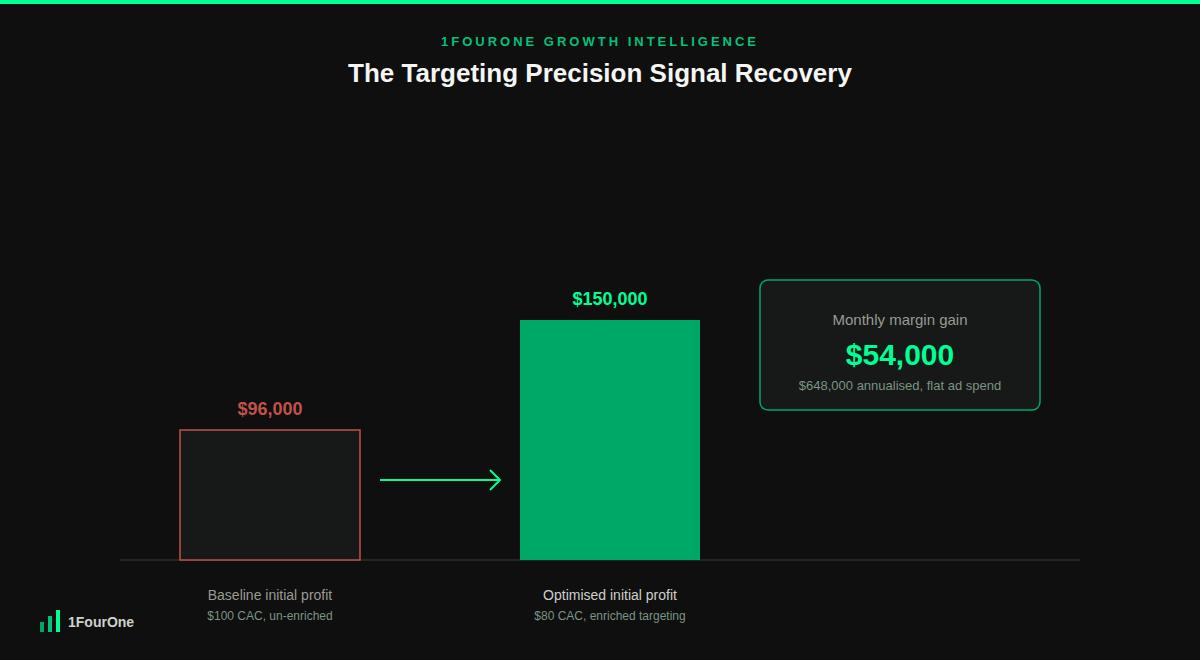
Reviewing initial order metrics reveals an unrecovered acquisition balance: initial gross profit generates $96,000 ($48 gross profit × 2,000 buyers), leaving $104,000 in unrecovered media spend ($200,000 total spend minus $96,000 initial profit). Because the business feeds basic, un-enriched conversion signals back to advertising ad platforms, the ad network struggle to optimise bid delivery toward high-intent prospects. This lack of signal depth keeps acquisition costs high and extends payback windows.
The brand’s growth operations team deploys a comprehensive first party data enrichment strategy to fix this targeting signal leak. They introduce interactive pre-purchase product finder quizzes on site, capture post-checkout usage preferences, and enrich 80% of active customer profiles with explicit category affinity tags. They feed these enriched high-value audience seeds directly into ad platform APIs to refine lookalike targeting algorithms, while using preference tags to deliver personalised bundle recommendations at checkout.
This operational alignment transforms overall campaign economics. High-intent enriched ad targeting increases on-site conversion rates from 2.0% to 2.5% on identical site traffic (2,500 new buyers generated across 100,000 sessions). Simultaneously, personalised product bundle recommendations raise initial Average Order Value from $120 to $150 ($60 gross profit per order at a 40% margin). Blended CAC plummets from $100 down to $80 ($200,000 spend divided by 2,500 buyers).
The financial return from this profile enrichment program is immediate and highly transformational. On the identical $200,000 monthly ad spend, initial gross profit scales from $96,000 up to $150,000 (2,500 buyers multiplied by $60 gross profit). The unrecovered initial acquisition spend contracts from $104,000 down to $50,000, recovering an additional $54,000 in immediate gross margin per month ($648,000 annualised margin expansion) on a completely flat marketing acquisition budget.
First-party data consists of behavioural signals and transactional records collected passively from customer interactions on your owned properties, such as order history, browsing paths, and email clicks. Zero-party data refers to explicit information that a customer intentionally and proactively shares with a brand, such as quiz responses, preference settings, and personal interests. Combining zero-party context with first-party purchase history is the practical foundation of any first party data enrichment strategy, since neither layer alone produces a genuinely complete customer profile.
Interactive diagnostic quizzes improve conversion rates by reducing choice overload and guiding cold visitors directly to the products that best match their specific needs. By answering a few simple diagnostic questions, shoppers receive curated product recommendations, reducing browsing friction and increasing purchase confidence. This guided shopping experience elevates both conversion rates and initial basket sizes.
Post-purchase surveys do not annoy recent buyers if they are placed on order confirmation screens or inside shipping tracking portals where they do not interrupt the checkout flow. When survey questions are framed around helping the customer get the best results from their purchase, response rates are typically high. Keeping surveys brief and providing instant value ensures a positive customer experience.
Enriched customer audience seeds should be synced with ad platform APIs automatically in real time or via daily batch uploads. Automated data syncing ensures that ad platform bidding algorithms always operate on current conversion signals, dynamic value tiers, and updated customer audience pools. Real-time syncing prevents ad spend from being directed to recently converted buyers while accelerating lookalike optimization.
Ensure compliance by obtaining clear, explicit consent during data collection, maintaining transparent privacy notices, and allowing customers to manage or delete their stored preference data easily. Store enriched profile data securely within encrypted first-party database systems, and ensure that data shared with third-party advertising networks is cryptographically hashed. Following recognised privacy frameworks protects your brand from regulatory penalties.
Allowing shallow transaction data to restrict your audience targeting is an expensive operational oversight that degrades media efficiency. At 1FourOne, we eliminate growth bottlenecks by deploying structured profile enrichment frameworks that refine ad targeting and maximise customer lifetime value. Contact our growth operations team today to secure a data-driven customer data audit tailored for your business.
Get your competitive audit in 48 hours and see exactly where your revenue is leaking.
Get Your Audit →