A Browser Pixel Only Fires If the Browser Lets It. A Server Doesn’t Ask Permission.

Building a resilient first party customer data architecture is the single most critical engineering task an e-commerce enterprise must execute to defend its data integrity as client-side tracking mechanism degradation undermines digital analytics software. Many retail brand operators rely on third-party marketing scripts running inside consumer browsers, completely failing to build an owned, server-side data pipeline. Allowing external browser filters to intercept transactional signals creates severe data drops, causing advertising platform bidding engines to miscalculate channel performance and inflate acquisition costs. Transitioning to a server-side data collection framework ensures growth teams capture complete transaction signals, protect media spend efficiency, and establish a reliable data foundation for long-term customer scaling.
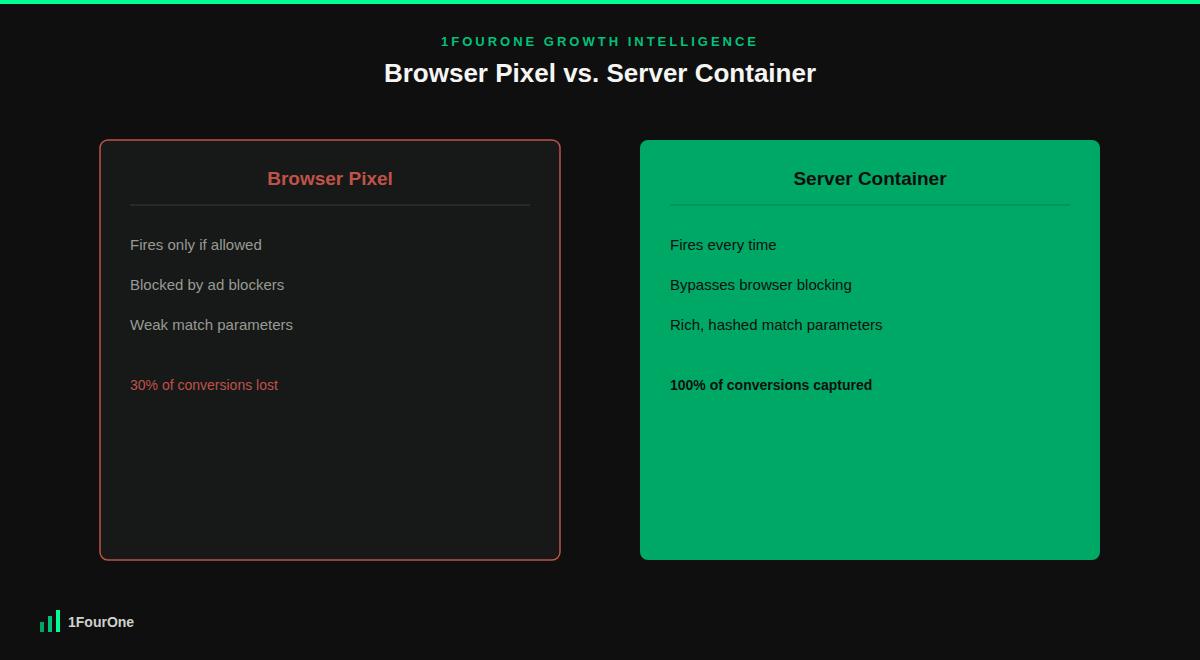
E-commerce operations frequently suffer from invisible revenue leaks caused by an over-reliance on browser-based analytics pixels. Traditional ad scripts rely entirely on a user’s web browser to process conversion code and transmit purchase events to external advertising networks. When ad-blocking extensions, browser privacy updates, or network connection timeouts suppress these client-side scripts, completed purchase events fail to register on ad platform dashboards. This tracking gap severely degrades reporting accuracy across all paid marketing channels.
Operating a digital storefront with degraded data streams introduces severe financial risk to your weekly marketing spend decisions. When advertising platform bidding algorithms receive incomplete conversion signals, their machine-learning models struggle to identify high-intent buyer groups. The ad platform responds by bidding blindly across broader, less qualified audience pools, driving up customer acquisition costs. Over time, this client-side data loss compresses net operating margins and restricts liquid working capital.
To establish an accurate commercial reporting pipeline, e-commerce engineering teams must move data collection away from consumer web browsers. Processing event data on an independent cloud server allows brands to capture purchase signals directly from backend store databases. Shifting to an owned server-side tracking architecture restores conversion visibility, stabilises ad platform bidding algorithms, and protects marketing spend efficiency across every acquisition channel.
Building a defensible digital retail model requires far deeper data governance than basic front-end tag management can provide. Incorporating server-side data collection into your broader growth intelligence framework enables commercial teams to maintain an accurate, unvarnished record of every customer interaction. By routing raw order events through a secure cloud container before distributing hashed signals to external partners, engineers can ensure total data completeness. This structural reliability prevents businesses from making strategic decisions based on skewed reporting dashboards.
Operating an owned data infrastructure also protects your paid customer acquisition programs against ongoing privacy policy shifts. As web browsers eliminate third-party tracking cookies and mobile operating systems restrict cross-app identification, first-party data captured directly at the server level becomes your primary source of competitive advantage. Supplying advertising networks with rich, server-validated event payloads increases match quality scores, allowing ad platform algorithms to optimise campaign delivery accurately and protect every paid customer acquisition dollar spent.
Validating server-side data initiatives against established empirical business research underscores their long-term value. Published research by the Harvard Business Review confirms that increasing customer retention rates by 5% scales overall corporate profits by 25% to 95%. This empirical baseline shows why capturing accurate, uncorrupted customer data to build reliable post-purchase retention workflows protects customer lifetime value, generating the stable cash flow required to support sustainable business growth.
| Data Pipeline Layer | Primary Technical Function | Operational Efficiency Goal |
|---|---|---|
| Server-Side Event Capture | Capturing purchase events directly from database webhooks | Eliminating 15% to 30% conversion signal drops caused by browser ad blockers. |
| First-Party Identity Resolution | Stamping transactions with persistent customer identifiers | Unifying cross-device sessions into a single customer profile. |
| API Payload Enrichment | Bundling hashed PII, IP strings, and match parameters | Maximising ad platform match quality scores to lower acquisition costs. |
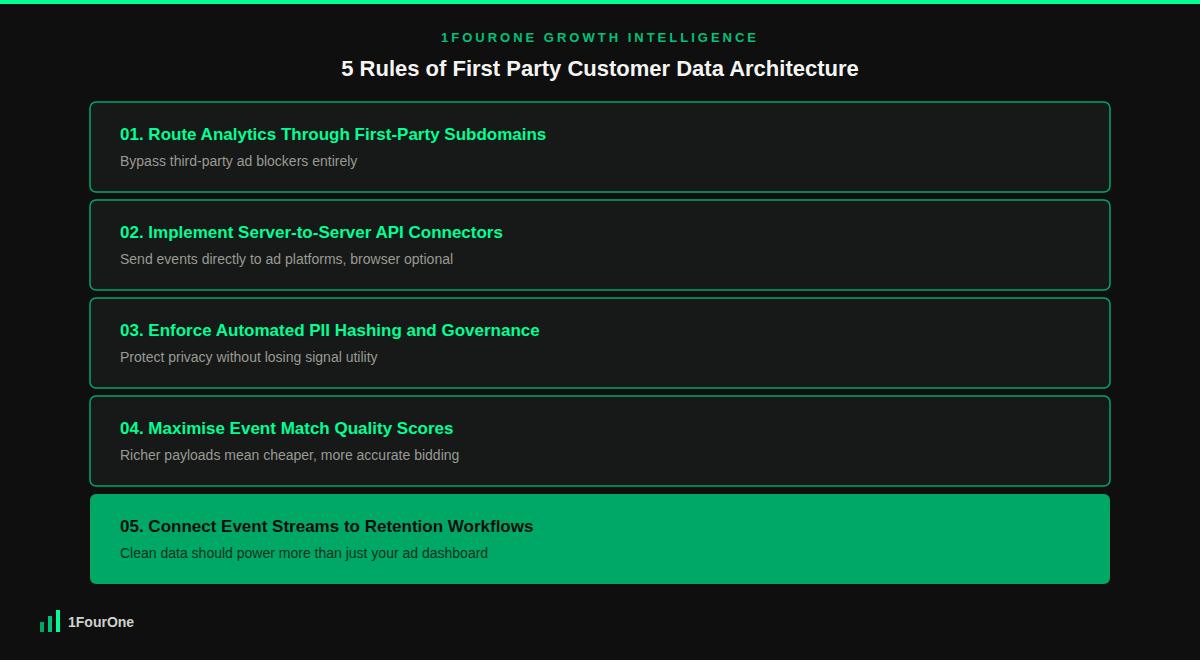
To systematically eliminate tracking signal loss and protect your operating margins, your engineering team must institutionalise this discipline across all digital sales properties. This operational framework replaces browser pixels with a resilient server-to-server data pipeline. The following five rules provide a repeatable methodology to capture clean transaction signals, improve ad platform match rates, and elevate customer lifetime value.
The primary reason client-side tracking scripts fail is that web browsers easily identify and block network requests sent to known third-party ad network domains. To prevent automated script blocking, your server-side tracking container must execute under a verified first-party subdomain that matches your primary retail store domain. Configuring a first-party subdomain ensures web browsers treat tracking data as internal site communications.
Configure your cloud tracking container under a dedicated subdomain and update DNS records accordingly. Integrate this first-party routing setup with your broader ecommerce first party data strategy pipeline. Routing data through a first-party subdomain prevents browser privacy filters from intercepting event payloads, ensuring that 100% of conversion signals reach your analytics database cleanly.
Relying exclusively on browser-based pixels to send conversion data to ad platforms leaves your marketing campaigns vulnerable to client-side data loss. To ensure complete signal delivery, your engineering team must implement direct server-to-server API connections between your cloud tracking container and advertising platform conversion APIs. This is the technical core of any first party customer data architecture, and server-side API connectors transmit transaction events directly from your server to partner networks, bypassing browser filters entirely.
Deploy server-side API integrations alongside existing browser tags, enforcing strict event deduplication rules using unique, randomised event IDs. As detailed in our technical guide on server side tracking framework rules, deduplicating joint browser and server events prevents reporting distortions. Combining browser and server data paths ensures optimal signal recovery while maintaining maximum match capability across advertising networks.
Transmitting raw customer information across public networks exposes your business to severe data privacy liabilities and regulatory non-compliance penalties. Before customer data leaves your server container to feed external advertising APIs, your data pipeline must execute automated data governance and security protocols. Hashing sensitive customer identifiers ensures privacy compliance while preserving signal utility for ad platform matching engines.
Configure your server container scripts to automatically scrub, normalise, and cryptographically hash customer email addresses, phone numbers, and location details using industry-standard hashing algorithms. To ensure this governance process meets a recognised quality benchmark rather than an internal guess, align your data handling controls with the international guidelines in ISO 10004:2018. As detailed in our operational guide on how to reduce checkout abandonment tactics, protecting customer data privacy builds long-term brand trust. Executing automated data cleansing at the server level ensures full privacy compliance while delivering the enriched data payloads required by ad bidding algorithms, all of which ultimately protects marketing spend efficiency by keeping campaigns funded by clean signals rather than guesswork.
Digital advertising platforms rely heavily on Event Match Quality metrics to link conversion events back to specific user profiles within their networks. When match quality scores drop due to missing customer parameters, ad platform machine-learning models struggle to optimise ad delivery, causing customer acquisition costs to increase. Your server pipeline must transmit rich, cryptographically secure matching parameter sets with every transaction payload.
Ensure your server API payloads include hashed email strings, phone numbers, IP addresses, browser user-agent details, and click identifiers whenever available. As outlined in our strategic guide on competitor ad audit 5 rules, supplying ad platforms with superior data signals protects your campaigns from ad auction inflation. High match quality scores enable ad bidding algorithms to locate qualified prospects efficiently, lowering overall customer acquisition costs.
Capturing clean server-side conversion signals should benefit your entire commercial operation, not just your front-end advertising dashboards. The real-time transaction event streams processed by your server container must feed directly into your customer relationship management systems and email marketing tools. Real-time data synchronisation enables immediate post-purchase onboarding and automated lifecycle triggers.
Configure your server container to stream validated order events directly into your post-purchase marketing tools. Incorporate process parameters from our framework on predictive churn audit rules to trigger automated re-engagement workflows when customer order intervals exceed normal boundaries. Real-time event streaming ensures your retention campaigns execute without delay, protecting customer lifetime value across every cohort.
To evaluate the direct commercial return of a first party customer data architecture sprint, let us examine an established digital retailer spending $250,000 per month on paid advertising campaigns. Under the baseline operational state, the brand relies on traditional browser pixels, which drop 30% of conversion events due to ad blockers, browser privacy settings, and network timeouts. Out of 2,500 actual backend sales ($100 AOV), browser pixels record only 1,750 sales on ad platform dashboards, displaying a distorted $142.86 CPA ($250,000 / 1,750) against a real baseline CPA of $100.00 ($250,000 / 2,500).
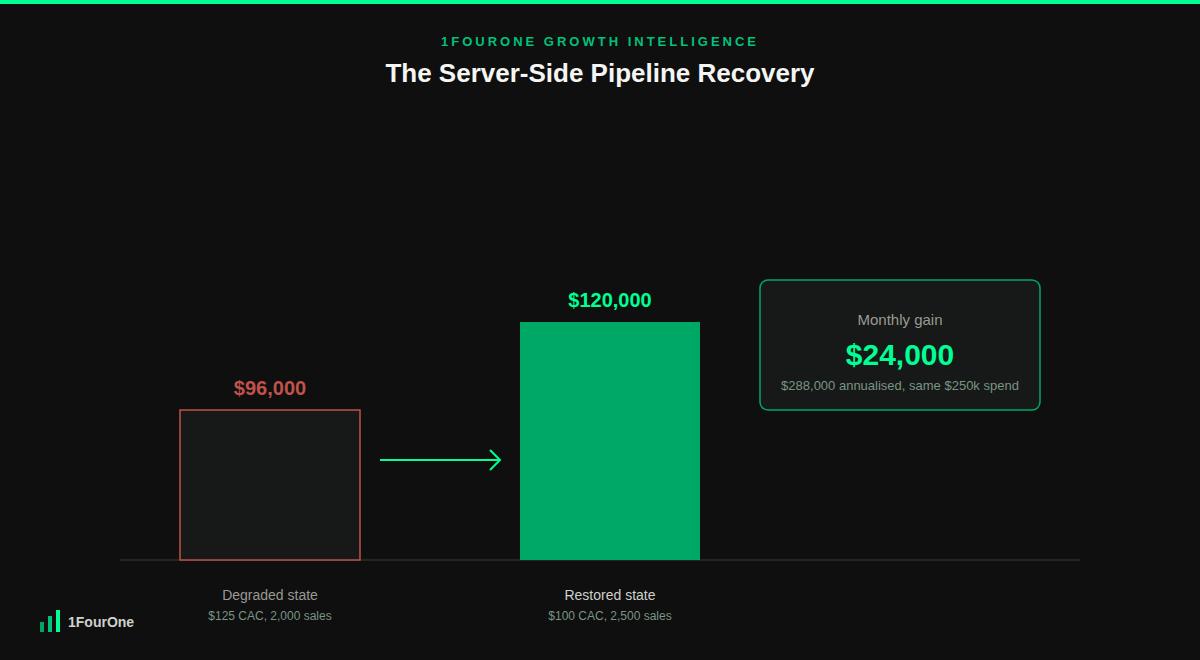
Because ad platform bidding engines receive incomplete conversion signals, their machine-learning models struggle to target high-intent buyers efficiently. Over time, this distorted optimization degrades actual campaign performance, driving real backend acquisition costs up from $100.00 to $125.00 per buyer. On the fixed $250,000 monthly ad budget, total completed sales contract from 2,500 down to 2,000 orders ($250,000 / $125.00). At a 40% gross margin ($48 gross profit per $120 order), initial gross profit drops to $96,000 (2,000 sales multiplied by $48), eroding monthly net operating income.
The brand’s growth engineering team deploys a custom first party customer data architecture to fix this tracking signal leak. They configure a first-party tracking subdomain, implement direct server-to-server API connectors to primary ad networks, enforce automated PII hashing, and stream rich match parameter sets with every transaction payload. This server-side infrastructure bypasses browser script blocking entirely, capturing and transmitting 100% of validated backend sales (2,500 orders) to ad platform APIs in real time.
This technical deployment completely restores targeting efficiency across all paid ad accounts. Supplied with complete conversion signals and high Event Match Quality scores, ad platform bidding engines recalibrate their machine-learning models, returning actual backend acquisition costs from $125.00 back to the efficient $100.00 baseline. On the identical $250,000 monthly ad spend, total completed sales scale from 2,000 back up to 2,500 orders ($250,000 / $100.00).
The financial return from this data infrastructure sprint is immediate and highly transformational for corporate cash flow. Initial gross profit expands from $96,000 up to $120,000 (2,500 sales multiplied by $48 gross profit), securing an immediate $24,000 monthly gross margin recovery ($288,000 annualised profit expansion) on a completely flat $250,000 marketing budget. This capital recovery provides substantial liquid cash flow to fund ongoing business expansion securely.
Client-side tracking executes JavaScript code directly inside a user’s web browser, sending event data from the browser to third-party ad networks. This approach is highly vulnerable to ad blockers, browser privacy settings, and script timeouts. A first party customer data architecture instead captures interaction data on your own cloud server directly from backend database webhooks, processing and transmitting hashed data payloads directly to partner APIs, bypassing browser-side script blocking entirely.
Server-side tracking improves Event Match Quality scores because servers capture and store reliable customer data, such as authenticated account emails, phone numbers, and persistent session tokens, that client-side scripts often miss. Transmitting these enriched, cryptographically hashed customer parameter sets alongside transaction payloads allows ad platform matching algorithms to match conversion events to user accounts accurately.
Implementing server-side tracking requires provisioning cloud container instances, which adds minor hosting infrastructure fees to your balance sheet. For mid-market e-commerce operations, cloud container hosting costs typically range between $50 and $200 per month, depending on monthly traffic volume and server request frequency. This minor hosting expense is comfortably offset by the substantial margin gains secured through improved media spend efficiency.
Server-side tracking architectures handle privacy consent by passing front-end user consent choices directly to the cloud container within the server payload. If a user opts out of tracking on your storefront consent banner, the server container automatically strips marketing identifiers before routing data to advertising APIs. This server-side governance ensures full compliance with privacy laws while maximising data capture for consenting cohorts.
Deploying a first party customer data architecture does not require rewriting your entire front-end data layer. Modern server tracking setups can ingest standard ecommerce data layer events from your existing storefront or collect order webhooks directly from backend platforms. The cloud container transforms, cleanses, and routes these incoming data streams to external APIs, simplifying technical implementation.
Allowing client-side tracking drops to distort your ad platform targeting is an expensive operational failure that degrades retail profitability. At 1FourOne, we eliminate digital tracking leaks by deploying custom first party customer data architecture solutions that protect conversion signals and maximise media cash flow. Contact our growth engineering team today to secure a data-driven technical audit tailored for your business.
Get your competitive audit in 48 hours and see exactly where your revenue is leaking.
Get Your Audit →