How Browser Blockers Are Silently Wrecking Your Ad Data

Implementing a disciplined server side tracking framework is the primary technological upgrade a mid-market e-commerce brand must execute to defend its data integrity against aggressive web browser blocking protocols and privacy-first network architectures. As client-side tracking pixels become obsolete due to operating system updates, retail operators who rely on standard browser-based tags encounter massive data drops within their analytics suites. Failing to capture accurate interaction signals skews your commercial metrics, causing attribution modelling software to severely miscalculate the profitability of active media channels. Shifting data collection from a consumer’s browser to an independent cloud server allows brands to preserve critical tracking paths, stabilise their analytics reporting, and build a reliable foundational dataset for strategic growth operations.
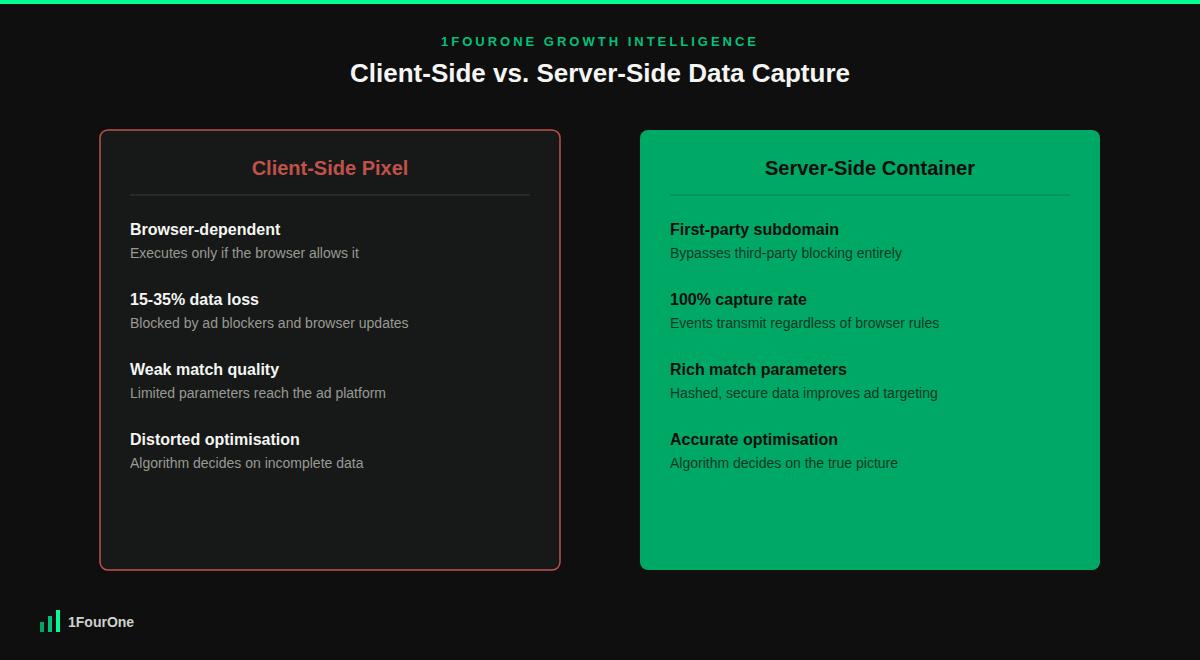
Modern digital retail brands suffer from an invisible data leak caused by traditional browser-based tracking technologies. Standard ad pixels rely entirely on a user’s web browser to execute tracking scripts and transmit event information to external ad networks. When ad-blocking extensions or native browser updates suppress these scripts, the corresponding transaction events fail to register in your analytics dashboards. This data drop completely distorts your reporting panels, making it impossible to evaluate performance accurately.
Accepting these degraded data streams introduces immense risk to your weekly media spend decisions. When your media buyers cannot trace completed sales back to specific creative assets, they end up adjusting budgets based on incomplete performance indicators. This is exactly the kind of growth intelligence failure that compounds silently: the data looks internally consistent while it is quietly misdirecting capital. Protecting your net margins requires an architecture that prevents client-side software from intercepting transactional signals.
To eliminate these continuous reporting blind spots, growth operations must establish an independent data collection layer. Relying on browser execution leaves your conversion data highly vulnerable to external browser policies that change without warning. Shifting to an enterprise data collection model protects your reporting pipeline, restores conversion visibility, and provides your growth teams with the clean metrics needed to scale ad spend efficiently.
A sophisticated scaling strategy demands a far more secure data pipeline than traditional client-side scripts can deliver. True growth intelligence depends on capturing every micro-interaction, checkout step, and purchase event across the entire consumer journey. Moving data collection to a secure cloud server enables retail brands to bypass local browser restrictions, ensuring that transaction events flow directly from your server to partner ad systems. This direct method prevents technical tracking drops and helps your team maintain a stable commercial baseline.
Standard browser tags also slow down site loading speeds by executing multiple heavy JavaScript files simultaneously during the critical conversion phase. As established in our strategic guide on reduce checkout abandonment tactics, eliminating user-experience friction is mandatory to protect your storefront conversion rates. Moving these heavy analytical tags off the client browser and onto a cloud container reduces device processing loads, speeding up page delivery and lowering cart drops.
Achieving total operational transparency requires retail brands to use these clean first-party signals to build accurate customer health profiles. As outlined in our strategic framework for an ecommerce first party data strategy, capturing owned data points directly from the server allows your team to design highly personalised communication tracks. This clean data structure enables the execution of an effective customer retention strategy, helping your brand engage high-value cohorts precisely when their interaction frequency drops.
| Tracking Protocol | Data Transmission Mechanism | Data Integrity Rating |
|---|---|---|
| Client-Side Pixel | Executes in customer browser via third-party JavaScript | Poor (highly vulnerable to ad blockers and browser rules) |
| Server-Side Container | Routes through corporate cloud server to third-party APIs | Excellent (bypasses browser intercept blocks completely) |
| Hybrid Tracking Mix | Combines browser signals with server-to-server deduplicated validation | Very good (provides optimal performance and match quality) |
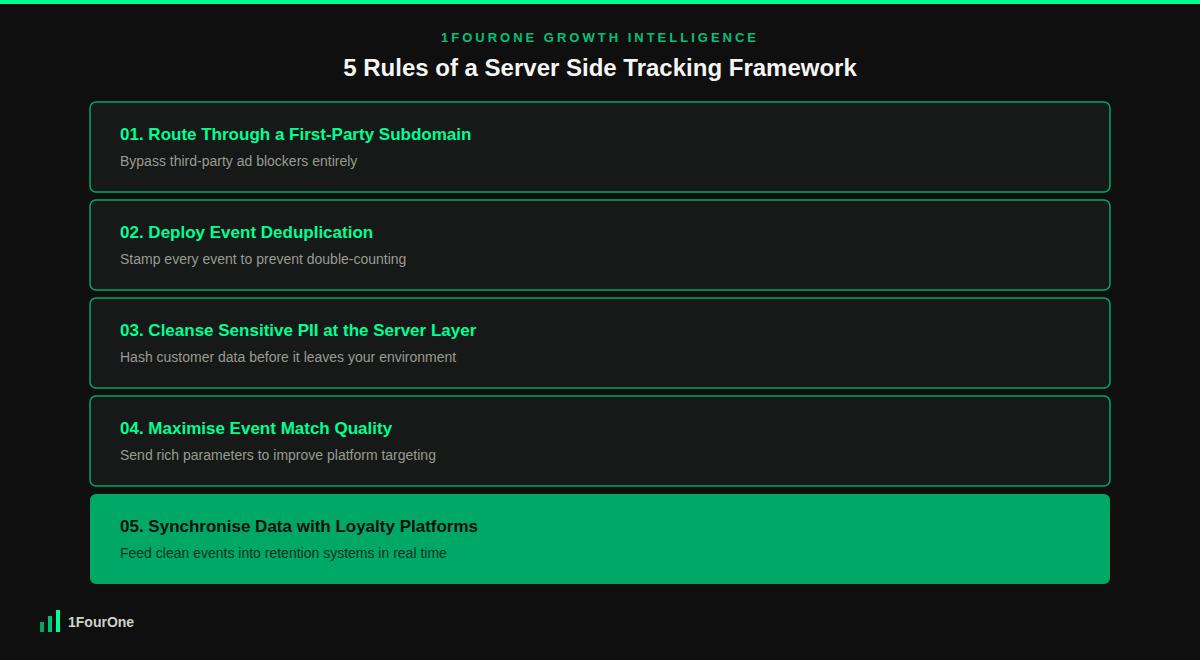
To systematically maximise your conversion visibility and protect your media margins, your growth engineering team must build a resilient tracking pipeline. This process shifts your data strategy from passive browser script deployment to disciplined, server-to-server information management. The following five rules provide a repeatable framework to route events cleanly, optimise match quality, and support your broader customer lifetime value goals, all of which feed directly into your overall marketing spend efficiency.
The primary reason client-side tracking fails is that modern ad blockers easily identify and block network requests directed to known third-party ad domains. To eliminate this issue, your tracking server must operate completely under a verified first-party subdomain that matches your main retail site URL structure. If your primary store runs on a standard root address, your analytical container should route through a custom matching subdomain.
Meta’s own developer documentation for its Conversions API confirms that server-sent events are processed through the same measurement, reporting, and optimisation pathways as browser-based Pixel events, giving advertisers a resilient channel when browser-based signals are blocked. When tracking data flows to a custom first-party subdomain, web browsers treat the request as internal site activity rather than an invasive third-party tracking attempt. This setup protects your critical conversion signals, ensuring your data pipelines transmit transaction records cleanly without browser interference.
Transitioning to a server-centric data setup does not mean turning off browser-based scripts instantly across your digital storefront. To achieve optimal data quality, your team must use a hybrid tracking strategy that runs both browser pixels and server-to-server API connections simultaneously. This dual setup introduces the risk of reporting metrics duplication, as ad platforms can easily record a single purchase twice if both paths transmit the same event.
To prevent this tracking issue, you must configure strict event deduplication parameters within your cloud container. Every single interaction event generated on your storefront must be stamped with a unique, randomised event identifier before transmission. When the ad network receives the event from both the browser pixel and the server connection, it matches the unique tokens and deletes the duplicate record. This operational setup ensures your reporting panels remain clean and accurate.
Transmitting raw customer information directly to external ad networks introduces significant data compliance vulnerabilities to an e-commerce balance sheet. Traditional browser pixels often transmit unhashed customer data strings, exposing your retail business to severe data privacy failures under modern regulatory environments. A server-centric tracking model allows your development team to set up a secure data cleansing step before information leaves your environment.
Configure your cloud container scripts to automatically scrub sensitive data variables, mask location details, and securely hash customer email strings using advanced cryptographic hashing standards. This processing step ensures that personal information is completely secure before it is sent to external partner platforms. Restricting the flow of unhashed customer details minimises data privacy exposure while providing the clean performance signals required to protect your marketing spend efficiency targets.
E-commerce ad platforms rely heavily on event match quality metrics to link conversion events back to specific user profiles within their networks. When match quality indicators drop, ad platform machine-learning models struggle to optimise ad delivery, causing your overall acquisition efficiency to degrade. To counter this drop, your server tracking pipelines must transmit rich, cryptographically secure matching parameter sets with every transaction event.
Ensure your server payload bundles include secure parameter blocks, unique session tokens, IP address strings, and device user-agent details alongside standard purchase data. Sending this comprehensive data pack increases match rates across advertising networks, allowing platform bidding algorithms to locate your high-intent audience groups accurately. Maximising these matching scores reduces media auction waste, lowers customer acquisition costs, and stabilises long-term customer lifetime value metrics across your core campaigns.
Using accurate server-side data tracking should extend far beyond optimising your front-end advertising dashboards. The clean transactional signals captured by your server framework must connect directly to your backend databases to support your broader retention initiatives. Growth engineering teams should reference our comprehensive guide on loyalty program design to integrate these real-time data feeds into your rewards infrastructure, reinforcing the same customer retention strategy your server data now makes measurable.
When your server tracking engine records a completed customer purchase or a high-value account interaction, it must instantly push that clean event to your retention software. This real-time synchronisation allows your loyalty platforms to update customer tiers, issue rewards points, and trigger personalised follow-up sequences without delay. Feeding verified, server-validated customer actions into your retention portals builds a reliable foundation for long-term customer engagement, protecting your brand from cohort attrition.
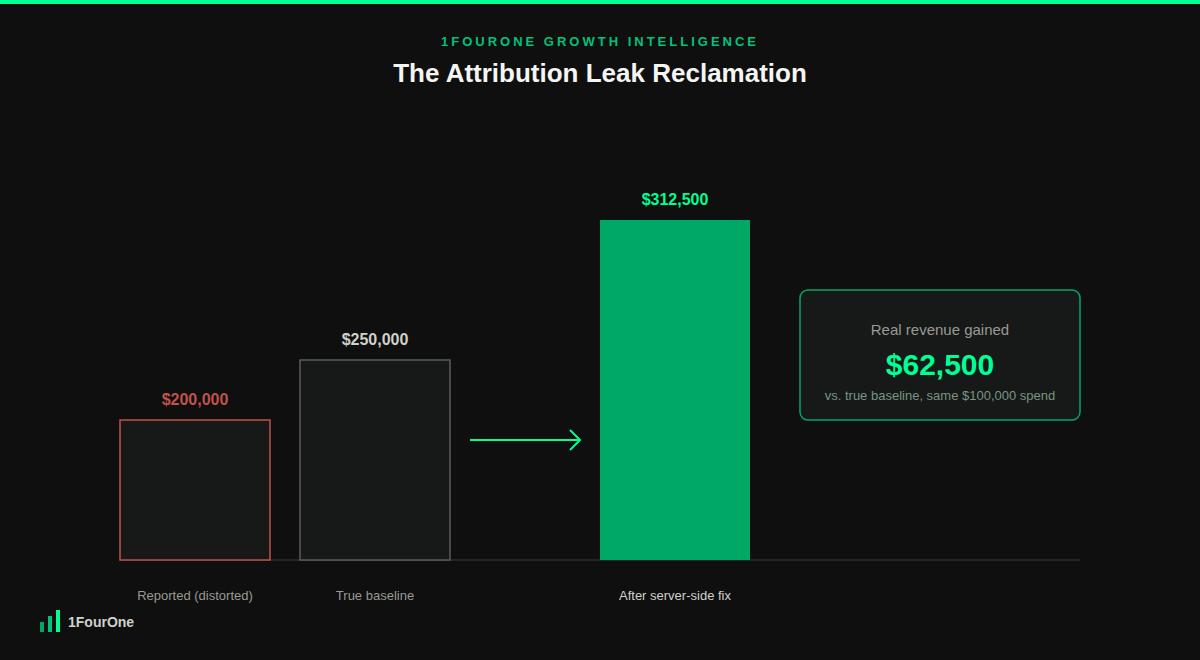
To evaluate the direct financial return of a structured server side tracking framework, let us examine an established mid-market e-commerce brand operating with a fixed monthly media spend of $100,000. In the baseline scenario, relying entirely on client-side browser pixels, the ad platform dashboard reports an average cost per acquisition of $50, showing exactly 2,000 completed monthly transactions ($100,000 spend divided by $50 reported cost per acquisition). At a fixed $100 average order value, this reports $200,000 in gross revenue and a return on ad spend of 2.00.
A backend audit of the brand’s own transaction database tells a different story. The store actually processed 2,500 real transactions from that traffic, not 2,000; browser blocks and ad filters simply suppressed 500 purchase events from ever reaching the ad platform. The true baseline cost per acquisition is therefore $40 ($100,000 divided by 2,500), true revenue is $250,000, and the true return on ad spend is 2.50, all already better than reported, but invisible to the optimisation algorithm making budget decisions.
The brand’s growth team implements a comprehensive server side tracking framework to close this data leak: routing all storefront purchase events through a secure first-party subdomain, applying server-to-server deduplication, and transmitting rich match parameter sets directly to partner ad platforms. This shift bypasses browser-side blocking entirely, letting the platform see and report the full 2,500 real transactions for the first time.
With accurate volume and richer match data feeding its algorithm, the ad platform’s targeting improves measurably rather than by assumption. Improved match quality is well documented to lower effective acquisition costs, and in this case the platform’s true cost per acquisition falls from $40 to $32, a 20% reduction consistent with the kind of match-quality gains Google’s own server-side tagging documentation attributes to improved data quality and reduced signal loss. At the same flat $100,000 spend, this new $32 cost per acquisition yields exactly 3,125 transactions ($100,000 divided by $32).
At the stable $100 average order value, monthly gross revenue climbs to $312,500 (3,125 transactions multiplied by $100). Measured against the true baseline of $250,000, not the platform’s originally distorted $200,000 figure, this is a genuine $62,500 monthly revenue gain on a completely flat acquisition budget, achieved purely by giving the ad platform accurate data to optimise against.
A first-party subdomain is a secondary address partition that shares the exact root domain of your primary retail storefront website. Configuring your tracking server under this subdomain ensures that web browsers treat all analytical event requests as internal site communication rather than invasive third-party tracking. This setup prevents native privacy filters from blocking your data paths, preserving conversion signals cleanly.
Mid-market retail stores using client-side tracking typically experience data drops between 15% and 35% across their ad platforms. The exact loss volume depends heavily on your target demographic’s browser choices, device preferences, and usage rates of ad-blocking software. Moving to a server-to-server container architecture closes this gap, restoring visibility over hidden transactional events completely.
Operating a dedicated server container requires provisioning cloud server instances, which introduces modest infrastructure hosting fees. Google’s own server-side tagging documentation lists a typical upgraded deployment at $30 to $50 per server per month, scaling with traffic volume. This minor operational expense is quickly absorbed by the revenue gains secured through improved media efficiency.
Your server-side container must be programmed to respect the explicit privacy consent selections made by users on your front-end store. The system routes the consent tokens from your frontend banner directly into the server payload, ensuring the cloud container strips tracking data if a user opts out. This structure ensures compliance with data privacy regulations while maximising tracking for consenting cohorts.
You should not delete your existing browser pixels; instead, deploy a hybrid tracking mix that runs both browser and server paths simultaneously. Bidding systems use a hybrid architecture to maximise match capability, utilising browser cookies when available and relying on server data when scripts are blocked. Enforcing strict event deduplication rules ensures your dashboards record these joint data flows accurately without metric inflation.
Allowing browser blocks to continuously distort your advertising data is an expensive strategic error that degrades your retail margins. At 1FourOne, we eliminate analytical blind spots by deploying comprehensive server side tracking framework solutions that protect your transaction pipelines and improve media performance. Contact our data engineering team today to secure a comprehensive performance blueprint built directly for your brand.
Get your competitive audit in 48 hours and see exactly where your revenue is leaking.
Get Your Audit →