A Stockout Doesn’t Just Cost the Sale. It Costs the Ad Spend That Drove the Click.
Executing a comprehensive ecommerce stockout revenue audit is the most critical operational adjustment a mid-market digital retailer can deploy to eliminate hidden margin leakage when high-intent traffic encounters depleted inventory levels across key product lines. Many online brand operators focus all strategic energy on paid media expansion, completely failing to calculate the true commercial cost of out-of-stock notices on top-selling items. Driving qualified prospective buyers to landing pages that cannot fulfill immediate purchase intent not only burns media capital but also drives value-conscious consumers directly into competitor conversion funnels. Transitioning to a data-driven inventory audit model allows growth teams to realign safety stock buffers, protect marketing spend efficiency, and preserve compounding customer lifetime value assets.
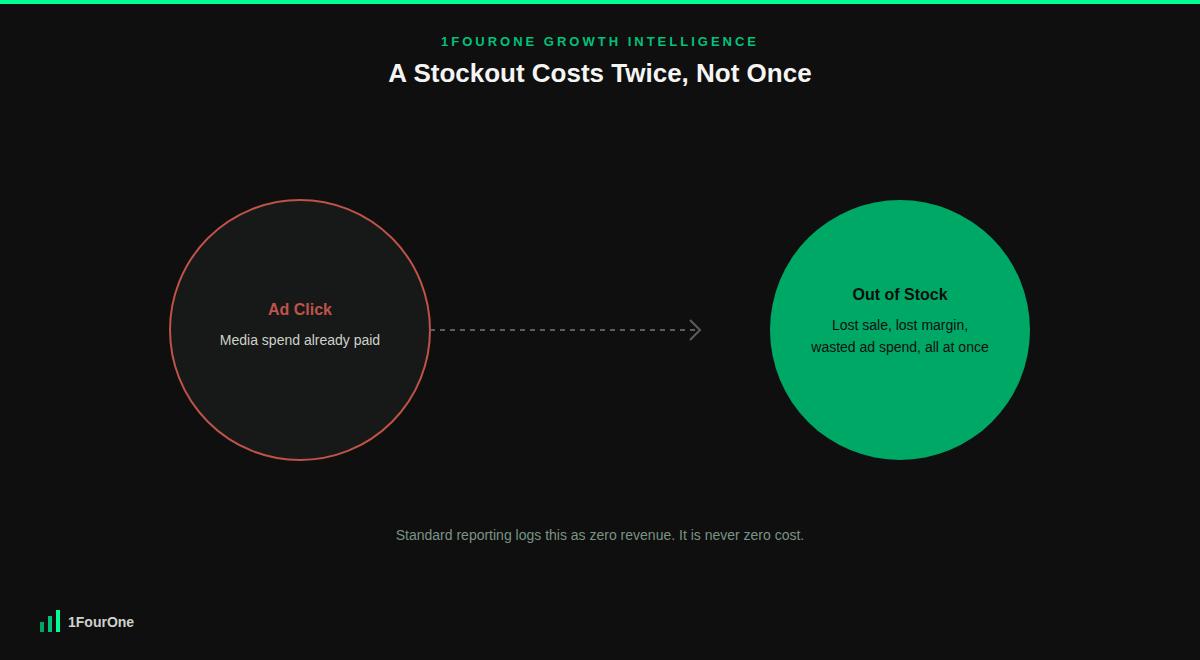
Digital retail enterprises frequently underestimate the severe financial damage caused by recurring stockout events on core product lines. When a high-velocity SKU runs out of stock, storefront analytics panels record a simple drop in conversion rate, but this surface-level metric obscures a much larger structural leak. High-intent shoppers who encounter an out-of-stock button rarely wait for replenishment updates; instead, they immediately return to search engines to locate alternative suppliers. This customer defection represents a permanent loss of immediate transaction revenue and future repeat gross margin.
Operating a storefront without real-time inventory visibility across advertising channels introduces substantial financial risk into a corporate balance sheet. When digital ad accounts continue spending aggressively on keywords pointing to depleted landing pages, marketing efficiency collapses instantly. The business absorbs the full cost of paid customer acquisition without any opportunity to generate an initial order gross profit to offset the ad spend. This lack of alignment between inventory control and media buying inflates overall acquisition costs and drains liquid operating capital.
To establish a defensible commercial operation, retail executives must evaluate stockout events as direct financial leaks. Understanding the exact contribution margin lost when key inventory categories hit zero allows supply chain and marketing teams to coordinate reorder triggers accurately. Shifting from reactive warehouse replenishment to disciplined stockout auditing ensures that marketing budgets fund traffic only for fully stocked, high-margin inventory.
Building a scalable e-commerce brand requires far deeper operational visibility than top-line revenue tracking can provide. Incorporating inventory availability metrics into your broader growth intelligence matrix enables commercial teams to measure the true net yield of every digital campaign. By mapping real-time warehouse stock levels against active paid ad channels, managers can establish dynamic bidding rules that prevent media spend on low-stock items. This operational alignment protects net contribution margins and ensures capital is deployed efficiently.
Preventing stockout events on flagship entry SKUs is also directly linked to preserving backend customer economics. Acquiring cold traffic through paid customer acquisition campaigns becomes highly unprofitable if inventory shortages prevent shoppers from completing their initial transaction or placing timely repeat orders. Protecting long-term customer lifetime value metrics requires maintaining consistent product availability on core lines, ensuring that acquired customer cohorts can establish reliable repurchase habits.
Validating stockout mitigation efforts against established empirical business research underscores its commercial necessity. Published research by the Harvard Business Review confirms that increasing customer retention rates by 5% scales overall corporate profits by 25% to 95%. This empirical baseline demonstrates why maintaining steady stock levels to satisfy active customer demand protects repeat order velocity, generating the reliable cash flow required to support sustainable business expansion.
| Stockout Leak Vector | Primary Financial Impact | Audit Optimisation Action |
|---|---|---|
| Ad Campaign Disconnect | Wasted paid media spend on out-of-stock landing pages | Implementing automated inventory scripts to pause ad sets at low stock. |
| High-Intent Customer Defection | Permanent loss of initial and repeat transaction gross margin | Rebalancing safety stock buffers based on lead-time volatility. |
| Regional Warehouse Imbalance | Inflated cross-shipping surcharges to cover regional stockouts | Syncing regional stock levels with localised campaign targeting. |
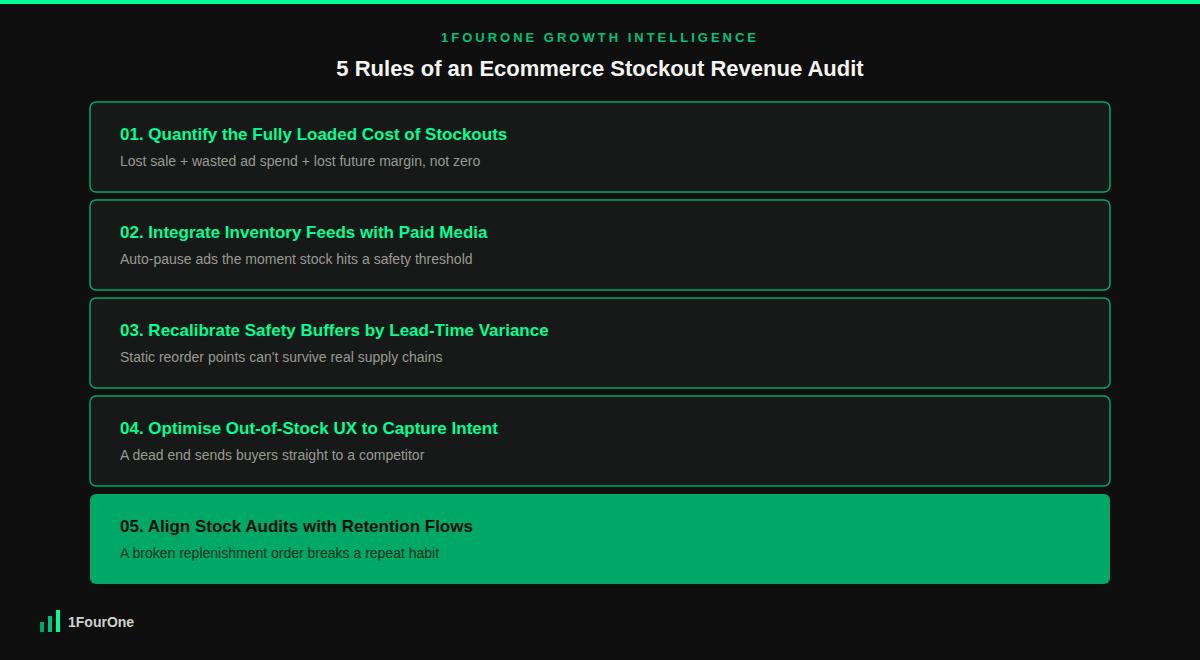
To systematically eliminate stockout margin leaks and protect operating cash flow, your commercial team must institutionalise a structured ecommerce stockout revenue audit framework across all sales channels. This operational approach replaces static reorder points with automated, demand-aligned inventory guardrails. The following five rules provide a repeatable methodology to audit stock availability, protect marketing spend efficiency, and preserve customer lifetime value.
The foundation of effective stockout governance is calculating the true financial cost of lost sales rather than treating out-of-stock notices as minor operational inconveniences. Standard reporting often logs lost sales as zero revenue, ignoring the sunk ad spend, lost initial gross margin, and permanent customer attrition caused by stockouts. Evaluating fully loaded stockout costs enables supply chain teams to justify carrying optimal safety buffers on key SKUs.
To calculate fully loaded stockout cost, sum the lost gross margin of unfulfilled demand, wasted paid media spend on out-of-stock pages, and the estimated lost lifetime margin from defected buyers. Integrate these calculations into your inventory management protocols alongside rules from our operational guide on inventory allocation strategy. Quantifying total financial impact ensures executive teams prioritise working capital allocation for high-velocity flagship products.
Running paid ad campaigns on items that are out of stock or near depletion is a common operational failure that severely degrades marketing spend efficiency. When an ad click leads to an unfulfillable product page, customer acquisition budget is instantly wasted. Marketing teams must establish automated script connections between warehouse inventory databases and digital ad platform accounts.
Configure automated scripts to pause specific ad groups or campaign keywords automatically when regional SKU stock drops below a defined safety threshold, such as 5 units. As detailed in our strategic breakdown of competitor ad audit 5 rules, eliminating ad spend waste on unviable landing pages protects campaign returns. Automatically pausing ads during stockouts preserves ad capital for active, fully stocked product lines.
Relying on static safety stock calculations that assume fixed supplier lead times leaves your inventory vulnerable to unexpected supply chain disruptions. When supplier transit delays occur during peak purchasing windows, static buffer stock is quickly exhausted, resulting in prolonged stockouts on core revenue drivers. Supply chain teams must implement dynamic safety stock formulas that adapt to lead-time volatility.
Structure your safety buffer calculations to update automatically based on real-time supplier delivery performance, seasonal demand spikes, and upcoming promotional events. Syncing inventory buffers with dynamic commercial pricing rules, as outlined in our strategic guide on ecommerce dynamic pricing strategy, prevents rapid stock depletion during promotional pushes. Dynamic safety stock management maintains product availability while preventing excess inventory lockup.
When an unexpected stockout occurs despite dynamic safety buffers, displaying a blunt, unoptimised out-of-stock message causes immediate site abandonment. High-intent shoppers who encounter dead ends leave the storefront to locate competitors. Storefront development teams must design high-utility out-of-stock user experiences that capture purchase intent and retain customer relationships.
Replace generic out-of-stock labels with back-in-stock notification signups, clear restock ETA dates, and intelligent alternative product recommendations. As documented in our operational guide on how to reduce checkout abandonment tactics, providing frictionless alternative purchase paths preserves user engagement. Capturing customer contact details for automated restock alerts allows your team to re-engage interested buyers the moment inventory is replenished.
Evaluating stockout impact based purely on initial missed sales ignores the damage inventory shortages inflict on backend customer retention. If a returning customer attempts to place a replenishment order only to find their preferred product unavailable, their repeat purchasing habit is broken. Operations teams must monitor inventory availability across SKUs that drive repeat customer retention strategy workflows.
Track stock availability trends specifically for products that serve as primary replenishment items or subscription components. To keep this monitoring anchored in a genuine quality standard rather than an internal guess, benchmark your post-purchase satisfaction tracking against the international guidelines in ISO 10004:2018. Incorporate parameters from our framework on predictive churn audit rules to identify accounts at risk of churning due to inventory delays. Maintaining consistent stock coverage on high-repeat items protects backend retention metrics and stabilises long-term customer lifetime value.
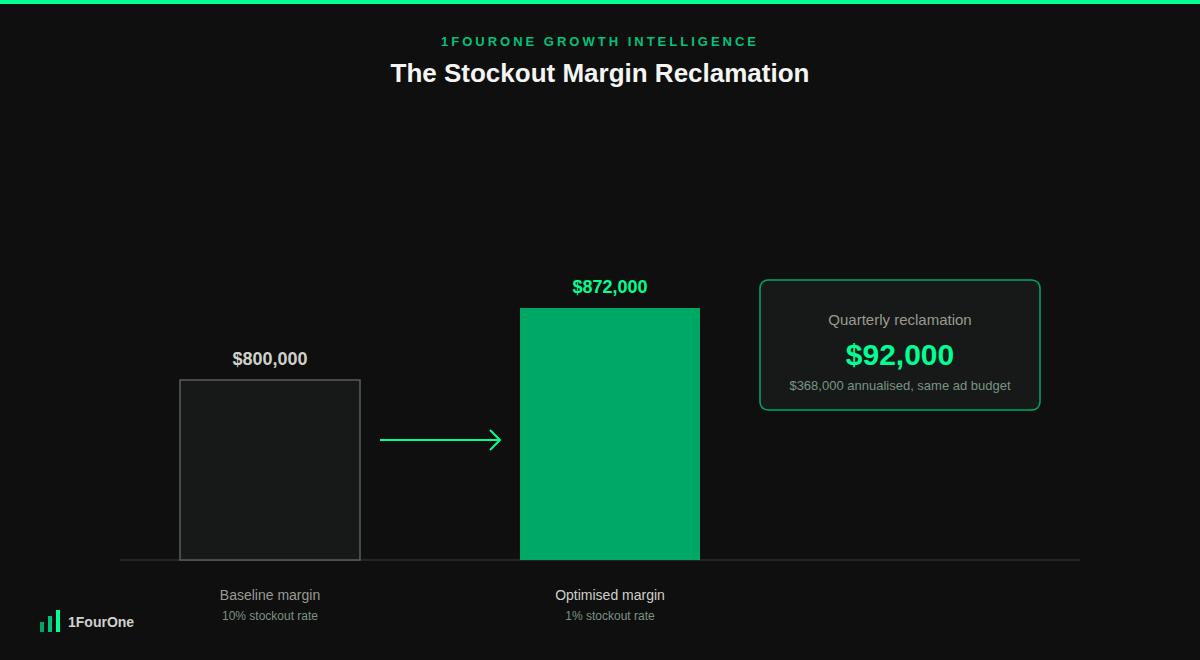
To evaluate the direct commercial impact of a structured stockout revenue audit, let us examine an established e-commerce retailer generating $2,000,000 in quarterly gross sales across 20,000 orders ($100 Average Order Value) with a baseline 40% gross margin ($800,000 baseline gross contribution profit).
Reviewing inventory performance uncovers a severe operational leak: high-intent traffic encounters out-of-stock notices on 10% of purchase sessions, representing 2,000 unfulfilled orders across the quarter. The severity of this leak is best illustrated by the buyers it costs outright: of those 2,000 sessions, roughly 1,500 shoppers abandon the store entirely to purchase from a competitor rather than wait, illustrating exactly how much immediate and future gross margin a single stockout event can permanently erase. On top of the lost sales, the brand wasted $20,000 in paid ad spend driving clicks to those same out-of-stock landing pages, inflating overall customer acquisition costs and draining operating cash flow.
The brand’s growth operations team deploys a comprehensive ecommerce stockout revenue audit to fix these inventory leaks. They integrate real-time warehouse stock feeds with ad accounts to pause ads automatically when stock hits 5 units, adjust safety buffer formulas to account for lead-time variance, and launch automated back-in-stock capture widgets on product pages. These structural improvements eliminate ad waste and ensure high-velocity items remain stocked.
This operational alignment alters quarterly financial performance significantly. Stockout frequency on top-selling SKUs drops from 10% down to 1%, recovering 1,800 of the 2,000 previously unfulfilled orders ($180,000 in recovered gross sales). Wasted paid ad spend on out-of-stock pages drops to $0. Total quarterly gross sales scale from $2,000,000 up to $2,180,000 across 21,800 completed orders.
The financial return from this inventory audit program is immediate and highly profitable. Gross contribution profit expands from $800,000 up to $872,000 ($180,000 recovered sales multiplied by the 40% gross margin = $72,000 additional gross margin). Combined with the $20,000 in saved ad spend, the business secures a $92,000 net quarterly contribution margin reclamation ($368,000 annualised profit expansion) on a completely flat marketing acquisition budget.
Calculate lost stockout revenue by multiplying out-of-stock product page views by your historical conversion rate for that SKU category, then multiplying that figure by the average order value. To determine net lost profit, apply your gross contribution margin percentage to the total lost revenue figure and add any direct marketing ad spend wasted driving traffic to those depleted pages during the stockout period. This is the same calculation method that underpins a full ecommerce stockout revenue audit, just applied on a per-SKU basis rather than storewide.
Digital ads should be paused instantly via automated API scripts the moment warehouse inventory hits a pre-determined safety threshold. Relying on manual campaign adjustments introduces delays that result in wasted ad spend on unfulfillable clicks. Automated real-time syncing ensures ad budgets are protected continuous without requiring manual monitoring by media buyers.
Increasing safety stock levels will not bloat working capital if safety buffers are adjusted dynamically based on sales velocity and lead-time variance. Dynamic safety stock formulas increase inventory depth only for high-turning, high-margin SKUs while reducing buffer stock on slow-moving items. This targeted approach improves overall stock availability while optimising overall working capital efficiency.
Product pages experiencing temporary stockouts should feature clear restock ETA dates, automated back-in-stock email or SMS notification signups, and prominent recommendations for similar, in-stock items. Presenting relevant alternative products captures immediate purchase intent, while back-in-stock signups preserve lead value and enable automated re-engagement upon inventory replenishment.
Stockout events degrade paid ad performance by increasing bounce rates and reducing landing page conversion metrics when users encounter out-of-stock notices. Ad platform algorithms interpret high bounce rates and low conversion activity as poor landing page user experience, which can lower ad relevance scores. Lower quality scores increase bidding costs, driving up overall customer acquisition expenses.
Allowing unmonitored stockout events to waste ad spend and alienate high-intent buyers is an expensive operational failure that degrades retail profitability. At 1FourOne, we eliminate supply chain leaks by deploying an ecommerce stockout revenue audit framework that protects stock availability and maximises net contribution cash flow. Contact our growth operations team today to secure a data-driven inventory audit tailored for your business.
Get your competitive audit in 48 hours and see exactly where your revenue is leaking.
Get Your Audit →