Why Sitewide Discounts Are Quietly Destroying Your Margins
Executing a disciplined ecommerce promotional strategy is the most effective operational adjustment a mid-market retail business can deploy to prevent gross margin erosion when competing for market share in crowded advertising auctions. Many digital brand operators rely heavily on broad sitewide discount codes to stimulate short-term sales volume, completely ignoring the structural profit decay caused by unhedged price reductions. Blanket discounting conditions value-conscious consumers to delay purchases until sales occur, eroding product margins and inflating customer acquisition expenses. Transitioning to a margin-backed promotional governance model allows growth teams to protect net contribution profits, elevate average order values, and maintain sustainable cash flow across every product catalogue.
E-commerce businesses frequently resort to price discounting as a primary driver for quarterly revenue targets. When sales volume slows, management teams often launch site-wide percentage reductions to stimulate immediate checkout activity. While these blanket promotions generate short-term transaction spikes on analytics dashboards, they severely damage underlying unit economics. Discounting full-priced demand trains core customers to expect price concessions, permanently lowering brand price equity.
Operating an unhedged promotional framework introduces significant financial vulnerability into a retail balance sheet. When a store offers flat percentage discounts without setting minimum order thresholds, customer basket sizes remain unchanged while gross margins contract. Variable costs like pick-and-pack labour, merchant processing fees, and shipping surcharges do not decrease when a price is discounted. As a result, the business absorbs the full financial burden of the discount, directly compressing net contribution margins.
To establish a resilient retail operation, executives must transition from broad price cutting to structured value-add promotions. Understanding the exact contribution margin of every inventory category allows operations teams to design promotional offers that protect unit profitability. Shifting from reactive discounting to disciplined, margin-backed incentive design ensures that promotional activity expands basket sizes rather than draining operating cash flow.
Building a profitable e-commerce enterprise requires far deeper operational analysis than top-line revenue tracking can provide. Integrating promotional margin controls into your broader growth intelligence matrix enables commercial teams to evaluate the true net impact of every campaign. By calculating fully loaded variable costs alongside promotional price reductions, managers can establish clear profitability thresholds for every offer. This analytical oversight prevents brands from subsidising unprofitable transaction volume.
Relying on heavy discounting to support front-end paid customer acquisition becomes unsustainable as ad auction costs increase. Acquiring cold traffic through price reductions often attracts low-intent buyers who rarely convert at full price in the future. Protecting long-term customer lifetime value metrics requires ensuring that initial promotional offers encourage repeat purchase habits, rather than conditioning buyers to wait for the next sale event. This distinction between acquiring a customer and acquiring a genuinely valuable customer lifetime value cohort is exactly what separates disciplined promotional governance from a short-term marketing spend efficiency drain.
Validating promotional parameters against established empirical benchmarks is essential to preserve long-term enterprise value. Published research by the Harvard Business Review confirms that increasing customer retention rates by 5% scales overall corporate profits by 25% to 95%. This empirical baseline shows why protecting net contribution margins on repeat transactions delivers substantial compounding returns, providing the stable cash flow needed to fund sustainable business operations.
| Promotional Mechanism | Primary Margin Leak | Governance Optimisation Action |
|---|---|---|
| Blanket Percentage Off | Unhedged margin erosion on existing full-price demand | Replacing sitewide codes with spend-threshold incentives. |
| Unconditional Free Shipping | Absorbing freight overheads on low-value orders | Setting free delivery limits above average basket size. |
| Public Coupon Distribution | Margin leakage to deal aggregator browser extensions | Restricting codes to single-use, authenticated customer accounts. |
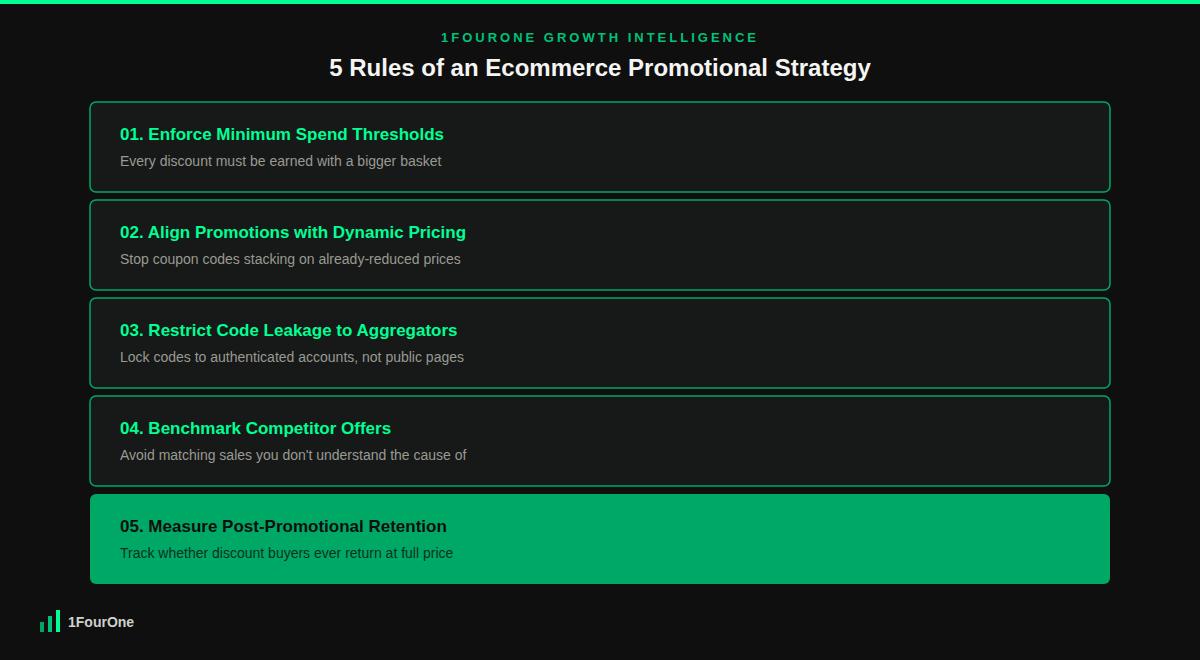
To systematically eliminate promotional margin drains and protect operating profits, your commercial team must institutionalise a structured ecommerce promotional strategy across all sales channels. This operational framework replaces reactive price cuts with controlled, data-driven offer structures. The following five rules provide a repeatable methodology to optimise promotional spend, protect marketing spend efficiency, and increase average order values.
The primary rule of margin-backed promotional design is requiring customers to increase their basket size in exchange for a price concession. Allowing shoppers to apply percentage discounts to single-item, low-value orders directly erodes net contribution profit. Implementing spend-threshold rules ensures that every promotional transaction yields additional gross margin dollars to offset the price reduction.
To structure effective threshold offers, calculate your baseline average order value and set the minimum promotional tier 20% to 35% above that benchmark. For example, if your average basket size is $100, offer a $20 concession only when basket values reach $135. This structure encourages customers to add higher-margin accessory items to qualify for savings, expanding gross basket value while keeping net contribution margins protected.
Running fixed promotional codes on items that are already subject to dynamic price adjustments can lead to severe margin compression. If an automated pricing tool lowers a product’s base price to match competitor activity, applying an additional promotional code on top of that reduced price can result in net transaction losses. Commercial teams must coordinate promotional parameters with automated pricing systems.
Your technical team should integrate promotional rule engines directly with your pricing software to prevent coupon stack errors. As outlined in our strategic breakdown of ecommerce dynamic pricing strategy, coordinating commercial pricing rules with campaign parameters prevents accidental margin erosion. This automated integration ensures that promotional codes are excluded from items operating near minimum margin floors.
Automated deal-finding browser extensions and coupon aggregator websites represent a significant source of promotional margin leakage for digital retailers. These platforms automatically inject public discount codes into checkout flows for consumers who were already prepared to purchase at full price. This unauthorised code distribution drains gross margin without generating any incremental transaction volume.
To block this margin drain, your technical team should deploy script detection tools to prevent automated code injection at checkout. You should also replace generic public promotion codes with unique, single-use promotional tokens tied to authenticated customer accounts. As detailed in our operational guide on how to reduce checkout abandonment tactics, securing your checkout flow prevents unnecessary margin leakage while preserving a clean payment experience for genuine buyers.
Reacting emotionally to a competitor’s promotional campaign by launching an identical site-wide sale is a common mistake that damages category profitability. If a rival brand liquidates excess inventory at steep discounts, matching their prices without understanding their underlying supply chain drivers can severely damage your balance sheet. Commercial teams must analyse competitor promotional intent before altering pricing structures.
Continuously monitor rival promotional structures, email cadences, and creative messaging to determine whether their sales reflect temporary inventory clearouts or permanent positioning shifts. As detailed in our strategic guide on competitor ad audit 5 rules, tracking rival promotional strategies allows you to identify open market positioning gaps. Use these insights to craft value-add alternative offers rather than entering destructive price wars.
Evaluating promotional success based purely on immediate conversion volume ignores the long-term impact on customer quality and retention. A promotional campaign that generates high transaction numbers but attracts buyers who never return or exhibit high refund rates yields poor long-term value. Commercial teams must track post-promotional cohort behaviour over extended time horizons.
Link your promotional tracking metrics directly to your customer retention analytics to measure repeat purchase rates by promotional source. To maintain operational quality standards, align your post-purchase satisfaction tracking with the international guidelines in ISO 10004:2018. Incorporating parameters from our framework on predictive churn audit rules ensures you identify unviable customer cohorts early, allowing you to refine promotional targeting toward high-value segments. Consider also connecting well-performing promotional cohorts directly into your loyalty program design, since a genuine marketing spend efficiency gain comes from converting a one-off discount buyer into a durable, ongoing account.
To evaluate the direct commercial impact of a structured ecommerce promotional strategy, let us examine an established e-commerce retailer generating $1,000,000 in quarterly gross sales across 10,000 orders ($100 Average Order Value). Under the baseline operational state, total variable expenses equal $70 per order ($40 COGS, $15 fulfilment and shipping, $15 marketing spend), resulting in $700,000 in total variable expenses across the 10,000 orders.
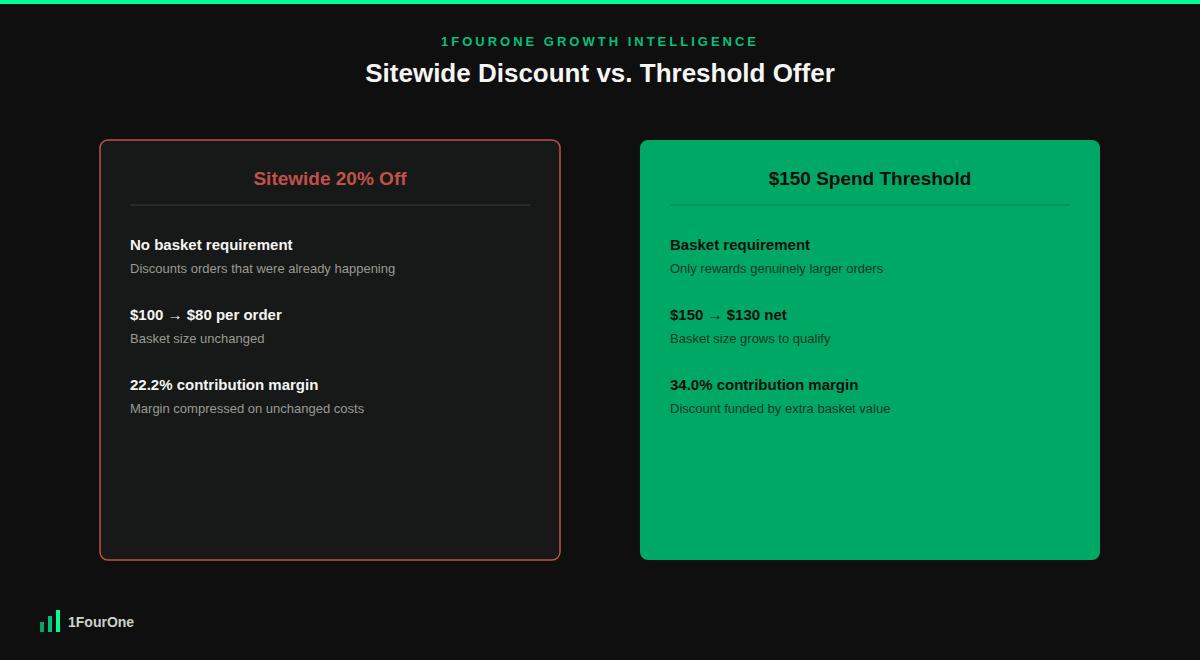
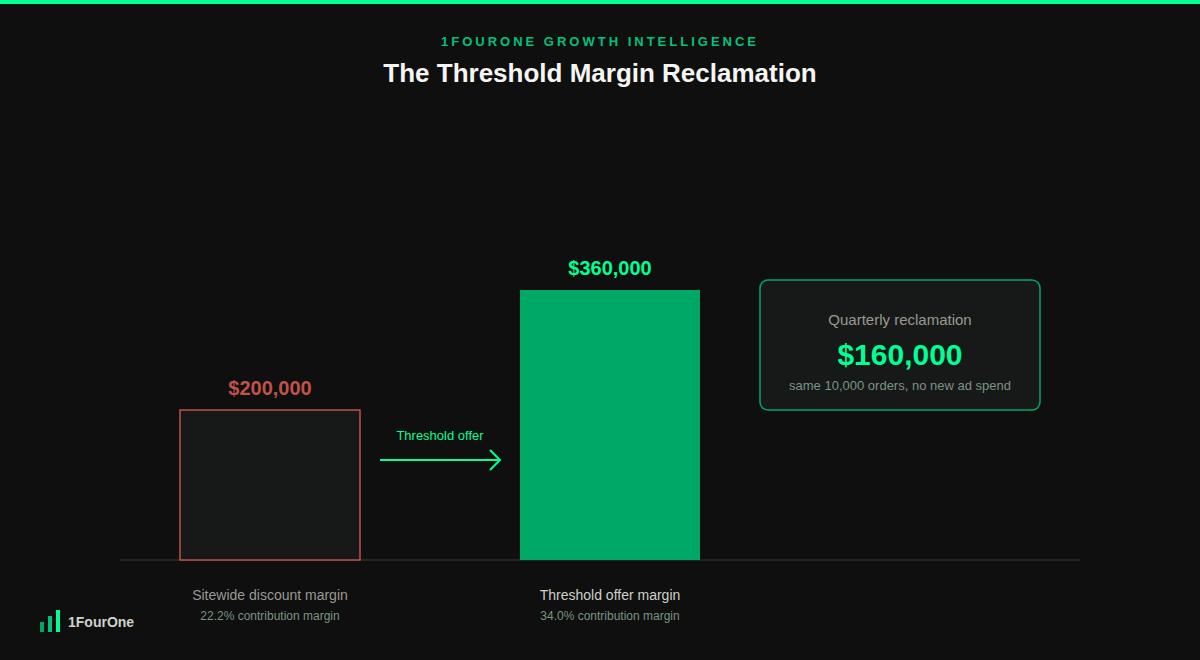
Reviewing promotional performance reveals a major margin drain: the store runs unhedged sitewide 20% discount codes, resulting in 5,000 orders being discounted from $100 down to $80. Gross quarterly revenue contracts to $900,000 (5,000 full-price orders at $100 + 5,000 discounted orders at $80). With variable expenses remaining fixed at $700,000 (10,000 orders at $70), net contribution margin drops to $200,000 ($900,000 gross revenue minus $700,000 variable costs), yielding a compressed 22.2% contribution margin.
The brand’s growth operations team implements a structured ecommerce promotional strategy to fix this margin leak. They eliminate sitewide discount codes and replace them with a spend-threshold offer ($20 off orders above $150 minimum spend). This threshold rule encourages buyers to add higher-margin items to qualify for savings, increasing the average basket size on promotional orders to $150 ($130 net revenue after discount). Under this new structure, 2,000 buyers reach the $150 threshold, while the remaining 8,000 orders convert at the full $100 price.
This promotional adjustment changes the quarterly financial profile significantly. Total gross revenue scales to $1,060,000 (8,000 full-price orders at $100 = $800,000, plus 2,000 threshold orders at $130 net = $260,000). Total variable expenses remain completely unchanged at $700,000 (10,000 total orders multiplied by the $70 baseline variable cost). Net contribution margin expands from $200,000 up to $360,000 ($1,060,000 gross revenue minus $700,000 variable costs), increasing contribution margin to 34.0%.
The financial return from this promotional realignment is immediate and highly sustainable. Without requiring additional paid customer acquisition spend or increasing baseline product prices, the business reclaims $160,000 in quarterly net contribution profit ($360,000 optimised margin minus $200,000 baseline margin). This 80.0% increase in net contribution profit protects operating cash flow and provides reliable capital to fund future business growth.
Calculate your optimal spend threshold by analysing your historical order value distribution and setting the qualification tier 20% to 35% above your median basket size. Ensure that the incremental gross margin generated by the additional items required to reach the threshold comfortably exceeds the dollar value of the promotional discount. This calculation guarantees that every qualified order delivers higher net contribution dollars.
Setting spend thresholds can slightly reduce conversion rates if the threshold is set too far above your average order value. However, presenting clear progress indicators in the shopping cart and recommending affordable, complementary add-on products helps customers reach the threshold naturally. The resulting increase in average order value and net contribution margin comfortably offsets micro-drops in conversion volume.
Prevent code leakage by deploying technical scripts that block automated code injection at checkout and replacing generic public coupon phrases with single-use, account-authenticated promotional tokens. Single-use tokens ensure that discount codes are locked to specific customer email addresses, preventing deal aggregator websites from distributing your promotional margin to non-target audiences.
Yes, low-margin SKUs and high-demand flagship products should be excluded from broad promotional campaigns. Low-margin items cannot absorb price concessions without generating net losses, while high-demand items convert reliably at full price. Focus promotional incentives on high-margin accessory categories or bundled offers where price concessions drive genuine volume lift without eroding core profits.
Evaluate promotional incrementality by running holdout tests across comparable customer cohorts or geographic regions during the campaign period. Compare the total net contribution margin generated by the promotional group against the unpromoted control group, accounting for baseline sales velocity and redemption costs. A defensible ecommerce promotional strategy treats this comparison as mandatory, since true promotional incrementality exists only when net contribution dollars increase above the control baseline.
Allowing unhedged promotional discounting to erode your net contribution margins is an expensive operational failure that degrades retail profitability. At 1FourOne, we eliminate financial margin leaks by deploying structured promotional strategies that protect unit profitability and maximize cash flow. Contact our growth operations team today to secure a data-driven promotional audit tailored for your business.
Get your competitive audit in 48 hours and see exactly where your revenue is leaking.
Get Your Audit →