A 10% Price Increase Cost Only 4% of Orders and Added $80,000 a Month in Profit

Executing a structured ecommerce price elasticity testing methodology is the most effective operational adjustment a digital retail enterprise can deploy to identify margin-maximising price points across key product lines without alienating prospective buyers. Many online brand operators rely on static cost-plus pricing models or arbitrary competitor matching, completely failing to test consumer price sensitivity across distinct product categories. Leaving retail prices unoptimised suppresses net contribution margins and restricts the operating capital available to fund customer acquisition. Transitioning to a data-driven price elasticity testing framework enables growth teams to capture hidden pricing power, protect marketing spend efficiency, and build compounding cash flow.
Modern e-commerce enterprises frequently suffer from invisible profit leaks caused by static retail pricing structures. When a brand sets product prices based on simple wholesale cost multipliers and leaves those prices unchanged for extended periods, it ignores shifts in consumer demand, inflationary pressures, and competitive positioning. Operating with static prices assumes that consumer purchasing intent remains constant regardless of economic conditions, leaving substantial gross margin uncaptured.
Managing a storefront without testing micro-price adjustments introduces structural vulnerabilities across a corporate balance sheet. If a product line possesses strong brand equity and low consumer price sensitivity, underpricing that item forces the business to rely on higher transaction volumes to meet net contribution targets. Higher order volumes increase pick-and-pack labour, shipping overheads, and customer support ticket volume, compressing overall net operating margins.
To establish a resilient commercial retail business, growth executives must evaluate pricing as a dynamic profitability lever. Understanding the exact coefficient of price elasticity for every SKU category allows pricing and marketing teams to adjust prices to maximise contribution dollars rather than raw order counts. Shifting from static pricing to disciplined price elasticity testing ensures that product catalogue prices capture true market value.
Building a defensible digital retail operation requires far deeper operational visibility than front-end conversion rate tracking can supply. Incorporating price elasticity analytics into your broader growth intelligence matrix enables commercial teams to measure how price adjustments impact net contribution dollars per session. By evaluating order volume shifts alongside gross margin expansion, managers can pinpoint the exact price point that maximises net profit. This analytical oversight prevents businesses from sacrificing profitability for hollow top-line volume.
Capturing optimal product pricing also directly protects your paid customer acquisition programs against rising ad auction costs. When product unit margins are expanded through successful price testing, marketing teams gain additional gross margin buffer per order. This expanded margin allows media buyers to maintain competitive bidding in ad auctions without generating net transaction losses, protecting customer acquisition efficiency and customer lifetime value across primary growth channels.
Validating price optimisation initiatives against established empirical business research underscores its commercial importance. Published research by the Harvard Business Review confirms that increasing customer retention rates by 5% scales overall corporate profits by 25% to 95%. This empirical baseline demonstrates why maximising unit gross contribution through price optimisation preserves financial stability, generating the liquid cash flow required to support long-term customer relationships and business expansion.
| Elasticity Profile | Demand Response Profile | Pricing Strategy Action |
|---|---|---|
| Inelastic Demand (<1.0) | Volume drop is proportionally smaller than price increase | Increasing prices incrementally to capture expanded gross unit margin. |
| Unitary Elasticity (=1.0) | Volume shift exactly offsets price adjustment percentage | Focusing on value-add bundling rather than direct base price changes. |
| Elastic Demand (>1.0) | Volume drop is proportionally larger than price increase | Maintaining competitive base prices and optimising backend order values. |
To systematically identify margin-maximising price points and protect operating cash flow, your commercial team must institutionalise a structured set of ecommerce price elasticity testing rules across all product lines. This operational framework replaces subjective pricing decisions with data-driven sensitivity testing. The following five rules provide a repeatable methodology to audit price elasticity, protect marketing spend efficiency, and expand net contribution margins.
Testing drastic price changes across your entire live storefront simultaneously introduces severe revenue volatility risk and can trigger negative customer feedback. To evaluate price sensitivity safely, commercial teams should execute micro-price adjustments, typically in 3% to 7% increments, across segmented geographic regions or controlled traffic cohorts. Testing small price variances delivers accurate conversion data while protecting overall baseline revenue.
Isolate specific delivery zones or user segments and apply dynamic price adjustments at the server level. Coordinate these testing cohorts with inventory rules from our operational guide on inventory allocation strategy rules. Micro-price testing across controlled cohorts exposes true consumer willingness to pay without disrupting global brand positioning.
Evaluating a price test based purely on conversion rate drops is a common operational failure that leads to incorrect pricing decisions. Increasing a product’s retail price will almost always cause a minor decline in conversion rate, but if the expanded gross profit per unit outweighs the volume drop, net contribution profit increases. Operations teams must evaluate tests using net contribution dollars generated per site session.
Calculate total gross contribution profit divided by total unique visitor sessions for each pricing variation. Syncing contribution targets with dynamic commercial pricing rules, as outlined in our strategic guide on ecommerce dynamic pricing strategy, ensures pricing decisions favour overall profit expansion. Selecting price points that maximise session contribution dollars builds long-term cash flow.
Treating cold prospective buyers and loyal returning customers as a single audience during price elasticity testing obscures important behavioural differences. First-time visitors arriving from paid customer acquisition campaigns evaluate pricing against alternative market options, exhibiting higher price sensitivity. Returning brand advocates exhibit lower price sensitivity due to established product trust. Pricing models must account for user intent variations.
Structure your storefront analytics to track conversion responses separately for authenticated returning users versus cold paid traffic. As detailed in our strategic guide on competitor ad audit 5 rules, understanding competitive positioning helps calibrate traffic expectations. Differentiating pricing rules between cold acquisition and returning cohorts protects new buyer acquisition while maximising value from loyal segments.
Attempting to increase base prices on highly elastic commodity items can cause sharp conversion drops that erode overall profitability. To capture higher order values on price-sensitive products without triggering conversion declines, growth teams should pair base price adjustments with complementary value-add accessories or premium service options. Value-add bundling shifts consumer focus from raw item price to overall package utility.
Design product bundle options that package secondary accessories with primary flagship items at a unified price point. As documented in our operational guide on how to reduce checkout abandonment tactics, presenting clear package value preserves checkout velocity. Value-add bundling expands average order values while insulating core conversion rates from price sensitivity friction.
Evaluating price elasticity based purely on immediate checkout conversion ignores the potential impact on post-purchase satisfaction and long-term customer retention. Setting prices too high may secure an initial purchase but induce buyer remorse, leading to elevated return rates, negative reviews, and reduced repeat order frequency. Pricing teams must track backend cohort behaviour post-checkout.
Track product return rates, review sentiment, and 90-day repeat order velocity for cohorts acquired across different price testing tiers. Ensure your post-purchase metrics align with international quality standards outlined in ISO 10004:2018. Incorporating process parameters from our framework on predictive churn audit rules ensures you identify price levels that compromise customer retention, allowing you to establish price points that support sustainable customer lifetime value.
To evaluate the direct commercial return of a dynamic ecommerce price elasticity testing program, let us examine an established digital retailer selling 10,000 units per month of its core product line at $100 retail price ($1,000,000 gross monthly revenue). Baseline variable product COGS and fulfilment costs total $60 per unit, leaving $40 in gross profit per unit ($400,000 total monthly gross profit). Paid marketing spend across primary customer acquisition channels totals $200,000 per month ($20 acquisition cost per unit), leaving a baseline net monthly contribution profit of $200,000 ($400,000 gross profit minus $200,000 ad spend).
Reviewing historical pricing uncovers an uncaptured profit opportunity: the brand has maintained its $100 price point for two years without evaluating price sensitivity, despite strong customer retention and rising competitor prices. The business absorbs rising supply chain costs without testing market willingness to pay higher prices.
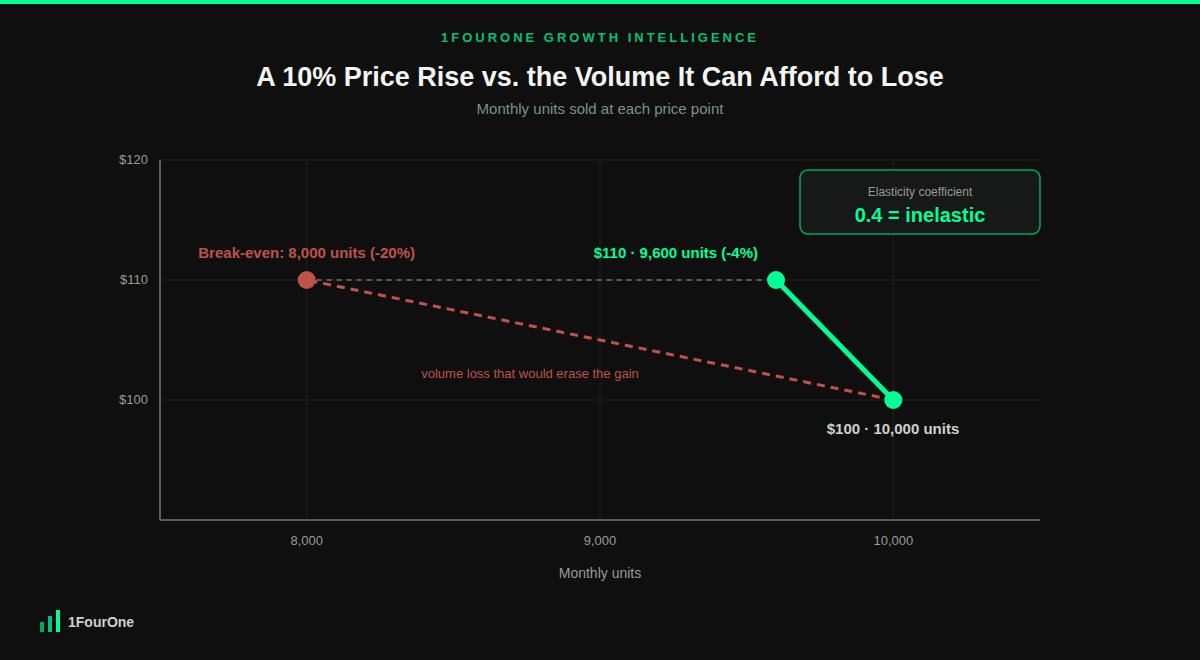
The brand’s growth operations team executes a controlled price elasticity test across geographic user cohorts, raising the retail price by 10% from $100 to $110. Testing reveals that the product line exhibits inelastic demand across micro-price adjustments: the 10% price increase causes conversion rates to decline by only 4%, resulting in monthly order volume contracting slightly from 10,000 down to 9,600 units.
This micro-price adjustment transforms unit-level financial performance. At $110 retail price, gross monthly revenue scales to $1,056,000 (9,600 units × $110). Variable COGS and fulfilment costs drop proportionally to $576,000 (9,600 units × $60), expanding gross profit per unit from $40 up to $50. Total monthly gross profit increases from $400,000 up to $480,000 (9,600 units × $50 gross profit).
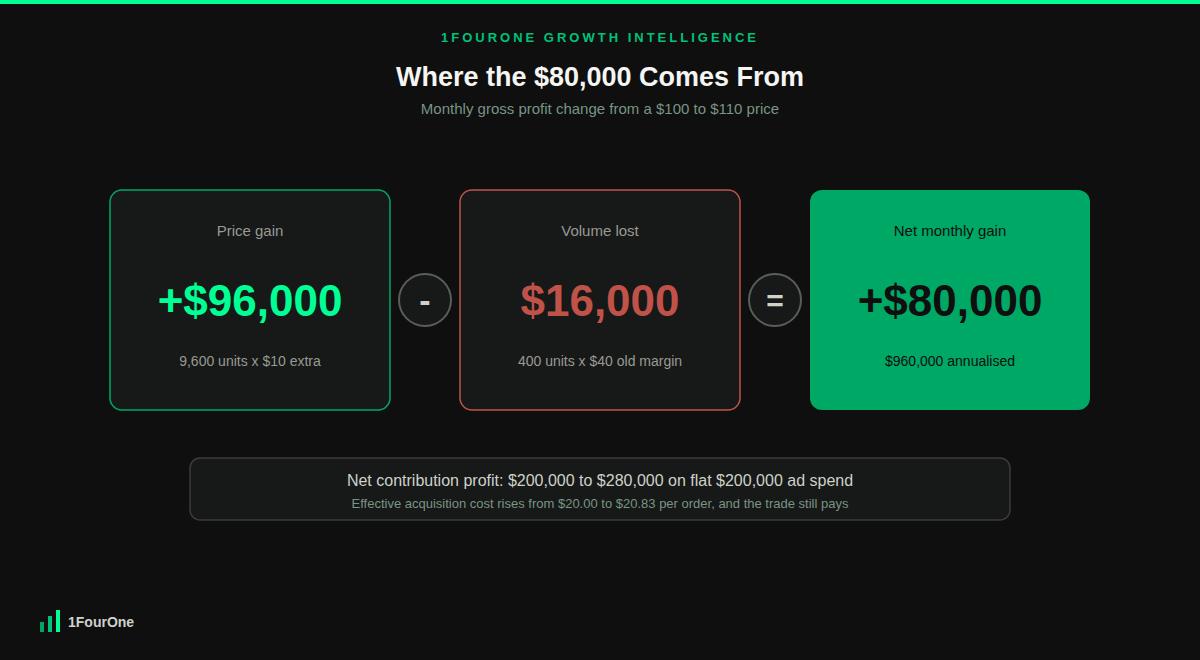
The financial return from this elasticity testing program is immediate and highly profitable. On identical paid marketing acquisition spend ($200,000 per month), net monthly contribution profit expands from $200,000 up to $280,000 ($480,000 gross profit minus $200,000 ad spend). The business secures an immediate $80,000 monthly net profit reclamation ($960,000 annualised cash flow expansion) derived entirely from dynamic price elasticity testing on a completely flat marketing acquisition budget.
Two details sit beneath the headline result. The $10 price rise adds $96,000 in gross profit on the 9,600 units still selling (9,600 × $10), while the 400 lost orders cost $16,000 at the old $40 margin (400 × $40), a net gain of $80,000. Effective acquisition cost also rises from $20.00 to about $20.83 per order, because the same $200,000 now buys 9,600 orders rather than 10,000. That trade is comfortably worth making, since order volume could have fallen by 20%, to 8,000 units, before this price rise stopped paying for itself.
Price elasticity of demand is calculated by dividing the percentage change in quantity demanded by the percentage change in price. If a 10% price increase results in a 4% drop in order volume, the price elasticity coefficient is 0.4 (-4% / +10%). A coefficient below 1.0 indicates inelastic demand, meaning a price increase will expand overall gross contribution profit.
A digital retailer should run a price elasticity test for a minimum of 14 to 30 days, or until reaching statistical significance across target traffic cohorts. Running tests across full weekly purchasing cycles accounts for weekend versus weekday buying behaviour and minimises external promotional noise.
Price testing will not alienate existing customers if implemented using server-side cohort segmentation, geographic isolation, or personalised VIP pricing. Avoiding rapid price fluctuations for logged-in, returning buyers while testing micro-adjustments on cold acquisition traffic preserves customer trust while delivering clean testing data.
Category-wide inflation generally decreases consumer price sensitivity toward moderate price increases, as shoppers expect higher prices across retail options. Executing price elasticity tests during inflationary periods allows retailers to adjust prices to cover rising COGS and freight expenses without experiencing severe volume drops.
No, ecommerce price elasticity testing should be applied systematically by product category rather than across an entire catalogue simultaneously. Testing high-volume flagship SKUs first delivers immediate financial impact, while low-turnover accessories can be tested subsequently or optimised through value-add product bundling.
Allowing unexamined, static retail pricing to suppress your gross contribution margins is an expensive operational failure that degrades retail profitability. At 1FourOne, we eliminate financial margin leaks by deploying a disciplined ecommerce price elasticity testing framework that identifies optimal price points and maximises net cash flow. Contact our growth operations team today to secure a data-driven pricing audit tailored for your business.
Get your competitive audit in 48 hours and see exactly where your revenue is leaking.
Get Your Audit →