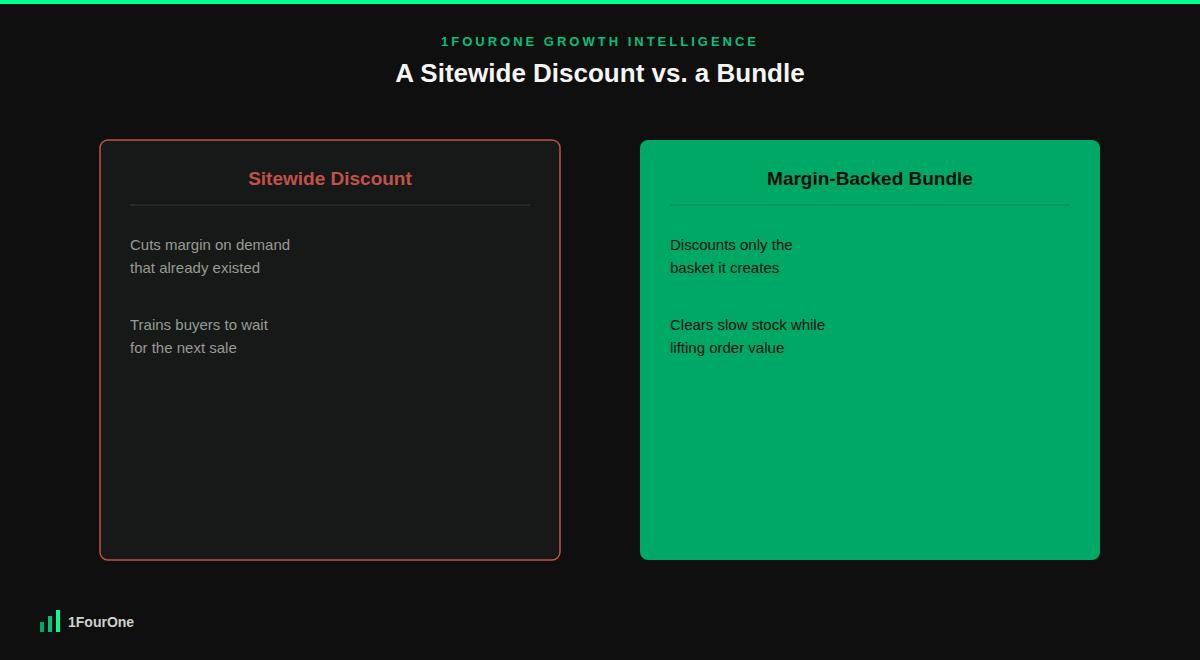
A Sitewide Discount Cuts Into Demand You Already Had. A Bundle Only Discounts What It Creates.
Implementing structured ecommerce bundle engineering rules is the most effective operational adjustment a mid-market retail business can deploy to expand average order values and accelerate secondary inventory turnover without eroding baseline product margins. Many digital brand operators rely on unhedged, site-wide percentage discounts to stimulate sales volume, completely ignoring the severe profit decay caused by indiscriminate price concessions. Unstructured discounting trains value-conscious consumers to delay purchases until sales events occur, compressing contribution margins and inflating acquisition overheads. Transitioning to a margin-backed bundling framework enables growth teams to clear slow-moving inventory, protect marketing spend efficiency, and build compounding cash flow across every product category.
E-commerce businesses frequently resort to blanket price discounting as a primary driver for quarterly transaction targets. When sales velocity slows, commercial teams often launch storewide percentage reductions to stimulate immediate checkout activity. While these unhedged promotions generate short-term order spikes on analytics dashboards, they severely damage underlying unit economics. Discounting standalone full-priced demand trains core buyers to expect price concessions, permanently lowering brand price equity.
Operating an unhedged promotional strategy introduces significant financial vulnerability into a retail balance sheet. When a store offers flat percentage discounts without requiring multi-item basket thresholds, order values remain flat while gross margins contract. Variable costs like pick-and-pack labour, merchant processing fees, and shipping surcharges do not decrease when a retail price is discounted. As a result, the business absorbs the full financial weight of the discount, directly compressing net contribution margins.
To establish a resilient retail operation, executives must transition from broad price cutting to structured, value-add product bundling. Understanding the exact fully loaded contribution margin of every inventory category allows operations teams to design bundle offers that protect unit profitability. Shifting from reactive discounting to disciplined, margin-backed offer engineering ensures that promotional activity expands basket sizes rather than draining operating cash flow.
Building a profitable e-commerce enterprise requires far deeper operational analysis than top-line sales tracking can provide. Integrating bundle engineering controls into your broader growth intelligence matrix enables commercial teams to evaluate the true net impact of every offer structure. By calculating fully loaded variable costs alongside promotional price concessions, managers can establish clear profitability thresholds for every bundle. This analytical oversight prevents brands from subsidising unprofitable transaction volume.
Relying on heavy discounting to support front-end paid customer acquisition also becomes unsustainable as ad auction costs increase. Acquiring cold traffic through price reductions often attracts low-intent buyers who rarely convert at full price in the future. Protecting long-term customer lifetime value metrics requires ensuring that initial promotional offers encourage multi-item basket habits, rather than conditioning buyers to wait for the next storewide sale event.
Validating bundle parameters against established empirical benchmarks is essential to preserve long-term enterprise value. Published research by the Harvard Business Review confirms that increasing customer retention rates by 5% scales overall corporate profits by 25% to 95%. This empirical baseline demonstrates why protecting net contribution margins on repeat transactions through high-utility bundling delivers substantial compounding returns, providing the stable cash flow needed to fund sustainable business expansion.
| Bundle Structure | Primary Margin Mechanism | Operational Optimisation Goal |
|---|---|---|
| Flagship + Dual Accessory | Pairing high-velocity items with high-margin accessories | Clearing slow-moving stock while expanding gross basket size. |
| Tiered Quantity Kits | Volume discounts linked to multi-pack thresholds | Reducing per-unit pick-pack and shipping costs per order. |
| Cross-Category Starter Sets | Curated onboarding collections for cold acquisition | Maximising initial gross profit to offset upfront media acquisition costs. |
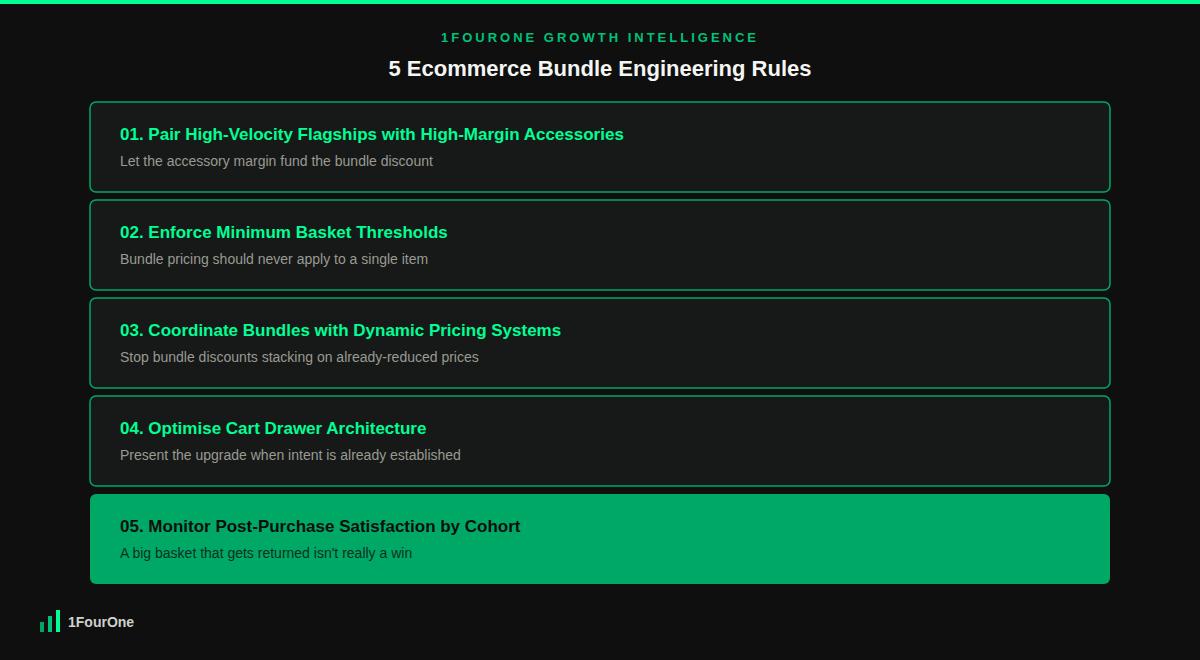
To systematically eliminate promotional margin drains and protect operating profits, your commercial team must institutionalise a structured set of ecommerce bundle engineering rules across all sales channels. This operational framework replaces reactive price cuts with controlled, data-driven offer structures. The following five rules provide a repeatable methodology to optimise bundle architecture, protect marketing spend efficiency, and increase average order values.
The core rule of high-yielding bundle design is pairing a high-demand, high-velocity flagship product with secondary items that carry exceptionally high gross profit margins. Flagship products drive initial purchase intent, but their baseline margins are often squeezed by competitive pricing. Combining a flagship item with low-cost, high-margin accessories allows you to offer an attractive total bundle discount while expanding overall contribution dollars.
Structure your bundle pairings so that the combined gross profit margin of the bundled items comfortably absorbs the promotional price concession. Coordinate these bundle pairings with inventory rules from our operational guide on inventory allocation strategy rules. Strategic item pairing increases average basket value while clearing secondary accessory stock that might otherwise sit idle in regional warehouses.
Allowing customers to access bundled pricing tiers on small, single-item purchases directly erodes net contribution profit. To protect unit economics, your checkout architecture must require shoppers to reach a specific item count or dollar value threshold before promotional savings apply. Enforcing minimum basket rules guarantees that every bundled transaction yields additional gross margin dollars to cover fulfilment expenses.
Calculate your baseline average order value and set the minimum bundle qualification threshold 25% to 40% above that benchmark. For example, if your average basket size is $100, design a $140 bundle offer that delivers $160 in total retail value. This structure encourages buyers to add complementary items to their cart, expanding gross order value while maintaining strong net contribution margins.
Running fixed promotional bundle offers on SKUs that are subject to automated dynamic price adjustments can lead to accidental margin compression. If an automated pricing tool lowers a product’s base price to match competitor activity, applying a fixed bundle discount on top of that reduced price can result in net transaction losses. Commercial teams must align bundle rules with automated pricing engines.
Integrate your bundling rule engines directly with your pricing software to prevent coupon stacking and unintended margin erosion. As outlined in our strategic breakdown of ecommerce dynamic pricing strategy, synchronising pricing rules with promotional parameters protects unit economics. Cross-referencing bundle performance against rival offer structures, as covered in our guide on competitor ad audit 5 rules, also helps ensure your paid customer acquisition spend is funding bundles that genuinely outcompete the market, not just matching it. This automated guardrail ensures that bundle discounts are excluded from items operating near minimum profit floors.
Presenting complex or confusing bundle choices during early browsing phases can introduce choice overload and increase site abandonment rates. The most effective point to present high-margin bundle upgrades is directly within the cart drawer or during the immediate pre-checkout flow. Presenting one-click add-on recommendations when purchase intent is already established minimises checkout friction.
Design your mobile cart drawer to feature dynamic, one-click bundle upgrade widgets that calculate savings in real time. As detailed in our operational guide on how to reduce checkout abandonment tactics, presenting clear, frictionless upgrade paths preserves conversion velocity. One-click cart upgrades convert single-item shoppers into multi-item bundle buyers without disrupting the checkout process.
Evaluating bundle performance based purely on immediate basket expansion ignores the long-term impact on customer satisfaction and repeat purchase behaviour. A bundle offer that drives high initial order value but includes irrelevant or low-quality accessory items can lead to buyer remorse and elevated refund rates. Commercial teams must track post-purchase cohort satisfaction across bundled orders.
Track return rates, product review scores, and repeat order velocity specifically for customer cohorts acquired through bundled offers. To maintain rigorous operational standards, align your post-purchase satisfaction tracking with the international guidelines in ISO 10004:2018. Incorporating process parameters from our framework on predictive churn audit rules ensures you identify unviable bundle combinations early, protecting customer lifetime value by refining offer structures around high-value customer segments rather than chasing basket size alone.
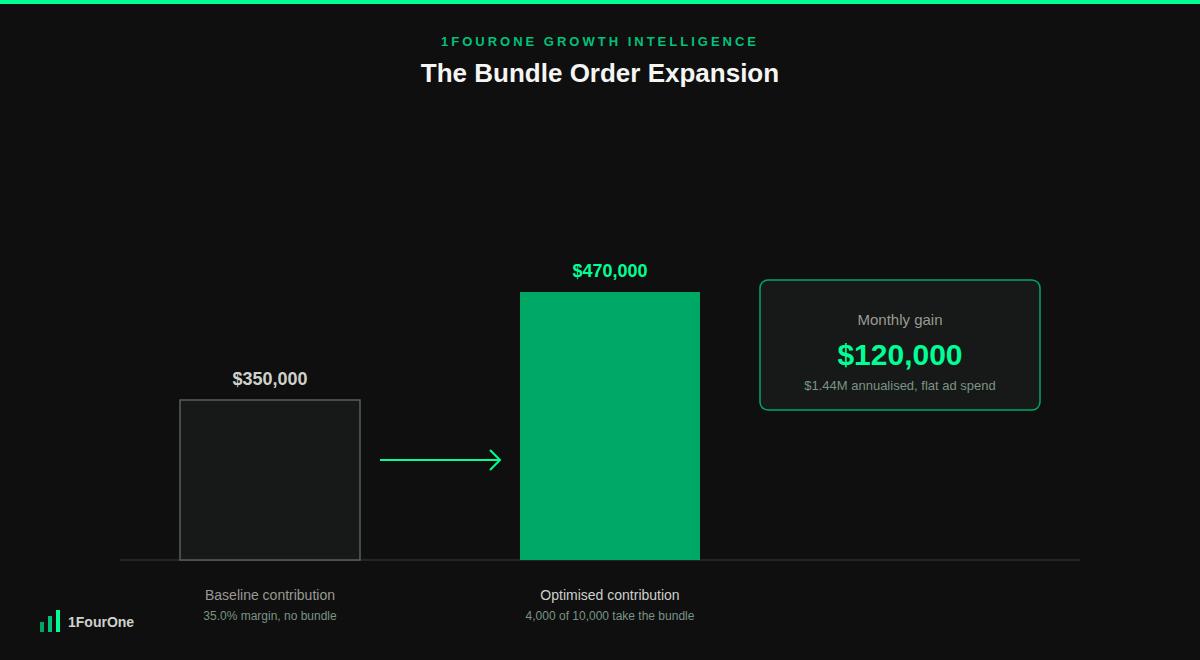
To evaluate the direct commercial impact of a structured bundle engineering sprint, let us examine an established digital retailer processing 10,000 monthly transactions at an Average Order Value of $100 ($1,000,000 gross monthly revenue). Under the baseline operational state, total variable costs equal $65 per order ($35 COGS, $15 fulfilment and shipping, $15 marketing spend), resulting in $650,000 in total monthly variable expenses across the 10,000 orders. This setup leaves a baseline net contribution profit of $350,000 ($1,000,000 revenue minus $650,000 variable costs), yielding a 35.0% contribution margin.
Reviewing inventory metrics uncovers a major merchandising opportunity: standalone sales of the store’s primary flagship product ($100 retail price, $35 COGS) generate steady turnover, but secondary accessory lines ($30 retail price, $5 COGS) sit idle in regional warehouses, incurring holding costs. The business relies on single-item purchases, leaving substantial basket expansion potential untapped on every customer session.
The brand’s growth operations team applies a structured set of ecommerce bundle engineering rules to fix this merchandising imbalance. They design a “Flagship + Dual Accessory” bundle priced at $140 (delivering $160 in total retail value via a $20 promotional discount). The bundle carries a combined COGS of $45 ($35 flagship COGS + $10 combined dual accessory COGS). They present this bundle as a one-click upgrade within the mobile cart drawer.
This bundling strategy transforms store performance metrics. Out of 10,000 monthly buyers, 4,000 select the $140 bundle upgrade, while 6,000 buyers continue purchasing the $100 standalone flagship. Total gross monthly revenue scales to $1,160,000 (4,000 bundles at $140 = $560,000, plus 6,000 standalone orders at $100 = $600,000), expanding Average Order Value from $100 to $116 across all transactions.
The financial return from this bundling program is immediate and highly profitable. Variable costs for the 6,000 standalone orders remain at $65 per unit ($390,000 total), while variable costs for the 4,000 bundle orders total $75 per unit ($45 COGS + $15 fulfilment + $15 marketing spend = $300,000 total). Total monthly variable costs rise to $690,000. Net monthly contribution profit expands from $350,000 up to $470,000 ($1,160,000 revenue minus $690,000 variable costs), securing a $120,000 net monthly profit reclamation ($1,440,000 annualised margin expansion) on a completely flat marketing acquisition budget.
Product bundling packages multiple complementary items together into a single curated offer at a unified price point, often featuring a small built-in price concession. Cross-selling presents individual add-on items separately during the browsing or checkout flow, requiring the customer to add each item to their cart independently at full retail price. Bundling simplifies decision-making and increases basket size by offering a complete solution.
Calculate the maximum allowable bundle discount by summing the individual gross contribution dollars of every item in the proposed bundle at full retail price. Subtract your minimum required net contribution dollar target for the transaction, along with fulfilment and merchant processing fees. The remaining margin represents the absolute maximum dollar discount you can offer while satisfying your profitability targets.
Offering product bundles will not lower conversion rates if the bundles are presented clearly and positioned at appropriate decision points, such as inside the cart drawer or on relevant product detail pages. Presenting clear value propositions, showing explicit dollar savings, and maintaining simple one-click selection mechanics prevents choice overload and supports purchase confidence.
Product bundles clear slow-moving inventory by pairing low-turn accessory items with high-velocity flagship products that already enjoy strong customer demand. Piggybacking slow-moving SKUs onto popular products exposes those accessories to high-intent traffic without requiring dedicated advertising spend. This targeted exposure is exactly what well-designed ecommerce bundle engineering rules are built to achieve, accelerating inventory turnover and freeing up warehouse working capital.
Fixed pre-set bundles typically deliver higher conversion rates for cold acquisition traffic because they eliminate decision fatigue and simplify the buying process. “Build-your-own” bundle flows work exceptionally well for returning customers or broad product catalogues with high category affinity, where buyers appreciate customising their selection. Testing both formats helps identify the optimal structure for your audience.
Allowing unhedged price discounting to erode your net contribution margins is an expensive operational failure that degrades retail profitability. At 1FourOne, we eliminate financial margin drains by deploying disciplined ecommerce bundle engineering rules that expand order values and maximise net cash flow. Contact our growth operations team today to secure a data-driven merchandising audit tailored for your business.
Get your competitive audit in 48 hours and see exactly where your revenue is leaking.
Get Your Audit →