A Public Clearance Sale Recovers Cash and Price Equity in the Same Transaction. Only One of Those Survives.
Executing a data-driven dead stock liquidation strategy is the most vital operational adjustment an established digital retailer can deploy to recover tied-up working capital and eliminate warehouse carrying penalties without damaging public brand price equity. Many mid-market e-commerce brand operators respond to accumulating inventory age by launching aggressive sitewide clearance sales, completely ignoring the long-term margin destruction caused by public discounting. Public price slashing conditions core buyers to delay full-price orders, erodes brand positioning, and inflates customer acquisition overheads. Transitioning to a structured, non-public liquidation architecture enables growth teams to clear stagnant inventory, protect marketing spend efficiency, and safeguard compounding customer lifetime value assets.
E-commerce enterprises routinely suffer from invisible cash flow leaks caused by slow-moving and obsolete inventory accumulating across regional fulfilment nodes. When products sit in warehouse racks past their primary seasonal window, they incur ongoing carrying fees, including storage floor rent, insurance premiums, handling labour, and shrinkage risks. Holding aging stock for extended periods quietly drains operating cash flow that should be funding high-velocity inventory reorders.
Operating a storefront with unmonitored inventory age creates severe operational vulnerability across a corporate balance sheet. As warehouse storage fees scale, total unit contribution margins compress, leaving less capital available for growth initiatives. If a retail brand attempts to clear this aging stock through public front-end price cuts, it creates a secondary financial leak: core customers who were prepared to pay full retail price substitute their purchases with heavily discounted clearance items, compressing overall average order value.
To build a resilient retail business, commercial executives must treat aging inventory as a capital recovery exercise rather than a marketing event. Understanding the exact holding cost percentage attached to every warehouse pallet allows supply chain and marketing teams to establish clear liquidation triggers. Shifting from public price slashing to controlled, private liquidation channels ensures that capital is recovered efficiently without compromising full-price market positioning.
Building a defensible digital retail model requires far deeper financial discipline than top-line transaction reporting can supply. Incorporating inventory age auditing into your broader growth intelligence matrix enables commercial teams to measure the true net yield of every inventory recovery channel. By comparing the fully loaded net cash yield of private VIP sales, B2B wholesale liquidations, and bundle inclusions, managers can select the optimal recovery path for every product category. This analytical oversight prevents businesses from destroying gross margins in public advertising auctions.
Avoiding public clearance events on primary storefront channels also directly protects your paid customer acquisition programs. Running digital ad campaigns promoting heavy price cuts attracts bargain-seeking audience segments that rarely convert at full retail price in subsequent months, quietly degrading the quality of every future paid customer acquisition cohort. Protecting long-term customer lifetime value metrics requires keeping your public storefront focused on value-driven flagship offerings, reserving promotional price concessions for authenticated, private customer segments.
Validating private inventory liquidation against established empirical business research underscores its commercial importance. Published research by the Harvard Business Review confirms that increasing customer retention rates by 5% scales overall corporate profits by 25% to 95%. This empirical baseline demonstrates why offering exclusive, private clearance access to your most loyal customer cohorts preserves brand affinity while recovering working capital, generating the reliable cash flow required to support business expansion.
| Liquidation Channel | Primary Margin Mechanism | Operational Capital Goal |
|---|---|---|
| Private VIP Member Events | Password-protected access for authenticated email buyers | Capturing maximum retail yield without public price exposure. |
| Off-Price B2B Liquidators | Bulk inventory sales to non-competing secondary markets | Clearing large volume batches to eliminate holding overheads instantly. |
| In-Cart Mystery Add-Ons | Bundling aging stock as surprise gifts with full-price orders | Elevating average order values while clearing secondary items. |
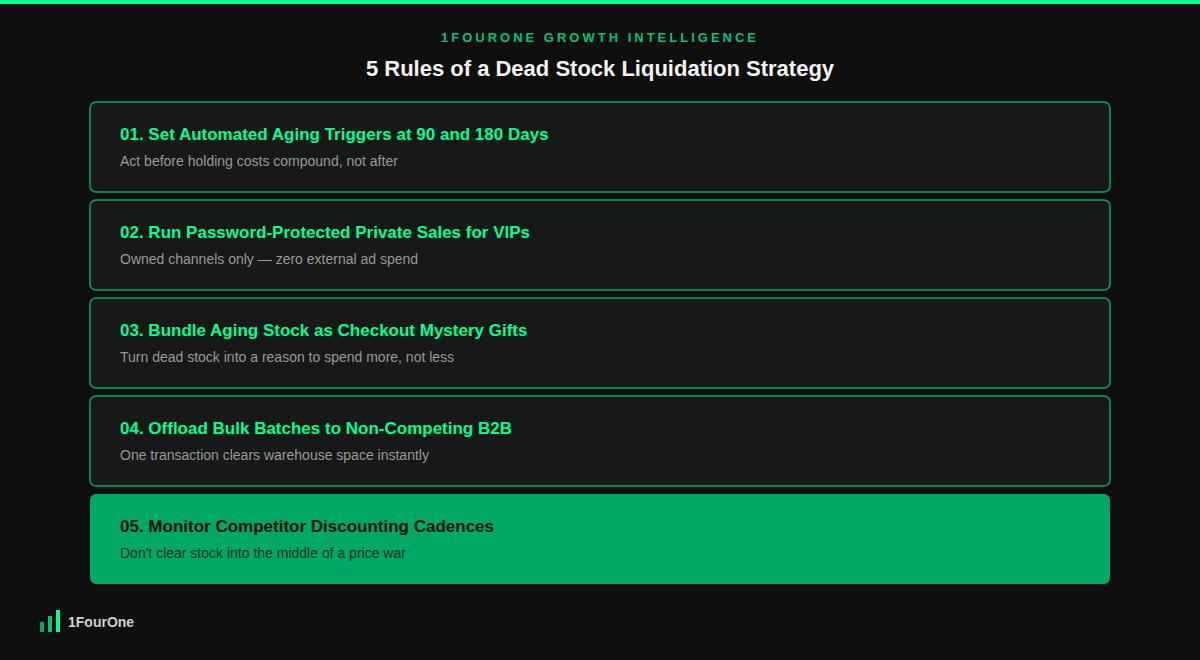
To systematically recover working capital and eliminate warehouse storage penalties, your commercial team must institutionalise a structured dead stock liquidation strategy across all inventory tiers. This operational framework replaces public price slashing with controlled, channel-segmented capital recovery workflows. The following five rules provide a repeatable methodology to audit inventory age, protect marketing spend efficiency, and recover liquid cash flow.
The foundation of effective inventory governance is establishing automated liquidation triggers based on explicit inventory age thresholds rather than waiting for warehouse capacity bottlenecks to force action. Allowing slow-moving inventory to sit past 180 days without a recovery plan results in compounding storage fees and deep inventory write-downs. Setting automated aging alerts ensures supply chain teams intervene before holding costs destroy product margin.
Configure your inventory management system to flag SKUs automatically as they pass 90 days of sitting idle without reaching historical turnover velocity benchmarks. Align these inventory flags with rules from our operational guide on inventory allocation strategy rules. Flagging aging stock early allows your team to initiate mild promotional bundling before aggressive liquidation becomes necessary.
Slashing prices publicly on your primary website navigation menus damages brand equity and alerts competitors to inventory management issues. To clear aging stock while maintaining public price integrity, commercial teams should host password-protected private sale events restricted to authenticated email subscribers and loyalty program members. Private sales deliver compelling value to your core audience without exposing discounted prices to casual browsers.
Build dedicated, unindexed landing pages protected by customer login gates, and announce the event exclusively through owned email and SMS channels. Using owned communications eliminates external ad spend, protecting overall marketing spend efficiency. Delivering exclusive clearance access to existing customers reinforces subscriber loyalty while recovering tied-up inventory capital.
Another highly efficient method for clearing secondary aging inventory is incorporating slow-moving SKUs into cart drawer promotion mechanics as mystery gifts or threshold rewards. Offering a complimentary mystery item when a customer’s cart value reaches a target spend threshold incentivises buyers to add full-priced items to their order. This approach transforms aging stock into a powerful tool for basket expansion.
Ensure that the perceived retail value of the mystery gift is communicated clearly while keeping the specific item selection hidden until package unboxing. As documented in our operational guide on how to reduce checkout abandonment tactics, presenting compelling threshold rewards during checkout elevates conversion velocity. To keep the unboxing experience itself genuinely satisfying rather than a source of complaints, benchmark your fulfilment quality against the international guidelines in ISO 10004:2018. Converting stagnant inventory into order-value incentives recovers product cost while increasing overall contribution margin per transaction.
When aging inventory volumes exceed what internal private sales or cart threshold rewards can absorb, attempting to clear the excess through retail channels takes too long, accumulating excessive storage fees. For high-volume inventory accumulation, supply chain teams must establish relationships with off-price B2B liquidators and secondary marketplace buyers. Offloading bulk inventory in single transactions clears warehouse space instantly.
Structure wholesale liquidation agreements with strict geographic and channel restrictions to ensure off-price liquidators do not resell products in your primary direct-to-consumer markets. Synchronising wholesale liquidation rules with dynamic retail pricing parameters, as outlined in our strategic guide on ecommerce dynamic pricing strategy, prevents channel conflict. Bulk B2B offloading replaces ongoing holding penalties with immediate liquid cash.
Executing an inventory clearance program without monitoring rival promotional activity can inadvertently trigger destructive price wars in paid ad auctions. If a direct competitor is simultaneously liquidating similar product lines through heavy public ad spend, launching a public promotional campaign on the same keywords drives up bidding costs while diluting conversion rates. Marketing teams must evaluate competitive activity before launching promotional messaging.
Continuously track rival ad creative, promotional landing pages, and email cadences using automated competitive monitoring tools. As detailed in our strategic guide on competitor ad audit 5 rules, tracking rival promotional strategies enables you to adjust campaign timing and messaging proactively. Incorporating parameters from our framework on predictive churn audit rules ensures you protect core customer accounts without engaging in margin-depleting ad bidding battles.
To evaluate the direct commercial impact of a private dead stock liquidation strategy, let us examine an established digital retailer holding $200,000 in inventory cost ($500,000 original retail value) of aging, slow-moving seasonal stock across regional fulfilment facilities. Standard warehouse holding costs average 20% annually ($40,000 annual holding penalty), quietly eroding operating cash flow and locking up working capital.
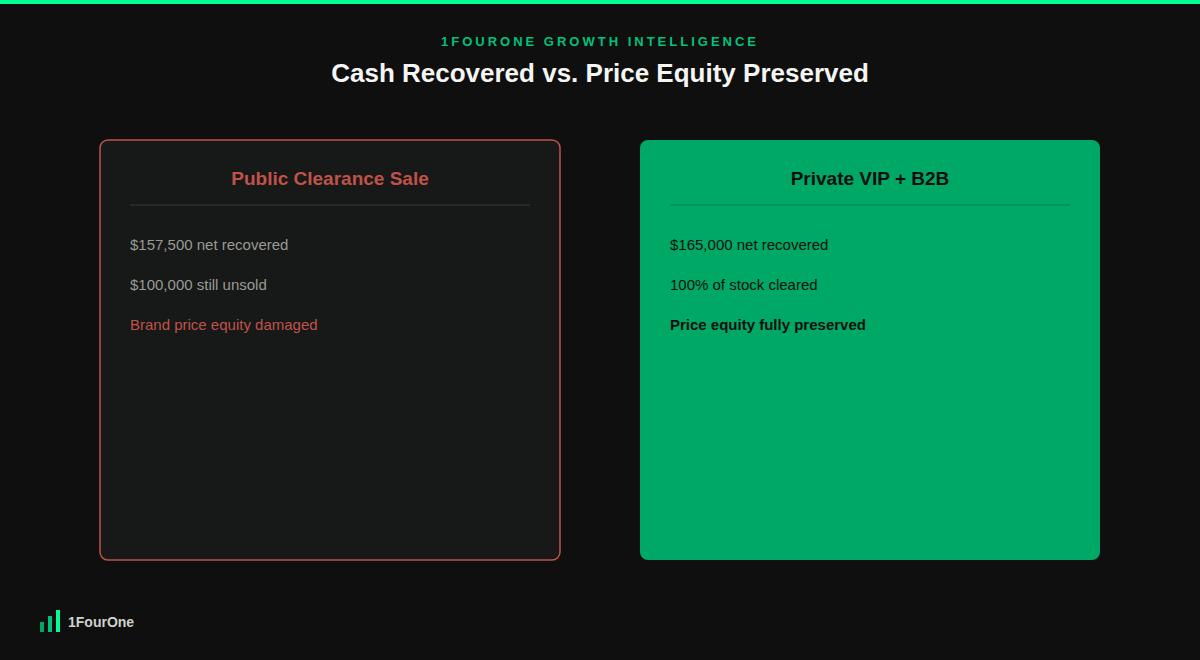
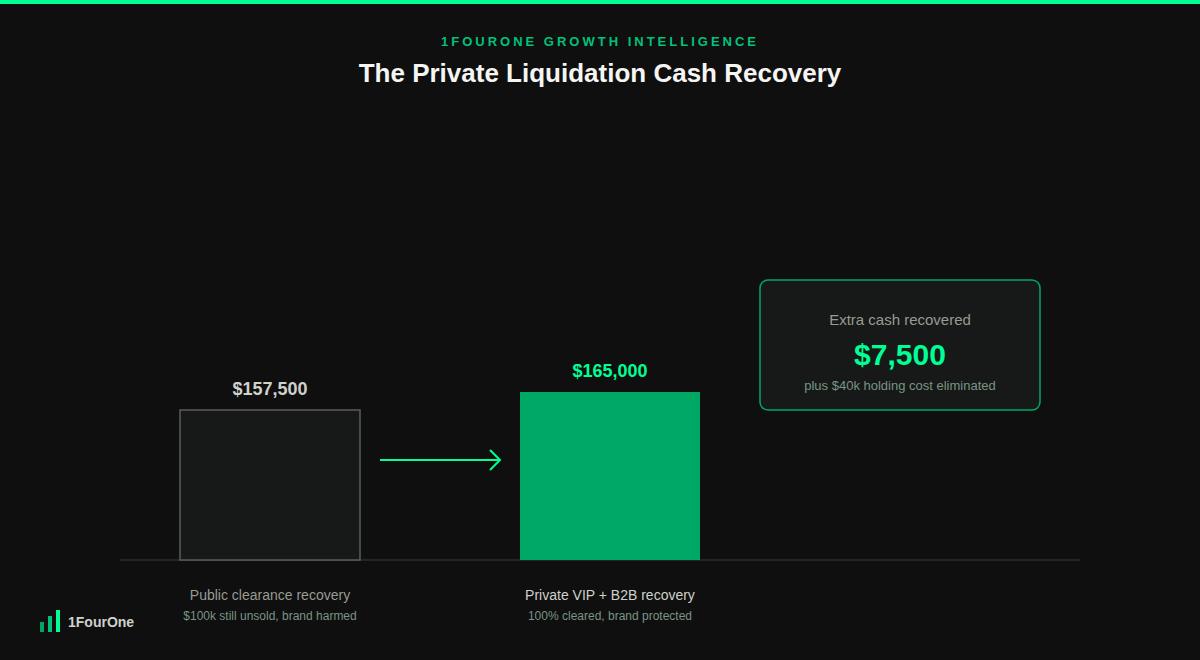
Reviewing the unhedged failure scenario reveals the danger of public clearance events: running a public 50% sitewide clearance sale on the main storefront sells half the inventory ($250,000 gross revenue), but damages brand price equity. External paid ad spend to drive traffic to the public sale totals $50,000, fulfilment and handling costs total $35,000, and merchant processing fees total $7,500. Net cash recovered is $157,500 ($250,000 sales minus $92,500 variable costs), leaving $100,000 in inventory cost unliquidated ($20,000 ongoing annual holding penalty), plus widespread brand devaluation among full-price buyers.
The brand’s growth operations team executes a structured, private dead stock liquidation strategy to recover this capital safely. They route $150,000 retail value through a private, password-protected VIP member event ($90,000 sales at a 40% private discount) and sell the remaining $350,000 retail value batch to a non-competing off-price B2B liquidator at 25% of original retail value ($87,500 bulk wholesale payout). Total recovered gross revenue equals $177,500 ($90,000 VIP sales plus $87,500 B2B payout).
This private operational structure alters the financial recovery metrics completely. Because the VIP event relies entirely on owned email and SMS lists (zero external ad spend) and the B2B liquidator covers freight, total variable expenses drop to $12,500 (VIP pick-pack labour and payment processing). Net cash recovered scales to $165,000 ($177,500 gross revenue minus $12,500 variable costs).
The financial return from this private liquidation strategy is immediate and highly advantageous. The brand secures a $7,500 higher net cash yield ($165,000 private recovery versus $157,500 public clearance) while completely liquidating the entire aging inventory batch, eliminating the $40,000 annual holding cost drain. Crucially, the brand preserves 100% of its public price equity, protecting ongoing contribution margins across its primary flagship product lines.
Dead stock refers to inventory that has remained unsold in fulfilment facilities past its expected selling season, typically 90 to 180 days without generating sales velocity. This aging inventory incurs ongoing warehouse storage fees, locks up working capital, and risks total obsolescence. A disciplined dead stock liquidation strategy identifies this inventory early, giving operations teams a chance to execute capital recovery before carrying costs destroy product value.
Public price discounting damages long-term brand equity by conditioning customers to delay purchases until sales events occur, eroding baseline full-price demand. Prominently displaying heavy price cuts on public storefront navigation menus creates a bargain brand perception, making it difficult to sell flagship items at full price in subsequent months. Private liquidation channels prevent this brand devaluation by keeping discounts hidden from the general public.
Recovery rates from off-price B2B liquidators typically range between 10% and 30% of original retail value, depending on product category, brand reputation, and batch volume. While wholesale liquidation payouts represent a significant discount off original retail price, bulk B2B sales eliminate ongoing storage fees immediately, free up warehouse space, and deliver instant liquid cash flow without requiring internal fulfilment labour.
Prevent channel undercutting by incorporating strict reseller covenants into wholesale liquidation contracts that restrict where and how the inventory can be resold. Mandate that liquidators sell only through offline physical off-price stores, international secondary markets, or non-competing online platforms. Explicit contract terms prevent liquidated stock from competing directly against your primary direct-to-consumer digital channels.
Yes, aging stock can improve acquisition efficiency when structured as a non-cash bonus item or high-value gift-with-purchase for new customer acquisition offers. Bundling an aging item with a flagship product allowed you to present a high total package value to cold ad traffic without lowering the base retail price of your flagship product. This value-add offer increases initial checkout conversion rates while clearing secondary inventory.
Allowing slow-moving inventory to accumulate in regional warehouses while eroding brand equity through public price cuts is an expensive operational failure that degrades retail profitability. At 1FourOne, we eliminate financial margin leaks by deploying structured private liquidation frameworks that recover working capital and maximise net cash flow. Contact our growth operations team today to secure a data-driven inventory audit tailored for your business.
Get your competitive audit in 48 hours and see exactly where your revenue is leaking.
Get Your Audit →