Getting Existing Customers to Buy Again Without Spending More on Ads
Executing a structured customer lifetime value optimisation framework is the most effective operational adjustment a mid-market e-commerce business can deploy to build compounding profitability as ad auction inflation degrades front-end media returns. Many digital retail brands direct their capital exclusively toward front-end traffic expansion, completely neglecting the post-purchase retention architectures that determine long-term enterprise value. Failing to systematically maximise repeat order frequencies and cohort retention rates forces your business into a costly cycle of customer replacement. Shifting focus toward backend lifecycle engineering allows growth teams to stabilise cash flow, protect operating margins, and extract maximum commercial yield from existing customer accounts.
Modern digital retail brands often suffer from an over-reliance on paid customer acquisition channels to drive top-line revenue growth. When digital ad networks increase bidding costs or alter targeting rules, brands that rely solely on first-time buyer volume experience immediate margin compression. This structural vulnerability occurs because the cost to acquire a cold visitor routinely consumes the entire gross margin of the initial transaction. Relying on single-purchase buyers creates a fragile business model that cannot withstand market volatility.
Managing an e-commerce operation without tracking cohort repurchase timing introduces significant financial risk into your long-term forecasting models. Front-end acquisition metrics indicate how effectively your ad creative generates initial site visits, but they reveal nothing about whether those buyers will ever return. If a large percentage of your customer base churns after a single purchase, your media spend is essentially subsidising temporary traffic rather than building an enduring brand asset. Protecting net contribution margins requires a strategy that converts one-off buyers into loyal, repeat customers.
To break free from this expensive acquisition cycle, growth operations must implement data-driven post-purchase workflows. Focusing on backend retention metrics allows your business to capture compounding revenue from customer relationships that have already absorbed their initial acquisition overheads. Shifting resources toward backend re-engagement stabilises unit economics, reduces reliance on paid channels, and builds a sustainable foundation for long-term retail growth.
Achieving sustainable e-commerce growth requires far deeper operational visibility than top-line sales dashboards can provide. True growth intelligence depends on analysing customer cohort survival curves, repeat purchase velocity, and contribution margin profiles over multi-year horizons. By evaluating these long-term behavioural metrics, analytical teams can determine which customer segments generate genuine profit and which ones merely inflate short-term transaction counts. This disciplined perspective prevents businesses from over-investing in low-value customer groups.
Prioritising customer retention is also directly validated by established empirical business research. Comprehensive data published by the Harvard Business Review confirms that increasing customer retention rates by 5% increases overall corporate profits by 25% to 95%. This mathematical reality highlights why deploying a disciplined customer retention strategy yields a significantly higher return on capital than continuously expanding front-end ad budgets. Protecting existing customer accounts preserves gross margins across your entire product catalogue.
Maximising post-purchase margins requires your technical teams to integrate their customer analytics directly with an ecommerce first party data strategy to monitor behavioural signals in real time. Capturing clean, owned interaction data allows your team to map exact repurchase intervals across every product category. This clear data pipeline ensures you can trigger personalised re-engagement campaigns precisely when a customer’s likelihood of making a repeat purchase peaks, protecting overall marketing spend efficiency.
| Lifecycle Stage | Primary Behavioural Metric | Operational Retention Target |
|---|---|---|
| First-Purchase Onboarding | 30-day unboxing and product engagement rate | Establishing immediate product utility to reduce early buyer remorse. |
| Repurchase Transition Window | 60-to-90-day secondary order conversion rate | Triggering timely replenishment offers before historical drop-off occurs. |
| VIP Cohort Maintenance | Annual order frequency and average basket value | Providing exclusive access to protect high-margin customer segments. |
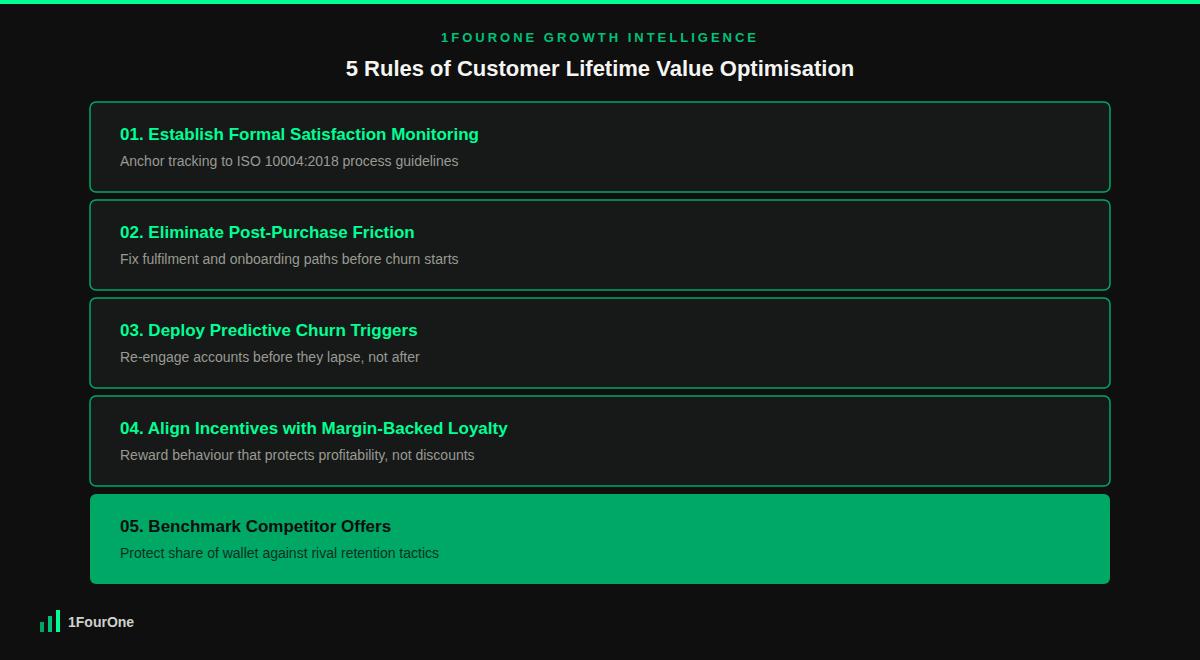
To systematically increase repeat order volume and protect your operating margins, your team must execute a disciplined customer lifetime value optimisation framework. This operational approach replaces uncoordinated promotional emails with structured, data-driven lifecycle rules. The following five rules provide a repeatable methodology to increase purchase frequency, reduce customer churn, and improve long-term marketing spend efficiency.
Constructing a high-performing retention engine requires an objective, repeatable process for measuring customer satisfaction across the entire post-purchase journey. Relying on informal feedback or isolated review scores prevents your team from identifying systemic operational issues that drive customer churn. To ensure analytical rigour, your post-purchase tracking protocols should align with the international guidelines set out in ISO 10004:2018.
Standardising your customer feedback collection against these recognized process guidelines ensures your team captures reliable satisfaction metrics at every major touchpoint. When post-purchase surveys or delivery metrics indicate potential customer friction, your automated systems can immediately route the issue to support teams for resolution. Resolving service issues proactively protects customer goodwill, prevents negative brand sentiment, and preserves the long-term value of your acquired customer cohorts.
A significant proportion of customer churn occurs shortly after the initial order due to unoptimised fulfilment communication or poor product onboarding sequences. When a customer encounters unexpected shipping delays, confusing tracking updates, or unhelpful product instructions, their trust in the brand degrades rapidly. This early friction destroys purchase momentum, making it extremely difficult to convert first-time buyers into repeat customers.
Your operations team must audit every post-purchase touchpoint to remove unnecessary friction from the delivery experience. Provide real-time shipping updates, clear unboxing instructions, and proactive usage tips to ensure customers get immediate value from their purchase. As detailed in our operational guide on how to reduce checkout abandonment tactics, eliminating user experience friction across every transactional touchpoint is essential to build lasting brand affinity and encourage repeat orders.
Waiting for a customer to stop opening emails or abandon their account before attempting re-engagement is a reactive approach that yields poor recovery rates. Your data engineering team must analyse historical transaction patterns to identify the specific behavioural signals that indicate a declining purchase intent. Track average order intervals across different product categories to determine the exact time window when an account moves into at-risk status.
When an active customer exceeds their expected repurchase window without placing a new order, your automated systems should immediately trigger tailored re-engagement workflows. Growth teams should coordinate these interventions with their broader retention infrastructure, incorporating guidelines from our strategic framework on predictive churn audit rules to structure effective win-back sequences. Re-engaging customers before they lapse preserves valuable account relationships without relying on heavy discounting.
Offering generic, site-wide discount codes to incentivise repeat purchases is an unoptimised tactic that erodes product margins and conditions customers to wait for sales. To build sustainable profitability, your retention incentives must be structured through a margin-backed rewards framework that encourages specific, high-value behaviours. Design your loyalty parameters to reward behaviours that directly support long-term profitability, such as higher order frequencies or multi-item basket sizes.
Your team should construct a tiered rewards system that provides increasing value as a customer’s cumulative spend grows over time. Consult our operational guide on loyalty program design to engineer reward structures that protect your core contribution margins while incentivizing repeat purchases. Offering exclusive perks, early product access, or dedicated support creates meaningful differentiation that locks in customer loyalty without sacrificing unit economics.
Even highly satisfied customers will consider alternative options if competing brands present superior value propositions or aggressive promotional offers. Your growth operations team must continuously monitor rival marketing strategies to ensure your post-purchase offers remain compelling in the market. Understanding how competitors structure their bundle offers, subscription discounts, and loyalty perks enables you to refine your retention messaging proactively.
Integrating competitive intelligence into your lifecycle marketing prevents rival brands from poaching your most valuable customer segments. As outlined in our strategic breakdown of competitor ad audit 5 rules, tracking the offer structures and creative strategies of immediate rivals helps you identify open market opportunities. Use these insights to craft targeted post-purchase communications that reinforce your unique value proposition and protect your overall share of wallet. Treating this as a standing input to your customer retention strategy, rather than a one-off competitive check, keeps your lifecycle offers relevant as the market shifts around you.
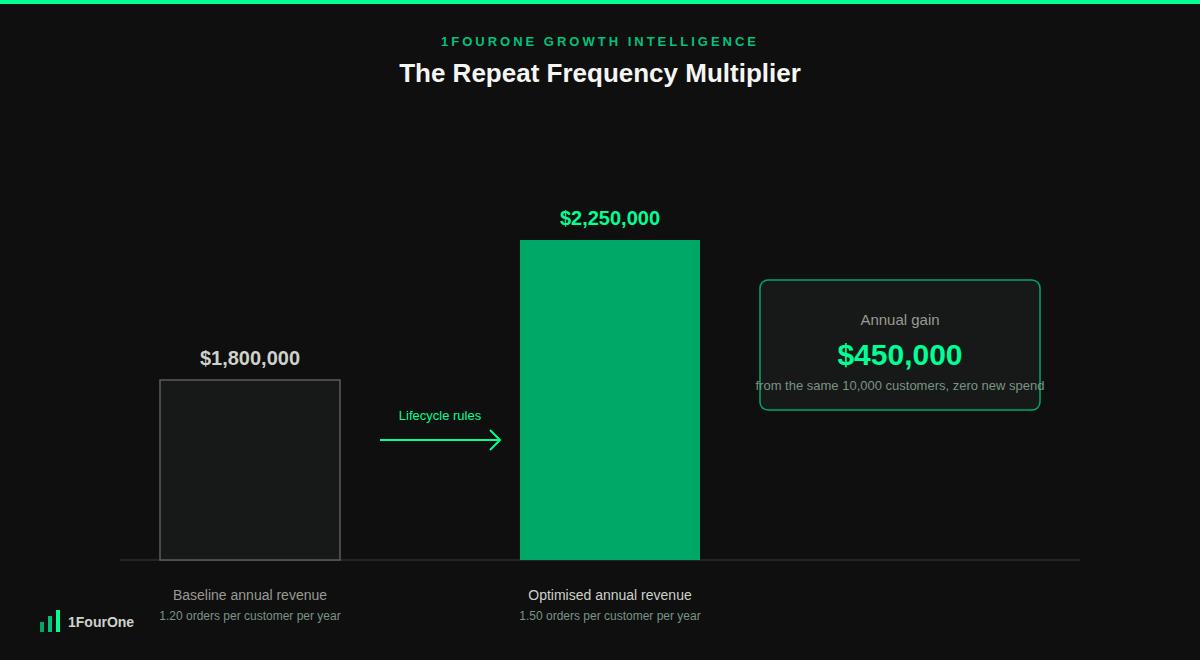
To evaluate the direct commercial impact of structured customer lifetime value optimisation, let us examine an established mid-market e-commerce business with an active base of 10,000 customers. Under the baseline scenario, these customers place an average of 1.20 orders per year at a stable Average Order Value of $150. This baseline performance generates 12,000 total annual orders (10,000 customers multiplied by 1.20 orders), resulting in $1,800,000 in baseline annual gross revenue (12,000 orders multiplied by $150 AOV).
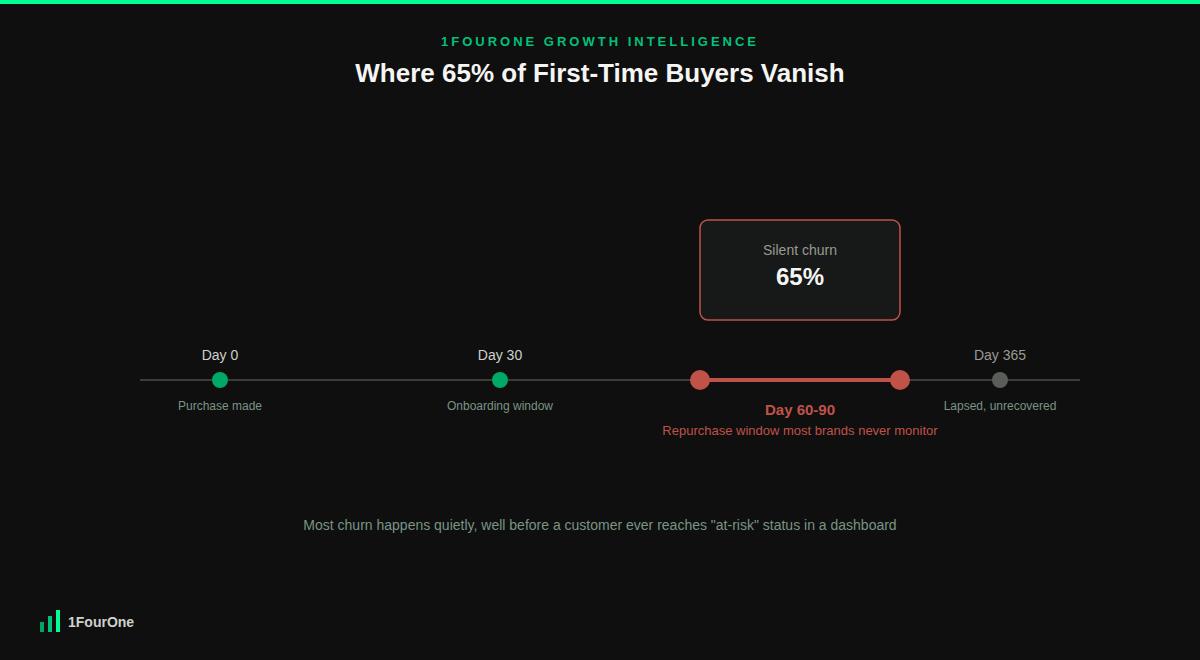
Reviewing the post-purchase analytics reveals a major retention opportunity: over 65% of first-time buyers never make a second purchase, despite reporting high initial product satisfaction. The business relies heavily on paid customer acquisition to maintain its annual sales volume, spending significant capital each month to replace churning customers. This reliance on cold traffic limits profit margins, as acquisition costs consume a large portion of the gross margin generated on initial transactions.
The brand’s growth operations team implements a comprehensive lifecycle re-engagement program to address this retention leak. They set up automated onboarding sequences, deploy predictive re-engagement triggers for accounts approaching their expected repurchase window, and launch a tiered loyalty program designed to incentivise repeat orders. These structural improvements eliminate post-purchase friction and encourage sustained brand engagement across the entire customer base.
This post-purchase optimisation program increases the average annual order frequency across the 10,000 customer base from 1.20 to 1.50 orders per year. With customer count and Average Order Value remaining stable at 10,000 buyers and $150 respectively, total annual order volume expands from 12,000 to 15,000 orders (10,000 customers multiplied by 1.50 orders). The brand’s optimised annual gross revenue reaches $2,250,000 (15,000 orders multiplied by $150 AOV).
The financial return from this lifecycle optimisation program is immediate and highly profitable for the business. Without spending any additional capital on paid customer acquisition, the brand increases its annual gross revenue by $450,000 ($2,250,000 optimised revenue minus $1,800,000 baseline revenue). Because these additional orders come from existing customers whose initial acquisition costs were already absorbed, this revenue expansion translates directly into expanded operating margins and improved cash flow.
Customer retention rate measures the percentage of active buyers who remain engaged with your brand or make a repeat purchase over a specific timeframe. Customer lifetime value represents the total net profit or gross revenue a single customer account generates across their entire relationship with your business. While retention rate tracks cohort loyalty, lifetime value quantifies the total financial returns generated by those retained customer relationships.
Post-purchase communication should initiate immediately after order confirmation with clear transaction details and fulfilment expectations. Educational content, usage instructions, and brand story messaging should be delivered while the customer awaits delivery to maintain excitement and reduce order anxiety. Providing immediate value during this period establishes a positive foundation for long-term customer engagement.
Increasing order frequency does not inherently reduce average order value if your lifecycle communications are structured effectively. By recommending relevant complementary products, replenishment items, or exclusive bundle options, you can maintain or even increase basket size on repeat orders. Tailoring recommendations to previous purchase history ensures that repeat offers remain relevant and valuable to the customer.
Calculate baseline customer lifetime value by multiplying your average order value by your average annual purchase frequency, then multiplying that figure by the average customer lifespan in years. To determine net lifetime value, apply your average gross margin percentage to the total revenue figure and subtract direct servicing costs. Ongoing customer lifetime value optimisation means tracking this metric across different customer cohorts to identify your most profitable buyer profiles, not just calculating it once.
Offering immediate price discounts to drive repeat purchases can condition customers to expect lower prices and erode your product margins over time. Instead, focus early re-engagement efforts on value-add content, product usage education, and loyalty point incentives that build brand affinity. Reserve financial incentives for win-back campaigns targeting lapsed accounts that have passed their expected repurchase window.
Failing to pursue disciplined customer lifetime value optimisation allows hard-earned retail margins to drain away through unaddressed cohort churn. At 1FourOne, we eliminate growth bottlenecks by deploying comprehensive retention frameworks that maximise repeat purchase frequency and protect operating profitability. Contact our growth operations team today to secure a data-driven performance audit tailored for your business.
Get your competitive audit in 48 hours and see exactly where your revenue is leaking.
Get Your Audit →