Your 3.0x ROAS Is Hiding a Product Line That Loses $35,000 a Month
Implementing a data-driven contribution margin bidding strategy is the most essential operational adjustment a mid-market e-commerce enterprise can deploy to prevent digital advertising platforms from spending media capital on unprofitable product lines. Many online brand operators evaluate paid acquisition performance using top-line Return on Ad Spend (ROAS), completely failing to account for underlying COGS, pick-and-pack labour, payment gateway fees, and shipping surcharges. Bidding aggressively on gross revenue targets tricks advertising algorithms into scaling sales volume on thin-margin SKUs that lose money on every order. Transitioning to a contribution-adjusted bidding architecture enables growth teams to eliminate wasteful media spend, protect marketing spend efficiency, and build compounding cash flow.
Modern e-commerce marketing teams frequently suffer from hidden financial losses caused by an over-reliance on top-line ad platform reporting. Standard advertising dashboards display aggregate revenue return targets that treat every dollar of sales as equal, regardless of individual product cost structures. A campaign promoting a thin-margin accessory line might report an impressive 3.0x revenue ROAS on Meta or Google, but once fulfilment overheads and merchant fees are deducted, every conversion generates a net operating loss.
Operating paid acquisition campaigns without itemised contribution margin targets creates severe structural vulnerabilities across a corporate balance sheet. When ad platform bidding algorithms are instructed to maximise gross revenue, their machine-learning engines automatically push spend toward low-friction, cheap-to-convert items that carry poor unit margins. As media buyers scale budgets based on inflated front-end revenue totals, net operating income contracts, draining liquid operating capital.
To establish a resilient retail enterprise, commercial executives must realign media acquisition targets with true unit economics. Understanding the exact net contribution dollar yield of every inventory category allows growth teams to set dynamic target return floors for specific product groups. Shifting from top-line revenue bidding to disciplined contribution margin governance ensures that digital ad budgets fund transactions that generate genuine enterprise profit.
Building a scalable digital retail business requires far deeper financial integration than basic pixel tracking can supply. Incorporating fully loaded contribution margins into your broader growth intelligence matrix enables commercial teams to measure the true cash flow impact of every ad campaign. By feeding net profit values rather than top-line order totals into advertising platform conversion APIs, performance marketers can train bidding algorithms to optimise for net dollar yield. This structural alignment prevents brands from subsidising low-yielding sales volume.
Aligning bidding limits with unit contribution margins also directly protects your broader paid customer acquisition programs. When ad spend is concentrated on high-margin flagship products, each initial transaction generates sufficient gross profit dollars to cover upfront media acquisition costs. Protecting long-term customer lifetime value metrics requires ensuring that initial product entries yield strong contribution margins, providing the necessary capital to fund post-purchase retention and re-engagement workflows.
Validating margin-based bidding architectures against established empirical business research underscores its commercial importance. Published research by the Harvard Business Review confirms that increasing customer retention rates by 5% scales overall corporate profits by 25% to 95%. This empirical baseline demonstrates why maximising net contribution profit on initial customer transactions creates the financial stability required to invest in long-term customer relationships, generating reliable cash flow to support business expansion.
| Product Margin Tier | Unit Net Contribution Profile | Media Bidding Governance Action |
|---|---|---|
| High-Margin Flagships (>50%) | Generates strong net profit after fulfilment overheads | Lowering target ROAS thresholds to aggressively scale impression share. |
| Medium-Margin Core Lines (30%-50%) | Generates moderate net profit; sensitive to freight costs | Enforcing strict target ROAS floors aligned with fully loaded COGS. |
| Thin-Margin Accessories (<30%) | Generates thin or negative net profit after pick-pack fees | Capping ad spend and restricting conversions to multi-item bundles. |
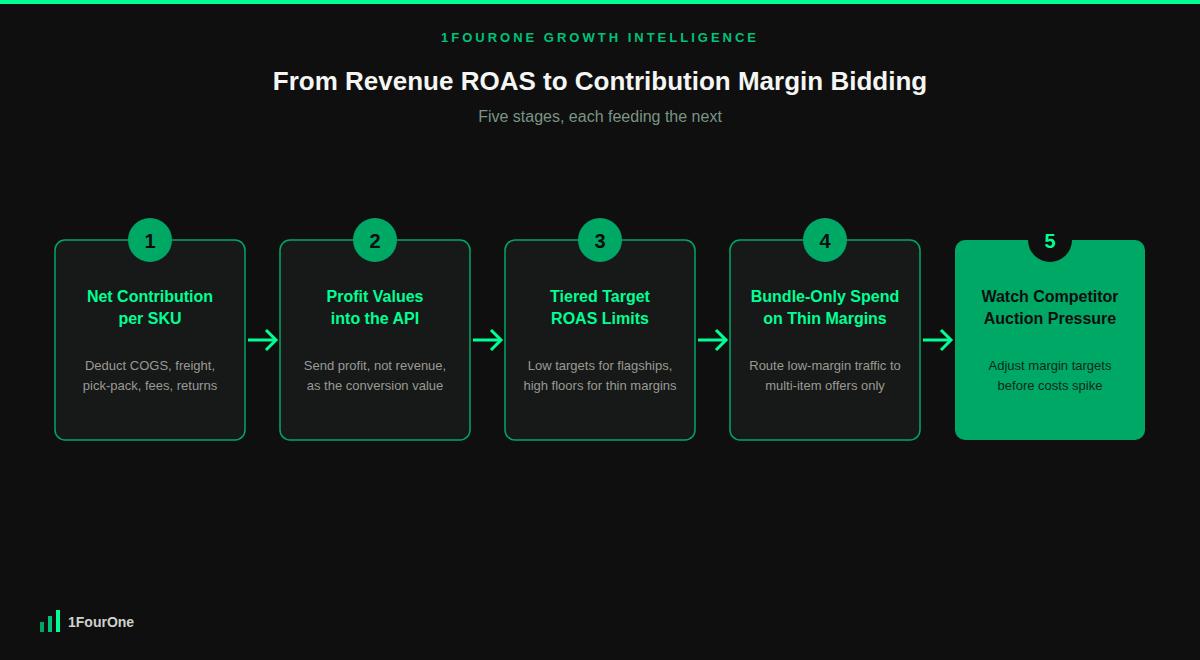
To systematically eliminate media spend waste and maximise net cash flow, your commercial team must institutionalise a structured contribution margin bidding strategy across all digital acquisition channels. This operational approach replaces unadjusted revenue targets with unit-level profit governance. The following five rules provide a repeatable methodology to audit campaign profitability, protect marketing spend efficiency, and scale net contribution margins.
The foundation of effective margin-backed bidding is calculating the exact net contribution dollar value for every product variant rather than relying on simple gross margin percentages. Evaluating items based solely on wholesale cost versus retail price ignores variable fulfilment labour, packaging materials, merchant processing fees, and category return rates. Failing to deduct these operational expenses leads to overestimating campaign profitability.
To calculate fully loaded unit contribution, subtract COGS, inbound freight, pick-and-pack labour, merchant gateway fees, and average return handling costs from net retail realisation. Integrate these unit calculations into your media campaign parameters alongside guidelines from our operational framework on inventory allocation strategy rules. Itemising true unit contribution ensures performance marketers set target return thresholds based on real profit margins.
Relying on standard ad platform conversion pixels that report gross revenue values forces bidding engines to optimise blindly for top-line order size. When an ad algorithm receives a gross purchase signal of $100, it treats that conversion identically whether the product yielded $50 in net margin or $5 in net margin. Performance marketing teams must pass net contribution values directly to advertising network conversion APIs.
Configure your server-side tracking container to calculate net contribution dollars dynamically at checkout and pass that custom profit value as the primary conversion metric to Meta and Google APIs. As detailed in our strategic breakdown of ecommerce dynamic pricing strategy, feeding profit signals to bidding engines forces algorithms to optimise delivery toward high-margin transactions. Profit-based API value signals directly improve campaign capital efficiency and protect the customer lifetime value of every cohort the algorithm acquires.
Applying a uniform target ROAS goal across an entire ad account containing products with varying margin profiles causes severe capital misallocation. High-margin items can operate profitably at lower ROAS targets, whereas thin-margin items require high ROAS targets to break even. Forcing a single account-wide ROAS target restricts ad spend on high-margin products while over-spending on thin-margin stock.
Structure your ad accounts into distinct campaign clusters grouped by unit contribution margin tiers. Set aggressive, low target ROAS limits for high-margin flagship campaigns to maximise impression reach, while enforcing high, conservative target ROAS floors for thin-margin categories. Tiered bid management ensures advertising spend remains strictly aligned with actual unit profitability.
Promoting standalone thin-margin items through paid acquisition channels is an unoptimised practice that frequently generates net operating losses. When pick-and-pack labour and shipping surcharges absorb most of a low-cost item’s gross margin, paying for paid customer acquisition on single-item orders destroys campaign returns. Marketing teams must restrict ad spend on thin-margin stock to multi-item bundle offers.
Route paid traffic for low-margin accessories exclusively to curated bundle landing pages or multi-pack checkout options. As documented in our operational guide on how to reduce checkout abandonment tactics, offering multi-item bundle upgrades elevates average basket size while covering fixed fulfilment overheads. To confirm bundle buyers are genuinely satisfied rather than simply converting, benchmark your post-purchase satisfaction tracking against the international guidelines in ISO 10004:2018. Restricting low-margin stock to bundle offers converts unprofitable single-item ad traffic into high-margin multi-item purchases.
Executing a margin-backed bidding strategy without monitoring rival advertising activity leaves your high-margin campaigns vulnerable to sudden competitive shifts. If a direct competitor launches an aggressive promotional campaign targeting your primary keywords, ad auction costs can spike rapidly, eroding your net contribution margins. Performance marketers must monitor competitor auction pressure continuously.
Continuously track rival ad creative, promotional offers, and search impression shares across primary acquisition channels. As detailed in our strategic guide on competitor ad audit 5 rules, tracking rival promotional strategies enables you to adjust target return thresholds proactively. Incorporating parameters from our framework on predictive churn audit rules ensures you protect core customer acquisition campaigns without engaging in margin-depleting ad bidding wars.
To evaluate the direct commercial impact of a contribution margin bidding strategy, let us examine an established digital retailer spending $200,000 per month on paid customer acquisition across two core product lines (Category A: $100,000 monthly spend; Category B: $100,000 monthly spend). Under the baseline operational setup, total monthly gross sales equal $600,000, displaying a blended revenue ROAS of 3.0x on advertising dashboards.
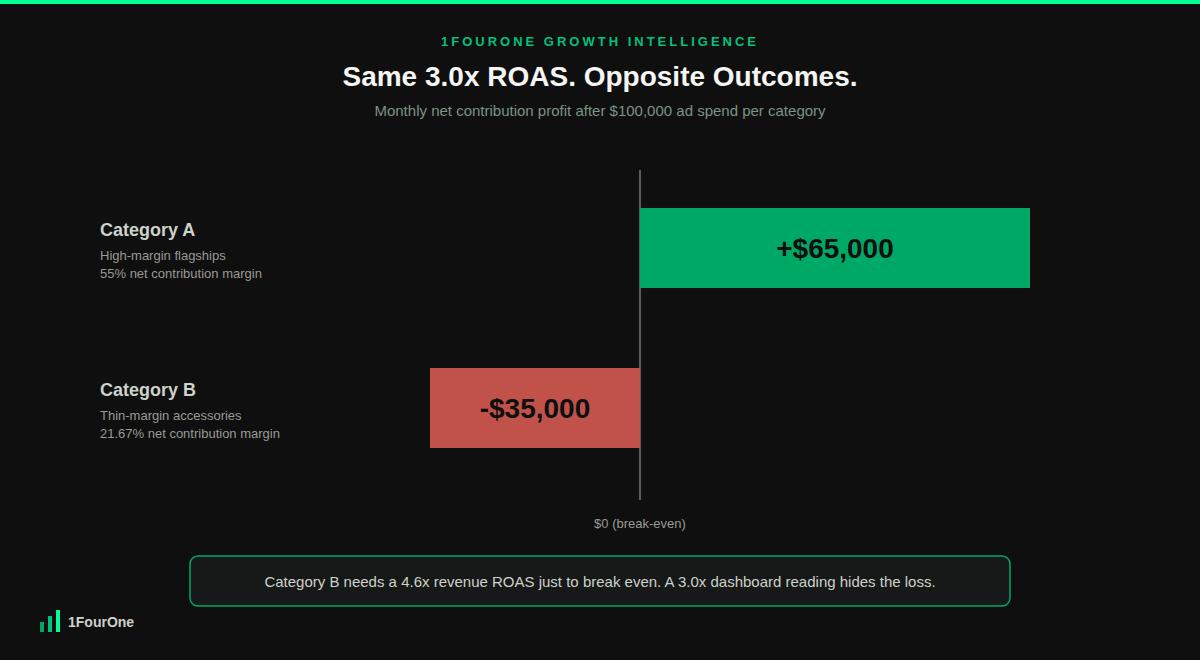
Reviewing unit economics uncovers a severe financial distortion between the two categories. Category A (High-Margin Flagships) generates $300,000 gross revenue on $100,000 spend (3.0x revenue ROAS). Gross retail margin is 60% ($180,000 gross margin), and variable fulfilment overheads total $15,000, leaving a net margin before ad spend of $165,000 (55% net contribution margin). Net contribution profit after $100,000 ad spend is $65,000.
Conversely, Category B (Thin-Margin Accessories) generates $300,000 gross revenue on $100,000 spend (3.0x revenue ROAS). However, gross retail margin is only 30% ($90,000 gross margin), and variable fulfilment overheads total $25,000, leaving a net margin before ad spend of $65,000 (21.67% net contribution margin). Net contribution profit after $100,000 ad spend is -$35,000, a net operating loss.
Both categories show an identical 3.0x revenue ROAS on the dashboard, yet one earns $65,000 and the other loses $35,000. Category B would need a revenue ROAS of about 4.6x simply to break even, so its 3.0x is a loss-maker that only looks healthy. The store generates a modest $30,000 in net monthly contribution profit ($65,000 profit minus $35,000 loss) on $200,000 in media spend.
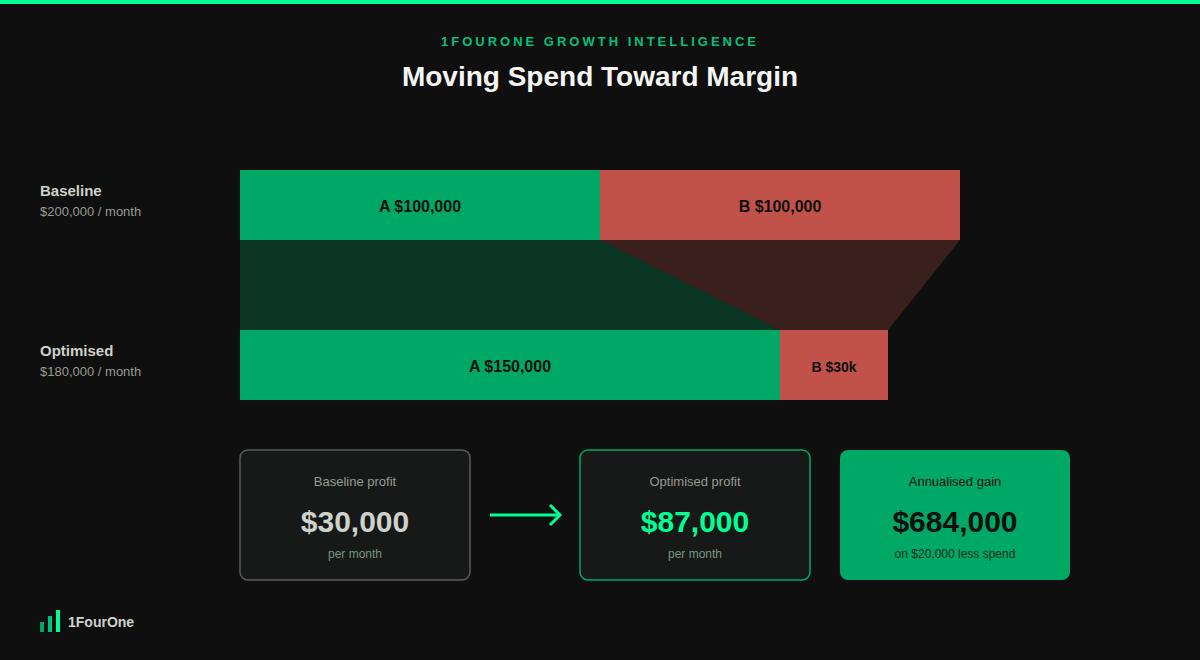
The brand’s growth operations team executes a data-driven contribution margin bidding strategy to fix this media capital drain. They replace account-wide revenue ROAS targets with itemised unit contribution rules, passing custom profit values directly to ad platform APIs. They cut Category B monthly ad spend by $70,000 (reducing spend to $30,000) and reallocate $50,000 to Category A (increasing spend to $150,000), lowering overall monthly media spend to $180,000.
Two assumptions behind this example are worth stating plainly. It assumes ROAS and unit margins hold constant at the new spend levels, which real accounts rarely do when budgets rise by 50%. The $30,000 retained in Category B is bundle-restricted traffic under Rule 4 rather than a permanent allocation, and cutting it to zero would lift monthly profit by a further $10,500 if bundle conversion does not improve.
This operational realignment alters company cash flow metrics completely. Category A gross revenue scales to $450,000 ($247,500 net margin before ad spend at 55%). Net contribution profit after $150,000 ad spend expands to $97,500. Category B gross revenue contracts to $90,000 ($19,500 net margin before ad spend at 21.67%), but its net operating loss shrinks dramatically from -$35,000 down to -$10,500.
The financial return from this bidding optimisation program is immediate and highly profitable. Total net monthly contribution profit jumps from $30,000 up to $87,000 ($97,500 Category A profit minus $10,500 Category B loss). The brand reclaims $57,000 in net monthly contribution cash flow ($684,000 annualised profit expansion) while reducing total monthly media spend by $20,000 ($180,000 versus $200,000), proving that optimising for contribution margin creates sustainable enterprise value.
Revenue ROAS calculates campaign returns by dividing total gross sales revenue by total ad spend, ignoring variable costs like COGS, shipping, and fulfilment fees. Contribution margin ROAS calculates returns by dividing net contribution profit dollars (gross revenue minus all variable product and fulfilment costs) by total ad spend. Contribution margin ROAS reflects actual cash profit generated by advertising campaigns.
Pass profit metrics directly to advertising platforms by using server-side tracking containers to calculate unit contribution margin dynamically at checkout. Substitute the default gross transaction value with the calculated net contribution dollar amount within the server API payload sent to Meta Conversion API or Google Ads API. Passing net profit signals enables ad bidding engines to optimise for actual profit dollars.
Thin-margin products lose money in paid campaigns because per-order variable expenses, such as pick-and-pack labour, packaging materials, shipping surcharges, and payment gateway fees, absorb a large portion of the item’s small gross margin. When customer acquisition ad spend is added to these variable fulfilment costs, total transaction expenses exceed retail realisation, resulting in a net operating loss.
Determine the break-even target ROAS for a product category by dividing 1 by the net contribution margin percentage before ad spend. For example, if a product category carries a 40% net contribution margin before ad spend, its break-even target ROAS is 2.5x (1 / 0.40 = 2.5). Any campaign achieving a revenue ROAS above 2.5x generates positive net contribution profit for the business.
No, you should not stop advertising thin-margin product lines completely, but you should restrict their ad spend to multi-item bundle offers, minimum order quantity tiers, or high-value cross-sell placements. Restricting thin-margin items to multi-item transactions elevates average order value, providing sufficient gross margin dollars to cover fulfilment expenses and ad acquisition spend comfortably.
Allowing unadjusted revenue ROAS targets to waste ad spend on thin-margin product lines is an expensive operational failure that degrades retail profitability. At 1FourOne, we eliminate digital media leaks by deploying a disciplined contribution margin bidding strategy that optimises ad auction capital and maximises net cash flow. Contact our growth operations team today to secure a data-driven campaign audit tailored for your business.
Get your competitive audit in 48 hours and see exactly where your revenue is leaking.
Get Your Audit →