What Is Growth Intelligence? A Strategic Mandate

The traditional retail marketing department is under unprecedented pressure. Marketing directors are tasked with delivering sustainable revenue growth in an environment defined by rapidly rising acquisition costs, fragmented digital channels, and increasingly sophisticated, automated competitor intelligence. Yet most organisations continue to manage this complexity through siloed, task-based marketing tactics. They optimise ad spend in one department, manage SEO in another, and attempt to improve user experience in a third, without recognising that these functions are intrinsically linked.
This siloed operational model is the primary reason for stagnation in the mid-market retail sector. To survive and thrive in this environment, retail leadership must undergo a structural change: a transition from reactive marketing tactics to growth intelligence. This is not new terminology for marketing, it is a fundamental shift in how commercial strategy is engineered, measured, and executed.
Growth intelligence is the unified framework that moves a business beyond simple output metrics, like clicks and impressions, toward integrated, intelligence-driven commercial operations. By synthesising AI and search visibility, cross-channel competitive data, rigorous customer journey mapping, and owned data architecture, retail brands can move from being passive observers of market shifts to active architects of their own growth. This article sets out that mandate, and how it functions as the strategic foundation for a modern, resilient e-commerce strategy.
For too long, e-commerce growth was treated as a marketing problem. If revenue stalled, the fix was to adjust the marketing mix, shifting budget between search, social, and display. This reactive approach treats the symptoms of revenue leakage rather than diagnosing the structural causes underneath them, and as the digital landscape has grown more complex, the limits of that approach have become painfully clear.
Growth intelligence asks retail leaders to look beyond marketing and toward total commercial operations. It requires deep integration between the technical engineering of the website, the logistics of the customer experience, the strategic positioning against category rivals, and the ownership of customer data. Marketing is no longer just about generating traffic, it is about engineering a repeatable, high-margin, and defensible commercial model.
This is not just a philosophical reframe. McKinsey’s research into consumer and retail marketing operating models found that only 27% of marketing leaders believe their organisation has a mature operating model built for cross-functional, integrated growth, with a siloed structure cited as the single biggest obstacle. Leaders who close that gap recognise that every internal department has a direct impact on digital revenue protection.
When the technical infrastructure is flawed, marketing budget is wasted. When data ownership is nonexistent, the brand loses its competitive advantage. Marketing leadership is evolving into commercial intelligence leadership, where decisions are driven by data-engineered insight rather than speculative trends.
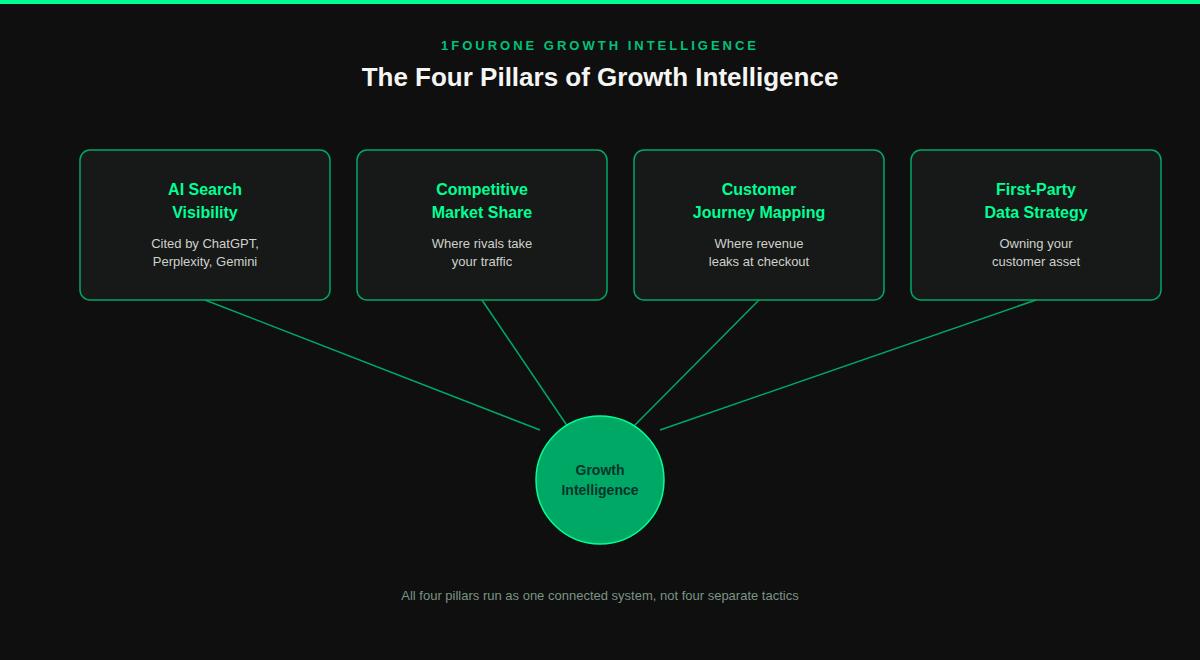
A growth intelligence framework is the synthesis of four critical, interconnected pillars. Without all four, the intelligence is incomplete and the resulting strategy will lack the durability needed to compete at the mid-market retail level.
The first pillar is visibility inside generative AI platforms. Buyers increasingly research and compare products inside ChatGPT, Perplexity, and Gemini before they ever reach a search engine results page, and standard SEO does nothing to guarantee a brand gets cited in that conversation. An AI brand visibility audit measures exactly where a brand stands in that emerging channel, and treating it as a genuine acquisition channel rather than a side experiment is what separates this approach from a standard SEO retainer.
The second pillar is competitive market share analysis. You cannot position your brand effectively without a transparent view of the total digital ecosystem. This requires mapping cross-channel competitor deficits, identifying exactly where rival brands are taking traffic and revenue from your most valuable search and affiliate channels.
The third pillar is customer journey mapping. Even strong competitive positioning is wasted if your site architecture fails to convert the high-intent visitors it attracts. Closing that gap takes forensic auditing to locate and close the friction points along the path to purchase, so acquisition spend actually turns into realised revenue.
The fourth pillar is a first-party data strategy. In an era of tightening privacy regulation, owned data is one of the most durable barriers to competitive entry a retail brand can build. This pillar mandates a shift from renting external audiences to owning your own commercial ecosystem, using that data to drive retention, build customer lifetime value, and insulate the brand from the volatility of external advertising platforms.
These four pillars are not independent workstreams. A brand that is cited well by AI platforms but has a leaking checkout is wasting the visibility. A brand with a frictionless checkout but no owned audience is rebuilding from zero every month. The value here comes specifically from running all four as one connected system, not from excelling at any single one in isolation.
Consider a mid-market homeware retailer with a healthy-looking traffic chart and a marketing director under pressure to explain why revenue has not grown at the same rate. A cross-channel competitor analysis shows two rivals have quietly taken over the organic and affiliate channels for the retailer’s highest-margin category. A customer journey audit finds a forced account-creation step is killing roughly a fifth of completed carts. Neither problem is visible from inside a single department’s dashboard, and neither would be caught by an agency hired to “run ads” or “fix SEO.”
Fixing both in isolation would help. Fixing both together, and feeding the result into a first-party data strategy that captures the recovered customers as an owned asset rather than a one-off sale, is what turns a short-term patch into a durable commercial advantage. Add a baseline AI visibility audit on top, and the retailer now has a genuine picture of where it is winning, where it is losing, and which fix to prioritise first based on revenue impact rather than which department is loudest in the next planning meeting. That sequencing, not any single tactic, is what this framework actually delivers.
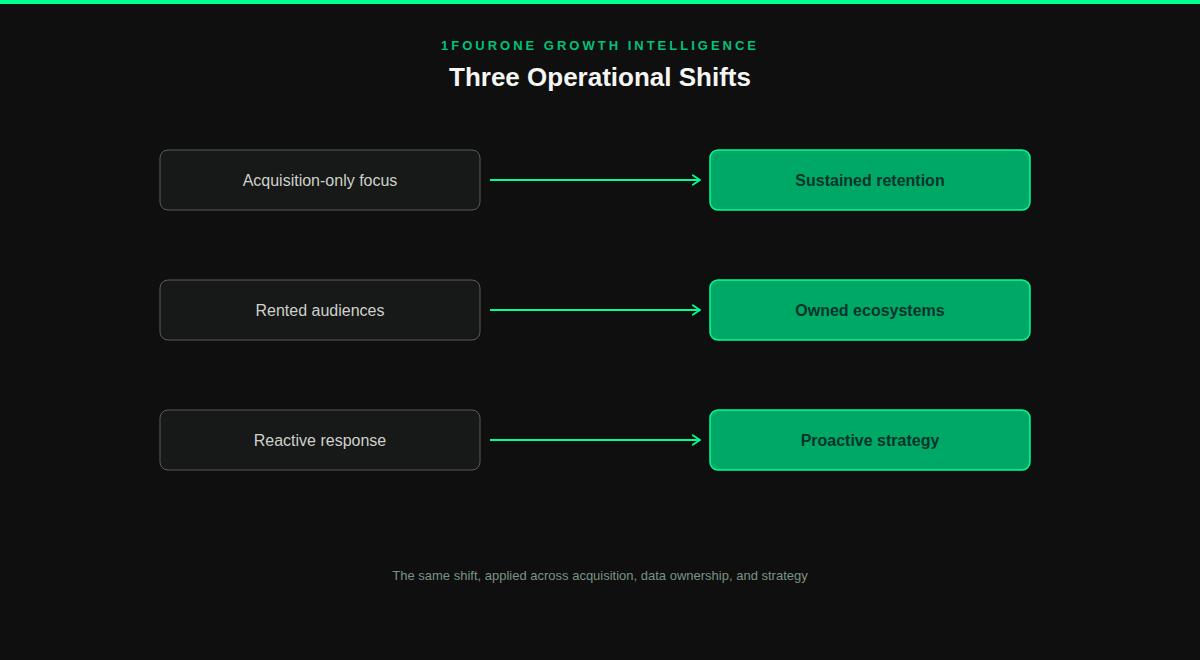
Adopting this framework requires fundamental operational changes across the organisation. These three shifts define the move toward a genuinely high-performance commercial engine.
The economics of retail have changed. With acquisition costs rising consistently, the first transaction is rarely the profit driver. This shifts the focus from pure acquisition to sustained retention, recognising that long-term profitability comes from repeated, high-value interactions. By building predictive lifetime value models, retailers can justify a higher acquisition cost because they have the infrastructure to maximise everything that customer does next.
Reliance on third-party digital landlords is a strategic liability. This approach prioritises owned digital properties and first-party data assets instead. When you own the data and the audience relationship, you remove the algorithmic gatekeepers that otherwise dictate your margins, which shifts your e-commerce strategy from dependency toward genuine autonomy.
Standard marketing teams are perpetually reactive, responding to a traffic decline or a drop in ROAS after the damage has already happened. A growth intelligence mandate enables a proactive stance instead. By continuously monitoring competitive activity, AI citation trends, and internal funnel performance, leadership can anticipate shifts in the market and adjust strategy before revenue leakage occurs. You become the organisation that sets the tempo, rather than the one trying to keep up with it.
The traditional agency model is built on task-based execution. Agencies are hired to run ads, fix SEO, or manage content. This creates a fragmented approach where vendors work in isolation, often producing conflicting strategies that erode overall brand cohesion. They are measured on outputs rather than the commercial outcomes that actually protect and grow market position.
Growth intelligence requires a partner operating at the executive level of commercial strategy. A genuine growth intelligence partner does not just execute marketing tasks, they engineer the systems, diagnostics, and data layers that let an organisation scale sustainably. Their job is identifying revenue leakage across every stage of the funnel and implementing structural, long-term fixes. The difference between an agency and this kind of partner is the difference between performing a task and protecting total revenue.
No. Marketing remains one input among several. The framework adds competitive analysis, conversion diagnostics, AI visibility, and data ownership as equal, integrated disciplines, measured against revenue protection rather than campaign output alone.
No, but you do need to measure all four before deciding where to start. A baseline audit across AI visibility, market share, customer journey, and data maturity tells you which pillar is leaking the most revenue right now, so the first fix is chosen by evidence rather than by which department asked first.
A CMO sits inside the organisation and is typically measured on marketing-specific KPIs. A partner like this sits alongside leadership with a cross-functional remit, similar to how an external CFO might assess the whole business rather than one department, and reports on commercial outcomes rather than channel performance.
Diagnostic findings, such as a specific checkout leak or a competitor’s organic gap, are typically actionable within weeks. Structural gains, like a mature first-party data asset or sustained AI citation share, build over one to two quarters as the underlying systems compound.
No. Established mid-market e-commerce brands with real trading history and existing market share to defend are the clearest fit, since they have the most to lose from revenue leaking out quietly while top-line numbers still look acceptable on paper.
This shift is the most significant operational investment a mid-market retail brand can make in the current environment. It means moving beyond siloed tactics and committing to a data-engineered, unified commercial strategy that protects revenue and grows long-term profitability. You cannot wait for the market to stabilise, you have to build the systems that let you compete regardless of market conditions.
1FourOne works with retail brands to engineer exactly this intelligence engine. We integrate AI visibility, competitive analysis, funnel diagnostics, and data infrastructure into a single, cohesive framework designed to capture market share and eliminate revenue leakage. Contact our Growth Intelligence team to baseline your current capabilities and start building a foundation for long-term commercial advantage.
Get your competitive audit in 48 hours and see exactly where your revenue is leaking.
Get Your Audit →