How to Audit Your Brand Visibility in ChatGPT, Gemini and Perplexity
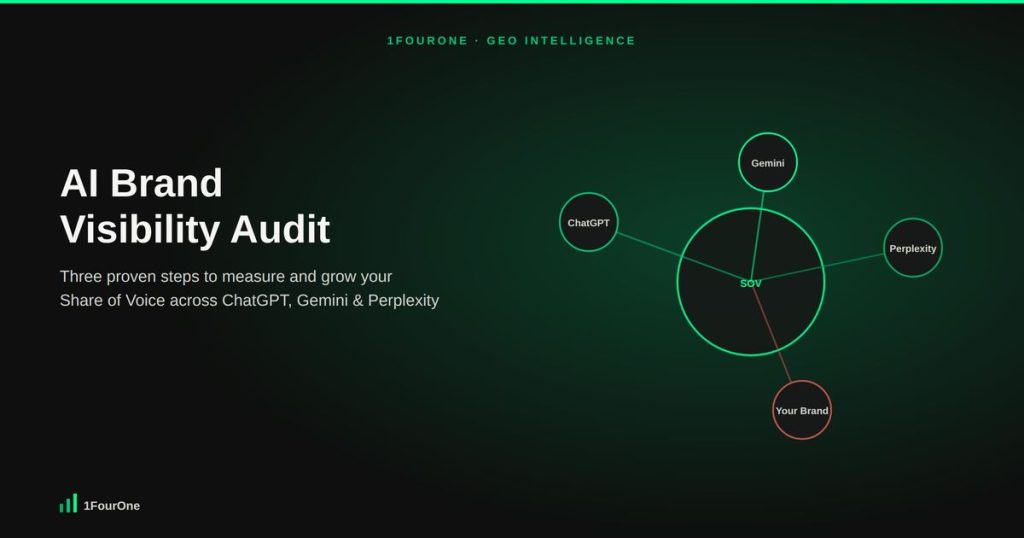
Millions of buyers now ask AI assistants which brand to choose before they ever open a browser tab. If your brand is not being cited in those answers, you are losing revenue to competitors you may not even know are winning. This guide walks you through a practical, repeatable AI brand visibility audit, walking you from first prompt to prioritised action plan.
AI brand visibility is the frequency with which your brand is cited, named, or recommended when a user queries an AI search engine about your product category. It matters because AI-generated answers now influence purchase decisions before a user ever visits a website, making a regular AI brand visibility audit a direct revenue requirement, not a vanity exercise.
Traditional search engine optimisation gets your website in front of a user. AI search works differently: the AI reads, synthesises and summarises sources, then presents one or two recommended brands directly. If your brand is not in that answer, the user may never know you exist. Research consistently shows that users act on the first AI-generated recommendation in the majority of sessions. Your AI search visibility across these platforms now has a direct bearing on which brands grow and which go unnoticed.
The category of retailers most exposed to this shift are mid-market e-commerce brands that rely on top-of-funnel organic traffic. These brands have built strong SEO foundations but have made no investment in the signals AI systems use to generate recommendations. The competitive window to act is still open, but it is closing quickly as category leaders conduct their own AI brand visibility audit and begin to optimise deliberately.
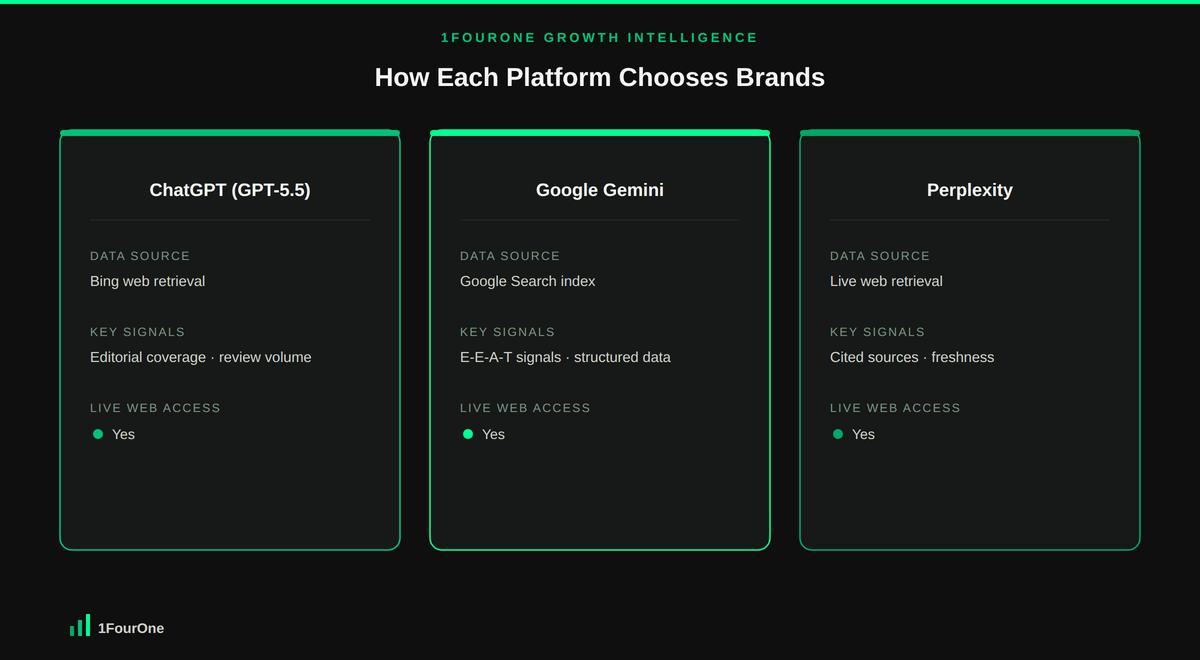
Each AI platform uses a different combination of training data, live web retrieval, and citation logic to generate brand recommendations. Understanding which signals each platform weights most heavily is the foundation of any effective AI brand visibility audit. There is no single universal ranking factor, but authoritative content, citation frequency, and review volume are consistently significant across all three.
| Platform | Primary Data Source | Live Web Access | Key Ranking Signals | Update Frequency |
|---|---|---|---|---|
| ChatGPT (GPT-5.5) | Real-time web retrieval via Bing integration | Yes (Browse mode) | Editorial coverage, review volume, brand mentions in authoritative sources | Real-time web retrieval via Bing integration |
| Google Gemini | Google Search index | Yes (native) | E-E-A-T signals, structured data, Google Shopping presence, review schema | Near real-time via Google index |
| Perplexity | Live web retrieval | Yes (always on) | Cited sources, domain authority, freshness, direct answer content | Real-time at query |
The practical implication is that a brand can be visible on ChatGPT but invisible on Perplexity because Perplexity weights recent, linkable content while ChatGPT draws on longer-term editorial authority. An AI brand audit must test all three platforms independently. Because each platform draws on different data sources, a single-platform snapshot gives you an incomplete and potentially misleading picture of where you stand.
Executing a professional AI brand visibility audit requires you to systematically test a defined set of prompts across ChatGPT, Gemini and Perplexity, record which brands are cited and in what position, and score your results against competitor benchmarks. The full process takes between two and four hours for a first audit and can be templated for quarterly repetition. For brands that prefer a professionally executed audit, 1FourOne’s Quick-Scan delivers a full 40-point competitive analysis within 7 business days.
Your prompt set should reflect the actual queries your target buyers use when researching purchase decisions. It should cover three query categories:
A minimum viable prompt set for an AI brand visibility audit contains twenty queries: five per category across four question types. Larger brands with multiple product lines should build a prompt set of fifty or more to capture category-level nuance.
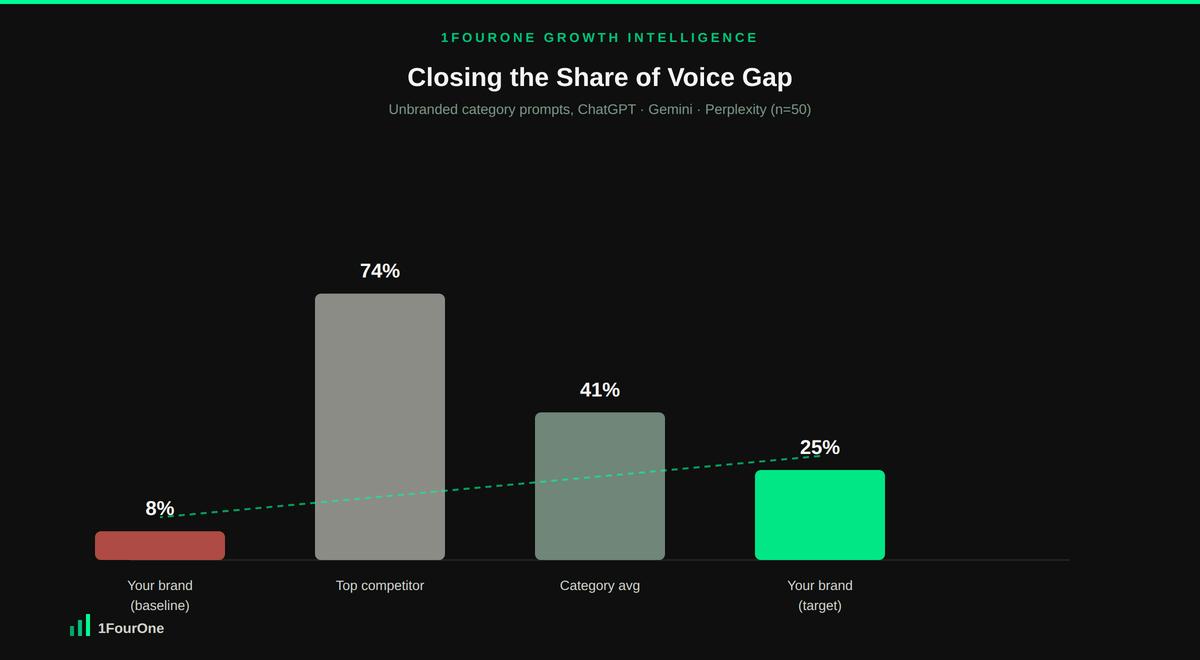
Figure 1.1: Cross-platform evaluation matrix mapping retail brand citation share against a dominant industry competitor. This baseline identifies clear recommendation deficits during an enterprise AI brand visibility audit.
Run each prompt across all three platforms and record the output in a structured spreadsheet. For each response, capture: whether your brand was mentioned, the position of your mention (first, second, third, or absent), the sentiment of the mention (positive, neutral, negative), and which competitors were cited ahead of you.
Calculate your Share of Voice (SOV) as the percentage of responses in which your brand was cited at least once. Calculate your Citation Position Score by weighting first-position mentions more heavily than lower positions. Calculate your Sentiment Ratio by dividing positive mentions by total mentions. These three scores form the baseline against which every subsequent AI brand visibility audit is measured.
A comprehensive AI brand visibility audit produces six core metrics: Share of Voice, Citation Position Score, Sentiment Ratio, Competitor Lead Index, Citation Deficit Score, and Content Gap Count. Together these metrics give you an accurate picture of where you stand, how far you are behind leading competitors, and which content gaps are causing the most damage to your visibility. Share of Voice is the foundational metric of the six, and our AI Share of Voice measurement guide walks through the full five-lever framework for growing it.
| Metric | What It Measures | How to Calculate | Benchmark to Target |
|---|---|---|---|
| AI Share of Voice (SOV) | How often your brand appears in relevant AI responses | Brand citations / Total prompts tested | Above 25% in your primary category |
| Citation Position Score | Whether you are recommended first, second, or further down | Weighted score: 1st = 3pts, 2nd = 2pts, 3rd = 1pt | First-position in 40%+ of category prompts |
| Sentiment Ratio | Whether AI mentions are favourable or cautionary | Positive mentions / Total mentions | Above 0.80 (80% positive) |
| Competitor Lead Index | How many more citations top competitors receive than you | Top competitor SOV / Your SOV | Below 2.0x (within 2x of leader) |
| Citation Deficit Score | The gap between your citations and category average | Category avg SOV minus your SOV | Positive (above category average) |
| Content Gap Count | Topics cited for competitors that you have no content covering | Manual content comparison against cited sources | Zero critical gaps in top 10 category topics |
Tracking these six metrics consistently across every AI brand visibility audit gives you a trend line that no single snapshot can provide. Your LLM brand visibility score, in particular, tends to move slowly, which makes regular measurement essential for spotting momentum early.
Competitor benchmarking is the step most brands skip and the step that produces the most actionable intelligence. Running the same prompt set for your top three to five competitors reveals which signals they hold that you do not, which content formats AI systems prefer to cite in your category, and precisely where your brand falls short during a competitive AI brand visibility audit.
When analysing competitor AI visibility, capture the following data points for each competitor across each platform:
This data directly informs your content and PR strategy. If a competitor is being cited because of a 2023 Wired feature and a cluster of detailed product reviews on specialist sites, you know exactly what type of coverage to pursue. The AI brand audit removes guesswork and replaces it with a ranked list of leverage points, ranked by the gap they close and the effort required to close it. To see how this benchmarking works in practice, explore how 1FourOne maps your competitive landscape.
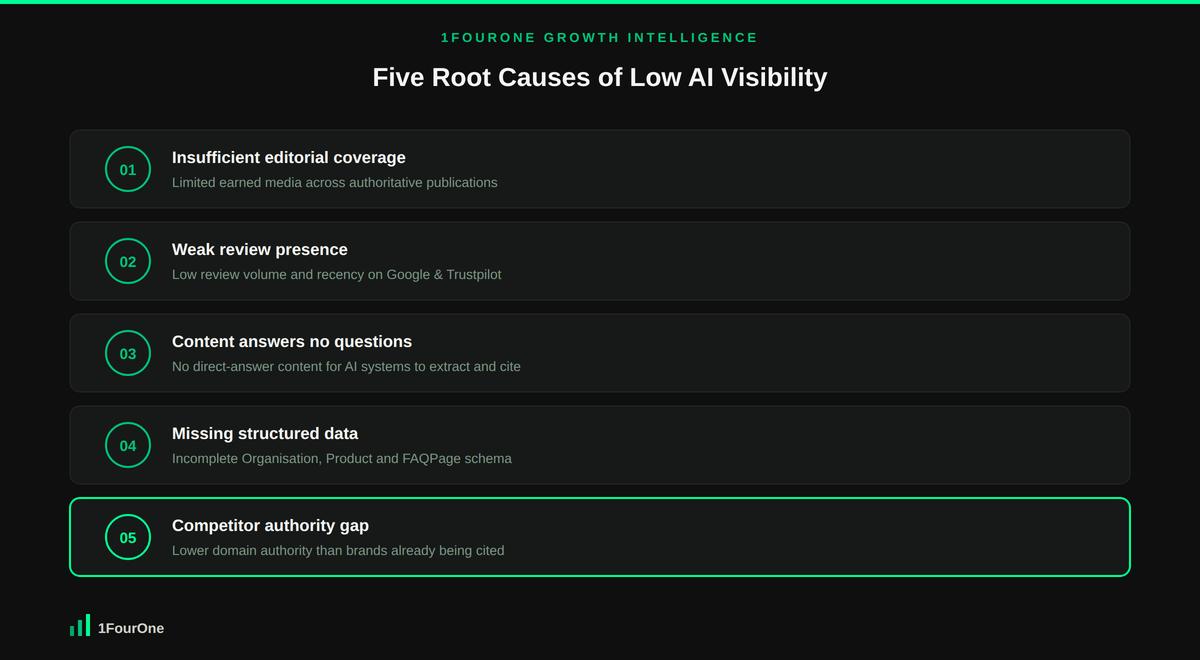
Low AI brand visibility is almost always caused by one or more of five root problems: insufficient third-party editorial coverage, a weak or inconsistent review presence, content that answers no specific customer questions, poor structured data implementation, and low domain authority relative to competitors being cited ahead of you.
Identifying which of these root causes applies to your brand is one of the most actionable outputs of a structured AI brand visibility audit. Without this diagnosis, content and PR investment tends to be scattered rather than targeted at the gaps that actually move your citation rate.
Improving your AI citation rate is the core goal of any AI brand visibility audit, and it requires a deliberate content and PR strategy built around the signals AI systems use to select recommendations. The fastest gains come from earning editorial coverage in authoritative publications, building a cluster of direct-answer content on your own site, and ensuring your structured data accurately describes your brand, products, and customer results.
Brands that treat AI visibility as a content and authority problem, rather than a technical problem, see the most durable gains. A single high-authority editorial placement can move Share of Voice by five to ten percentage points within weeks of publication, because AI systems update their citation pools continuously as new content is indexed. If you are ready to act, speak to our team about building your AI visibility strategy.
We recommend scheduling an AI brand visibility audit every sixty to ninety days. AI systems update their training data and retrieval indexes continuously, meaning your visibility can change significantly in response to a single competitor article, a cluster of new reviews, or a shift in how a platform weights certain source types. Quarterly audits catch these shifts before they compound into a structural disadvantage.
Between full audits, run a lightweight check monthly using a subset of your highest-priority prompts, particularly category and problem queries where first-position citations have the greatest commercial impact. If you detect a sudden drop in Share of Voice during a monthly check, investigate immediately rather than waiting for the next scheduled audit.
Document every audit in a consistent format so that you can track trend lines over time. A single audit tells you where you stand. Six consecutive audits, run at regular intervals, tell you whether your strategy is working, where your LLM brand visibility is gaining ground, and which platforms require the most urgent attention.
Get your competitive audit in 48 hours and see exactly where your revenue is leaking.
Get Your Audit →