Google Ads Brand Protection: Stop Competitor Bidding
Google Ads brand protection starts with a problem every growing retailer eventually hits: a rival’s advertisement appears at the very top of your own branded search results. When a customer searches for your specific company name, they have already bypassed the consideration phase, they are looking for you, specifically. When competitor bidding intercepts that click, a rival is siphoning off your highest-intent traffic and turning your own brand equity against you.
This is an aggressive form of conquesting, and it is a common point of revenue leakage for mid-market retailers. If you do not have a dedicated competitive market share analysis in place, you may not even realise how much traffic is being diverted until you see a sudden, unexplained dip in your own conversion rates. It forces you to pay more to acquire your own customers while handing a free lead to a rival.
Stopping this requires more than frustration. Real google ads brand protection takes a systematic approach across trademark enforcement, bidding strategy, and technical monitoring. This guide covers how to regain control of your branded search real estate, and how the principles of customer journey mapping help keep buyers inside your own ecosystem once you have them back.
Rivals target your brand terms because it is the most efficient way to reach high-intent buyers already at the bottom of the funnel. A user typing a specific brand name into a search engine is not browsing, they intend to purchase. By placing an ad above your organic result, a competitor can redirect that buyer with very little effort, often at a lower cost than acquiring a cold lead.
This tactic is itself a signal that your brand has real recognition in the category. Competitor bidding against your name is implicitly an admission that your search volume is worth intercepting. If they capture even 10% of that volume, they have acquired a pre-vetted customer without doing any of the work of building the brand themselves.
It is rarely personal. It is a cold, calculated move to capture low-hanging fruit. If your brand is not actively defending its space, a competitor will treat that traffic as fair game and insert themselves directly into your relationship with your own customer.
The categories most exposed to brand name bidding tend to share a pattern: high customer acquisition costs, low switching friction, and a checkout process similar enough across competitors that price becomes the deciding factor once a buyer lands on either site. If your category fits that description, treat branded defence as a standing line item, not a reaction to a single incident.
The immediate consequence is an artificial rise in your own acquisition costs. To reclaim the top ad spot, you are often forced to bid higher on your own keywords than you otherwise would. Google’s auction model rewards higher bids and stronger ad relevance, so competitor bidding pushes your cost-per-click up just to maintain visibility you previously held at a lower price.
This is not a fringe tactic. An analysis of 8.5 million Google Search ads across 25 major brand keyword auctions found that one in eight ads shown on a brand’s own name came from a different advertiser entirely. Both sides end up paying more to reach the same customer, a textbook prisoner’s dilemma that benefits the ad platform far more than either brand.
The damage is not only financial. A user who clicks a competitor’s ad expecting your store, then lands somewhere else entirely, experiences exactly the kind of friction customer journey mapping is built to catch. If that user finds a similar product or a better offer on the rival’s site, your own marketing has just funded a sale for someone else, and you lose the ability to track that customer through your first-party data strategy entirely.
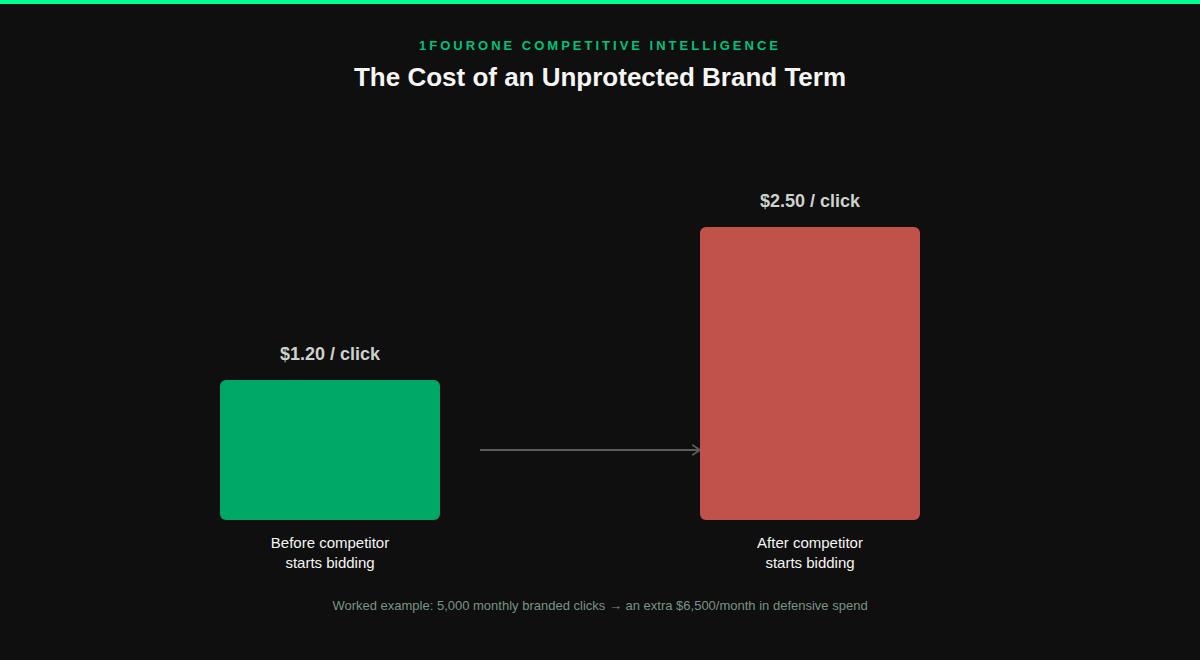
A worked example makes the cost concrete. A retailer with an unprotected brand term paying $1.20 per click on their own name might see that cost climb to $2.50 once a determined competitor starts brand name bidding against them, even though nothing about the retailer’s own ad or landing page has changed. Across 5,000 monthly branded clicks, that single shift adds $6,500 a month in pure defensive spend the retailer did not need to budget for a year earlier.
The first line of defence is understanding what Google’s actual trademark policy allows. Google permits advertisers to bid on keywords that are trademarked, including a competitor’s brand name. What it does not generally permit is a rival using your trademarked name directly inside their ad headline or body copy.
This is a reactive system, not a proactive one. Google removed its proactive trademark pre-authorisation process in February 2025, so there is no longer a one-time registration that blocks future misuse automatically. If you spot a competitor using your brand name in their ad text, you file a specific complaint against that ad through Google’s trademark reporting process, and Google reviews the individual case.
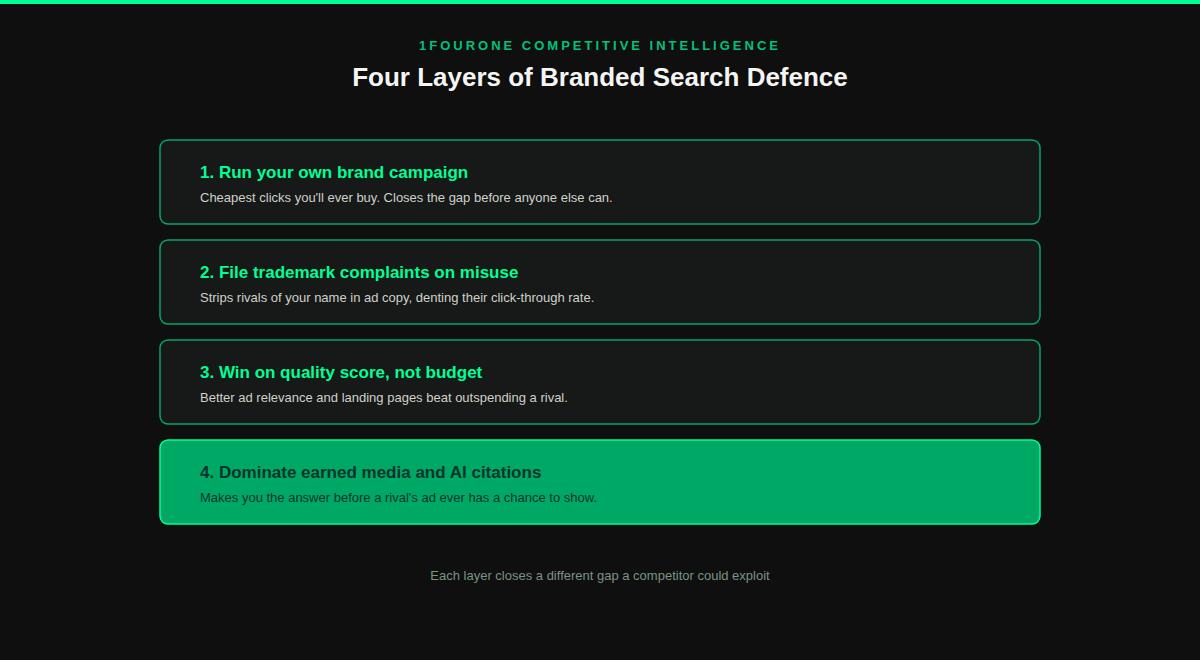
Winning that complaint will not stop a rival from bidding on your keyword, since bidding itself is allowed. It does strip them of the ability to use your name in their copy, which usually causes a meaningful drop in their click-through rate, since the ad becomes far less relevant to someone who searched for you by name. It is a necessary step, not a complete fix on its own.
The instinct is often to fight a bidding war until the rival gives up, but that usually backfires. Raising your bids indiscriminately just pushes the entire auction floor higher, including for your own future spend. A better brand bidding strategy focuses on quality score and ad relevance rather than raw budget.
Google’s algorithm rewards ads that are most relevant to the query. You can hold your position by keeping your own ads tightly optimised, using high-quality extensions, and linking to a landing page that delivers a genuinely better experience than a generic category page. Outperforming a rival on ad quality often means you keep the top spot while paying less per click than they do.
It is also worth running an ongoing monitoring cadence as part of your broader competitive market share analysis, tracking which competitors bid on your terms and when. Some rivals only show up during specific promotional windows. Knowing the pattern lets you concentrate defence spend exactly when it is needed, rather than running it on autopilot year-round.
Treat the budget for this as separate from your acquisition budget entirely. Brand name bidding defence is not growth spend, it is closer to insurance: the goal is protecting margin you already earned, not generating new demand. Folding it into the same budget line as prospecting campaigns makes it too easy to quietly cut when targets are tight, right at the moment a competitor is most likely to be testing your defences.
Real digital revenue protection goes further than monitoring your own paid search auctions. Competitors also use affiliate networks and publisher sites to achieve a similar result, placing comparison articles above your organic listings to intercept buyers before they ever reach a search engine ad. Defending branded search alone leaves this entire channel open.
The structural fix is making your own organic footprint dominant enough that there is little room left for a rival to insert themselves. That means securing mentions in industry reports, authoritative publications, and trusted review sites, the same earned-media work covered in a competitive market share analysis. Once you are the primary source a buyer finds, you become far harder to displace regardless of how much a rival spends on advertising.
Increasingly, this extends to how AI platforms answer category questions too. A buyer asking ChatGPT or Perplexity to compare your brand against a rival is running the same evaluation step a search engine ad is trying to intercept, just on a different surface, and it sits outside anything a Google Ads defence can touch.
No. Bidding on a trademarked term as a keyword is permitted under Google’s policy and has generally been upheld by courts as long as the term is used only as an invisible targeting trigger, not in the visible ad copy itself.
Yes, in almost every case. Running your own branded campaign typically costs very little per click, since your own ad relevance and landing page experience score highly, and it closes the exact gap a rival is trying to exploit.
No. Google does not allow brand owners to block competitors from bidding on a trademarked term as a keyword. You can only restrict how that term is used inside the ad’s visible text, through a trademark complaint.
Google typically reviews and acts on a specific complaint within a few business days, disapproving the named ad if it violates policy. It does not retroactively block every future ad from that advertiser.
Sometimes, but it works far better as a deliberate, separate campaign than as a reflexive response to being targeted yourself. Decide it on its own commercial merits, with its own budget and landing pages, rather than treating it as automatic retaliation.
Stopping a rival from quietly taxing your branded search demand takes more than frustration. Real google ads brand protection means a systematic approach across trademark enforcement, defensive bidding, and the organic earned-media presence that makes your brand harder to intercept in the first place. Most mid-market teams are managing this reactively, if at all.
1FourOne audits your branded search exposure, tracks which competitors are running competitor bidding against you and when, and builds the organic and earned-media defences that reduce how much it costs to defend your own name. Contact our Growth Intelligence team to baseline your current search visibility and protect your brand equity going forward.
Get your competitive audit in 48 hours and see exactly where your revenue is leaking.
Get Your Audit →