Building a Customer Database That Survives Without Cookies

Executing a structured first party data framework is the primary operational requirement for mid-market e-commerce brands seeking to protect their analytics pipeline against third-party cookie depreciation and browser tracking blocks. As consumer privacy regulations expand and operating systems restrict client-side data collection, retail businesses that rely on external tracking pixels experience severe performance drops across their marketing dashboards. Failing to capture and unify owned customer interaction signals skews your commercial reporting, making it difficult to evaluate campaign profitability accurately. Transitioning to an enterprise data collection model allows growth teams to secure high-intent customer records, stabilise media reporting, and build a defensible foundation for long-term customer retention strategy execution.
Modern digital retail operations face an ongoing reporting crisis caused by traditional third-party tracking mechanisms. For years, e-commerce stores relied on browser-based tracking pixels to capture user browsing behaviour and pass conversion events directly to advertising networks. As web browser vendors deploy automatic tracking protections and users opt out of cross-site monitoring, these client-side scripts frequently fail to execute. This data drop creates massive blind spots in your commercial dashboards, hiding true transactional sources.
Operating paid acquisition channels without accurate user tracking introduces significant financial risk to your business model. When advertising platforms fail to receive purchase signals, their machine-learning algorithms lose the capability to identify and target high-intent audience segments efficiently. This data degradation forces media buyers to spend higher budgets to acquire the same volume of customer transactions. To insulate your sales pipeline from external system updates, you must establish an independent data capture architecture.
To eliminate these continuous reporting errors, growth operations must build a centralized customer identity repository. Depending on third-party networks leaves your retail store vulnerable to sudden policy shifts that alter attribution metrics overnight. Shifting to an owned data framework ensures your team retains full control over your customer intelligence, preserves conversion tracking accuracy, and protects your baseline unit economics across all digital sales channels.
A sophisticated scaling strategy requires far deeper behavioural insight than top-line transaction counts can provide. True growth intelligence depends on capturing explicit consumer preferences, purchase history timelines, and direct engagement signals across the entire post-purchase journey. By unifying these owned data layers into a single source of truth, retail teams can isolate high-margin customer cohorts and deploy highly relevant messaging sequences that drive repeat purchases.
Maintaining clean customer records is also directly linked to expanding your long-term customer lifetime value metrics. Benchmark research published by the Harvard Business Review confirms that increasing customer retention rates by 5% drives a corresponding profit increase of 25% to 95%. This empirical reality demonstrates why investing in an owned customer retention strategy delivers a far higher return on capital than continuously chasing volatile paid acquisition traffic.
Achieving this level of operational control requires integrating your owned data pipelines with advanced infrastructure like a server side tracking framework to bypass client-side script blocks completely. Passing verified transaction records directly from your cloud server to your internal databases protects information flow, ensuring your customer profiles update instantly upon purchase completion.
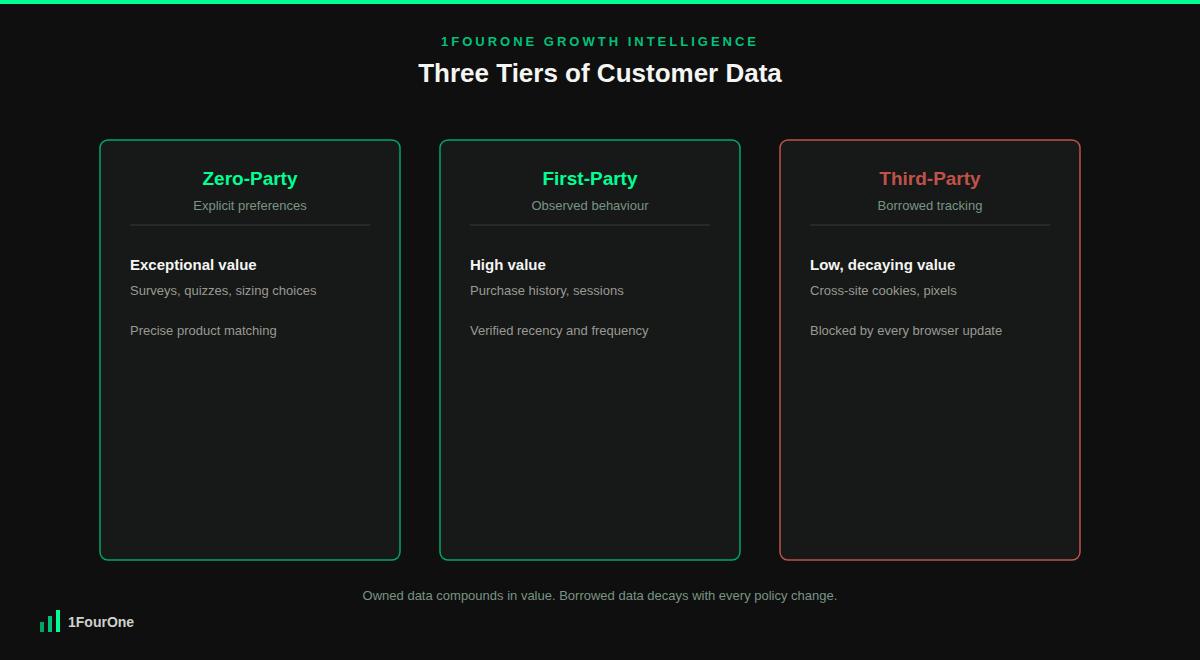
| Data Classification | Collection Source | Strategic Commercial Value |
|---|---|---|
| First-Party Behavioural | Direct storefront interactions and checkout events | High (Provides verified purchase recency and frequency signals) |
| Zero-Party Preference | Explicit customer surveys and quiz selections | Exceptional (Enables precise product recommendation mapping) |
| Third-Party Tracking | Cross-site network cookies and external pixels | Low (Highly vulnerable to browser blocking and data decay) |
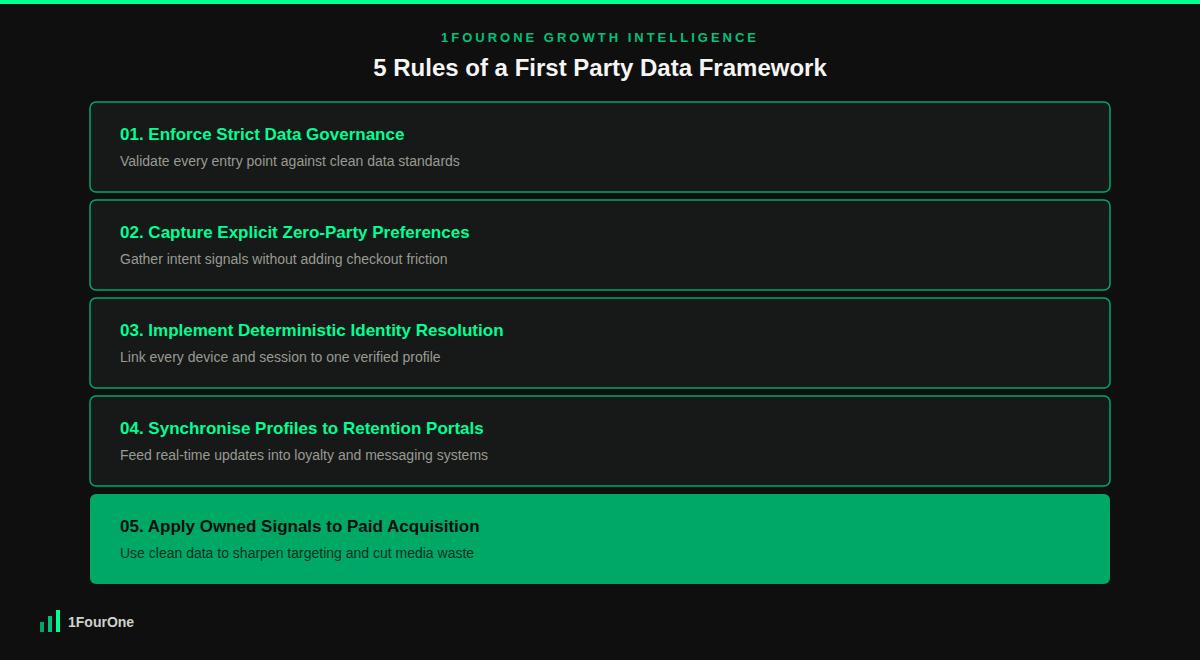
To systematically maximise your conversion visibility and protect your operating margins, your operations team must institutionalise this discipline with rigour. This protocol moves your customer data strategy away from fragmented tracking scripts toward structured, server-validated record management. The following five rules provide a repeatable framework to capture clean signals, unify customer identities, and safeguard marketing spend efficiency.
Building an effective customer data repository requires a uniform structure that ensures every incoming interaction event is validated cleanly. Allowing unstandardised form entries, incomplete contact fields, or duplicate email records into your database corrupts your analytics suites and ruins automated campaign delivery. To prevent this reporting decay, your technical team must implement explicit data validation rules across every customer entry point.
Aligning your data collection rules with international quality guidelines, such as those published in ISO 10004:2018, ensures your customer tracking mechanisms maintain high empirical standards. Setting strict structural requirements for profile data inputs prevents dirty data from entering your marketing automation tools. This operational discipline guarantees that every segment model relies on clean, verified behavioural information.
While first-party data records what a customer did on your website, zero-party data captures what they intend to do next. Zero-party data consists of explicit preference selections, sizing details, and style choices that a consumer intentionally shares with your brand. Your growth operations team must integrate low-friction preference capture mechanics into key post-purchase screens and onboarding sequences.
Deploying targeted interactive quizzes, post-checkout surveys, and account preference centres allows you to gather rich profile data without interrupting the purchase flow. As highlighted in our strategic guide on reduce checkout abandonment tactics, keeping the initial checkout journey frictionless is essential to secure the primary transaction before asking for optional preference inputs. Enriching profile records with these explicit choices allows your marketing team to deliver hyper-relevant product offers that increase repeat order frequency.
A major obstacle in modern retail analytics is connecting isolated session actions to a single customer record when consumers switch devices or browsers. Relying on probabilistic matching models introduces significant error margins, as algorithms attempt to guess user identities based on dynamic IP addresses or location signals. Your data architecture must use deterministic identity resolution to link actions to verified customer accounts.
Require unique account authentication tokens and persistent first-party identifiers that bind sessions to a master profile the moment a user logs in or completes a purchase. This technical setup bridges session drops across desktop and mobile storefronts, giving your growth analysts a complete view of individual purchasing journeys. Unifying customer histories prevents message duplication and protects your marketing spend efficiency targets.
Capturing high-quality customer intelligence offers minimal commercial value if those records remain isolated inside static database tables. To extract maximum financial return from your owned data assets, your development team must build real-time data pipelines that pass clean profile updates directly into your automated marketing tools and loyalty platforms.
Connecting verified purchase histories to your customer retention strategy allows your messaging systems to deploy targeted win-back sequences, re-order reminders, and tier updates automatically. Reference our operational breakdown of loyalty program design to build dynamic reward structures that incentivise ongoing profile enrichment. Supplying your retention engines with real-time transactional data increases brand affinity and protects customer lifetime value across your core buyer segments.
A primary objective of any first party data framework is reducing reliance on third-party tracking, but these clean signals should also be used to improve your paid media targeting. Advertising networks allow brands to upload hashed customer lists securely to build high-value lookalike audience models and exclude existing buyers from cold prospecting campaigns.
Passing hashed, high-margin customer segments directly to partner advertising platforms improves bidding algorithms, allowing them to locate prospective buyers who match your top-performing customer profiles. Excluding verified buyers from prospecting ad sets prevents media waste, ensuring your acquisition budgets focus entirely on reaching new market demand. This strategic integration reinforces your overall growth intelligence framework, maximising your total media returns.
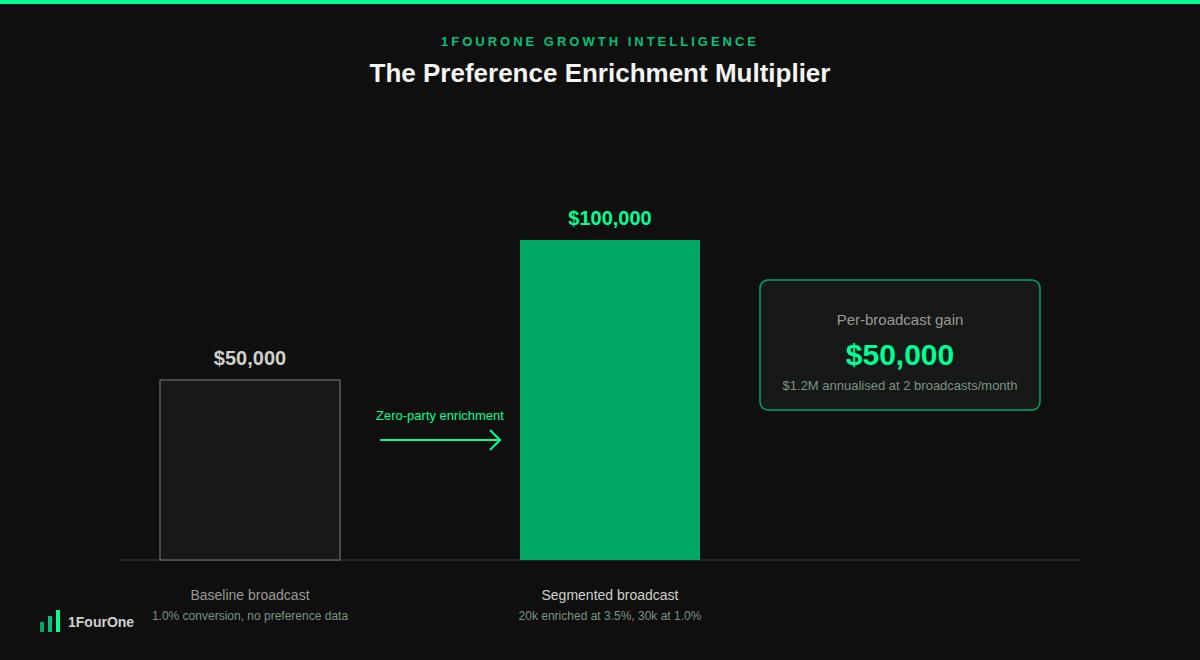
To evaluate the direct commercial return of a structured first party data framework deployment, let us examine an established mid-market apparel brand managing an active email database of 50,000 customer profiles. In the baseline operational state, the brand possesses zero preference data, forcing the team to send generic marketing broadcasts to the entire list. This unsegmented approach achieves a baseline conversion rate of 1.0%, generating 500 completed transactions per campaign.
With an average order value fixed at $100 across these orders, each broadcast generates exactly $50,000 in baseline gross revenue (500 transactions multiplied by $100 average order value). Because the marketing team cannot isolate customer preferences or sizing details, broadcast engagement remains low, and list fatigue causes steady unsubscribe rates over time. This unsegmented setup limits campaign profitability while driving up customer replacement costs.
The brand’s growth operations team implements a systematic first-party data capture program, deploying interactive preference surveys during post-checkout onboarding and account setup. Over ninety days, this initiative enriches 20,000 profiles with explicit sizing, style preferences, and purchase intent choices. The remaining 30,000 profiles continue to receive standard baseline messaging.
The marketing team restructures its broadcast strategy, sending targeted product campaigns matched explicitly to the zero-party choices of the 20,000 enriched profiles. Because these messages align precisely with verified customer preferences, the enriched segment conversion rate scales from 1.0% up to 3.5%, delivering 700 orders from those 20,000 profiles (20,000 profiles multiplied by 0.035). The remaining 30,000 standard profiles yield 300 orders at the baseline 1.0% rate (30,000 profiles multiplied by 0.01).
Combining these segments increases the total broadcast output to exactly 1,000 completed customer transactions (700 enriched orders plus 300 standard orders), doubling the campaign’s conversion volume. Assuming the average order value remains constant at $100, the new gross revenue per broadcast climbs to $100,000 (1,000 transactions multiplied by $100).
The financial return of this data-driven optimisation sprint is immediate and highly profitable. Without spending a single additional dollar on paid customer acquisition ads or expanding list size, the brand secures an incremental $50,000 in gross revenue per broadcast ($100,000 optimised revenue minus $50,000 baseline revenue). Running two segmented broadcasts per month generates $1,200,000 in annualised incremental revenue, demonstrating the scale of return available from an enriched ecommerce first party data strategy.
First-party data consists of observable behavioural records collected passively as a consumer interacts with your digital storefront, such as purchase history, session duration, and page view patterns. Zero-party data represents explicit information that a customer intentionally shares with your business, including survey responses, sizing preferences, and product interests. Both data types are essential to build high-performing personalisation engines.
Capturing data directly through your owned storefront environments allows your technical teams to implement clear consent management protocols and transparent privacy controls. Storing customer records in secure first-party repositories ensures you comply with global data protection laws, avoiding severe financial penalties. This controlled architecture provides complete auditability over how customer records are gathered and processed.
You should never require consumers to complete extensive preference surveys during the active checkout flow, as adding fields increases purchase friction. Keep the payment journey focused entirely on transaction execution, and introduce optional preference capture elements on post-purchase confirmation screens or via follow-up onboarding emails. This separation preserves checkout conversion rates while steadily building profile richness.
Your automated marketing databases should process incoming first-party interaction events and zero-party updates in real time to ensure campaign triggers execute instantly. However, your core customer segment definitions and health scoring rules should undergo a full strategic review every calendar quarter to align with shifting catalogue trends. Continuous validation keeps your segment parameters accurate and high-yielding.
Mid-market retail brands can build a high-performing data setup using standard customer data platforms and modern email marketing suites. The key requirement is setting up clean data validation protocols and using first-party subdomains for event routing rather than purchasing expensive enterprise software. Focusing on structured data hygiene allows smaller operators to achieve enterprise-level analytics precision efficiently.
Allowing fragmented third-party tracking blocks to erode your operational reporting is an expensive strategic mistake that degrades your retail margins. At 1FourOne, we eliminate analytical blind spots by deploying comprehensive first party data framework solutions that protect your transaction pipelines and maximise customer lifetime value. Contact our data engineering team today to secure a performance audit built directly for your brand.
Get your competitive audit in 48 hours and see exactly where your revenue is leaking.
Get Your Audit →