Why Your SEO Strategy is Invisible to LLMs
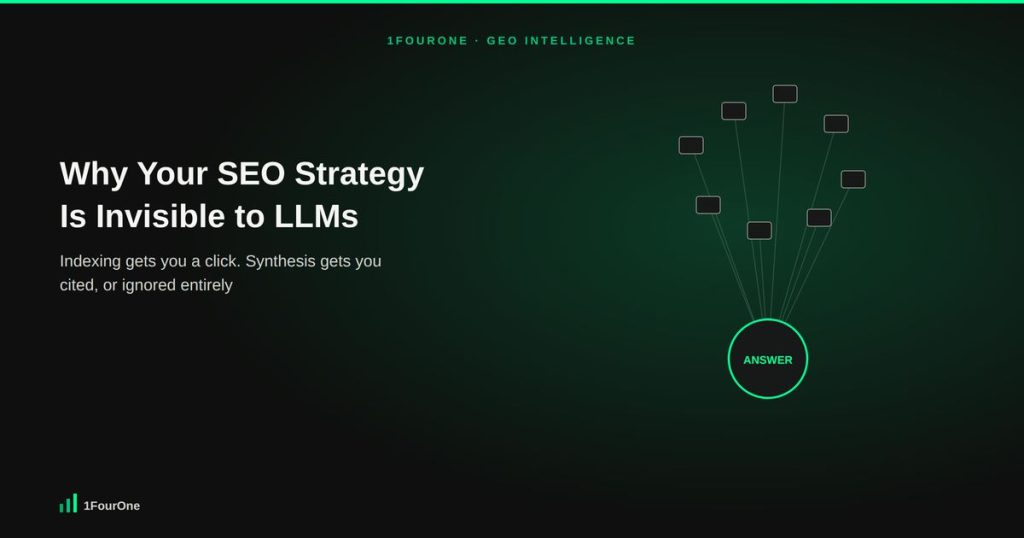
Securing AI search visibility is now the primary revenue protection mandate for retail and e-commerce marketing directors. You have spent a decade building traffic acquisition funnels based on traditional search engine optimisation. You rank for a keyword, capture a click, and funnel the user towards a conversion. That mechanical process is breaking down as high-intent buyers shift their research to conversational artificial intelligence platforms.
Being visible on a standard search results page no longer guarantees your brand will be cited when a user asks ChatGPT or Perplexity for a recommendation. This structural shift introduces a severe threat to top-of-funnel revenue for established merchants. Gartner forecasts that traditional search engine volume will fall by a quarter by 2026, as AI chatbots and virtual agents absorb the queries search marketers used to own. Optimising for a search engine crawler is fundamentally different from optimising for an LLM.
If your technical architecture and content strategy have not adapted to this new environment, your AI search visibility will trend to zero. This article explains precisely why legacy SEO frameworks fail to register with modern generative engines, and how generative engine optimisation can close the deficit.
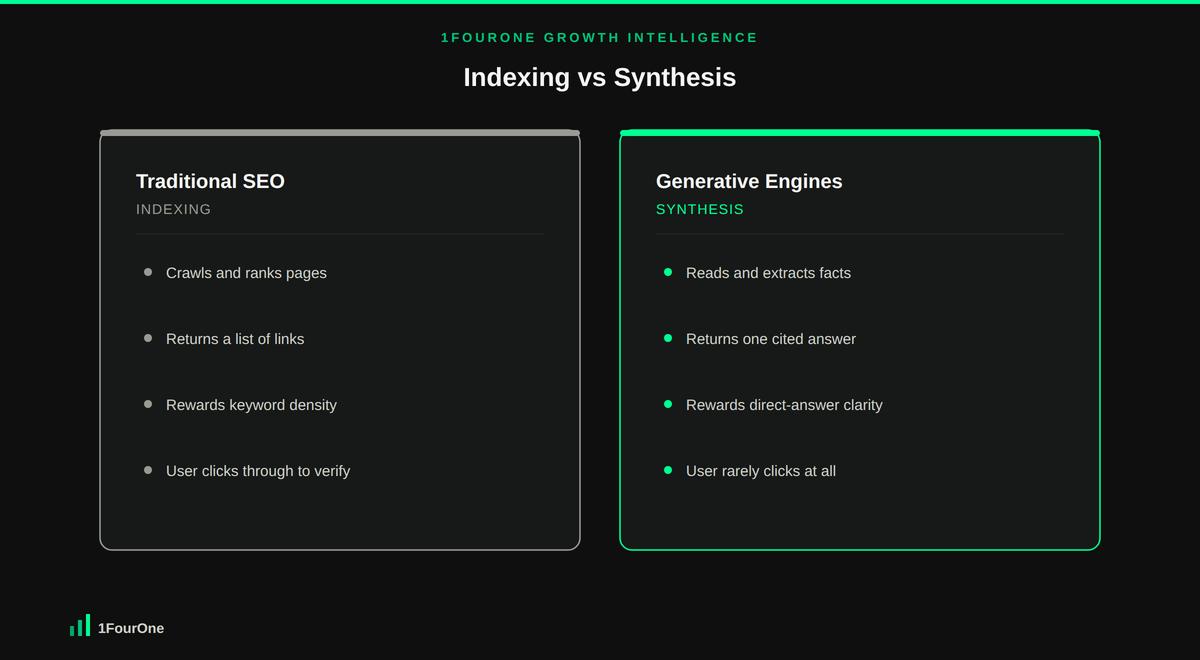
Traditional search engines function as digital librarians. They index billions of pages, rank them based on inbound links and keyword relevance, and present the user with a list of options to click. Large language models operate as digital synthesisers instead. LLMs read those same pages, extract the underlying facts, and generate a single definitive answer that bypasses the need for clicks entirely.
This difference in utility completely invalidates standard keyword density strategies. An AI model does not care how many times a category keyword appears on your collection page. It cares whether your domain provides a clear, factual answer to the highly specific query the user just entered. If your website is built purely to catch search volume rather than answer complex questions, generative engines will simply ignore your content.
Standard search engine bots crawl your site to map its architecture and discover new URLs. Generative AI crawlers, such as GPTBot and PerplexityBot, visit your site with a different objective: they scrape clean text to feed training data and real-time retrieval systems, rather than building a link graph.
These crawlers have very low tolerance for slow, script-heavy pages or convoluted navigation structures. If your core product data is buried under dynamic JavaScript layers or requires user interaction to load, the crawler will leave before extracting your information. You must serve a clean, text-rich HTML layer to these agents.
Failing to optimise your server response for AI agents means your newest products and updated pricing may never reach the model’s knowledge base. This creates a latency gap where the AI engine treats your brand as outdated, even when your catalogue is current.
Marketing teams frequently prioritise emotive copywriting over factual density. Brand narratives, lifestyle imagery, and clever taglines might convert human readers, but they are entirely invisible to retrieval augmented generation pipelines. AI crawlers are scanning the web for explicit data points like material specifications, warranty terms, and exact pricing structures.
Consider a high-end espresso machine retailer. A traditional SEO page might feature a lengthy story about Italian coffee culture to capture broad search terms. An LLM ignores this entirely, looking instead for exact pump pressure metrics, boiler materials, and dimensions.
When an engine cannot instantly extract these facts from your product pages, it moves to a competitor whose data is easier to read. Content must be reformatted to provide direct answers immediately at the top of the page. By front-loading the most critical facts, you ensure the LLM can parse and ingest your specifications without expending unnecessary computational energy.
Many e-commerce brands assume their standard platform template handles technical SEO effectively. While basic schema markup might satisfy Google Shopping requirements, it is severely lacking for advanced language models. These models rely on explicit entity definitions to understand who you are, what you sell, and how your products compare to market alternatives.
Without deep JSON-LD structured data, your website is just a wall of unstructured text to an AI agent. You must deploy comprehensive markup for your organisation, your products, and your frequently asked questions. This code acts as a direct technical signpost, feeding your exact product inventory and brand entity attributes straight into the data layers of Gemini and ChatGPT.
Your own website is the least trusted source of information about your brand. Generative models are programmed to seek third-party validation before presenting a product recommendation to a user. If your entire digital footprint is contained on your own domain, engines will naturally rank you below competitors who have secured independent editorial coverage.
AI systems measure authority by cross-referencing your brand entity against industry publications, specialist reviews, and high-trust media outlets. When you run an AI brand visibility audit, you will immediately see that models heavily favour brands with consistent external citations. Building your internal site architecture is only half the battle. Building durable AI citation authority requires a proactive digital PR strategy that places your brand name on domains the LLMs already trust.
Some marketing directors treat generative search as a temporary disruption, something to wait out until search behaviour reverts to familiar patterns. The underlying data does not support that view. The Pew Research Center found that when Google shows an AI-generated summary, the click-through rate to a traditional search result falls to 8%, compared with 15% on pages without one. That gap is now a structural feature of search, not a temporary side effect of an early-stage product.
Once an LLM has assembled an answer from third-party sources, the user rarely needs to leave the conversation to verify it. This pattern compounds over time, as each generation of buyers researches more of their journey inside conversational interfaces and less on traditional results pages. Brands that wait for the data to plateau will spend years building authority that competitors are accumulating now. Delaying action does not preserve your current position, it erodes it.
For an established retail brand, the risk concentrates at the exact point where high-intent buyers compare options before purchasing. A shopper asking an LLM to compare espresso machines, software platforms, or supplement brands is past the awareness stage and close to a buying decision. If your brand is absent from that specific answer, the lost prospect rarely returns to a traditional results page to find you. This is revenue lost at the most valuable point in the funnel, not impressions lost at the top of it.
Treat generative engine optimisation as a parallel discipline running alongside your existing SEO programme, not a replacement for it. The objective is not to abandon search engine optimisation, but to ensure your AI search visibility grows at the same pace as the channel itself.
That parallel discipline is most effective when embedded within a broader growth intelligence operation — one that integrates GEO alongside competitive, conversion, and retention intelligence to give established retailers a complete picture of where they are winning and where they are not.
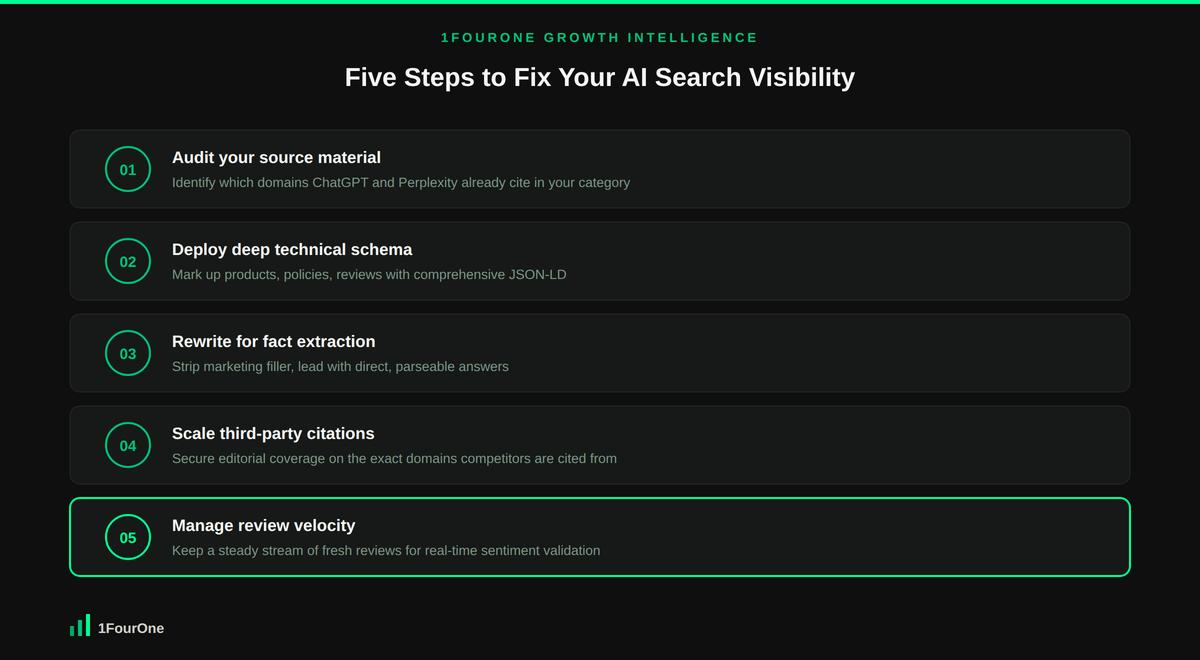
Closing the gap between traditional SEO and generative engine optimisation requires targeted technical and editorial execution. Marketing directors can begin correcting their visibility deficits by actioning these five structural changes immediately.
You cannot optimise blindly. Identify exactly which third-party websites ChatGPT and Perplexity currently use to generate answers in your category. Run specific prompt tests to see which domains are cited most frequently when users ask for product recommendations. These domains become your primary targets for external PR outreach.
Upgrade your site architecture with comprehensive JSON-LD markup to explicitly define your product catalogues and brand entity. Go beyond basic pricing and availability. Mark up your return policies, shipping details, and individual customer reviews to give the LLM a complete dataset to reference.
Strip marketing filler from your core product descriptions. Replace it with dense, direct-answer formatting that LLMs can easily parse. Use clear headings, bulleted specification lists, and direct, declarative sentences to state exactly what your product does and who it is for.
Target the specific authoritative publications your competitors are cited from and secure editorial coverage on those exact domains. This is not traditional link-building, it is entity validation. You want your brand name mentioned in context alongside positive attributes by trusted editorial voices.
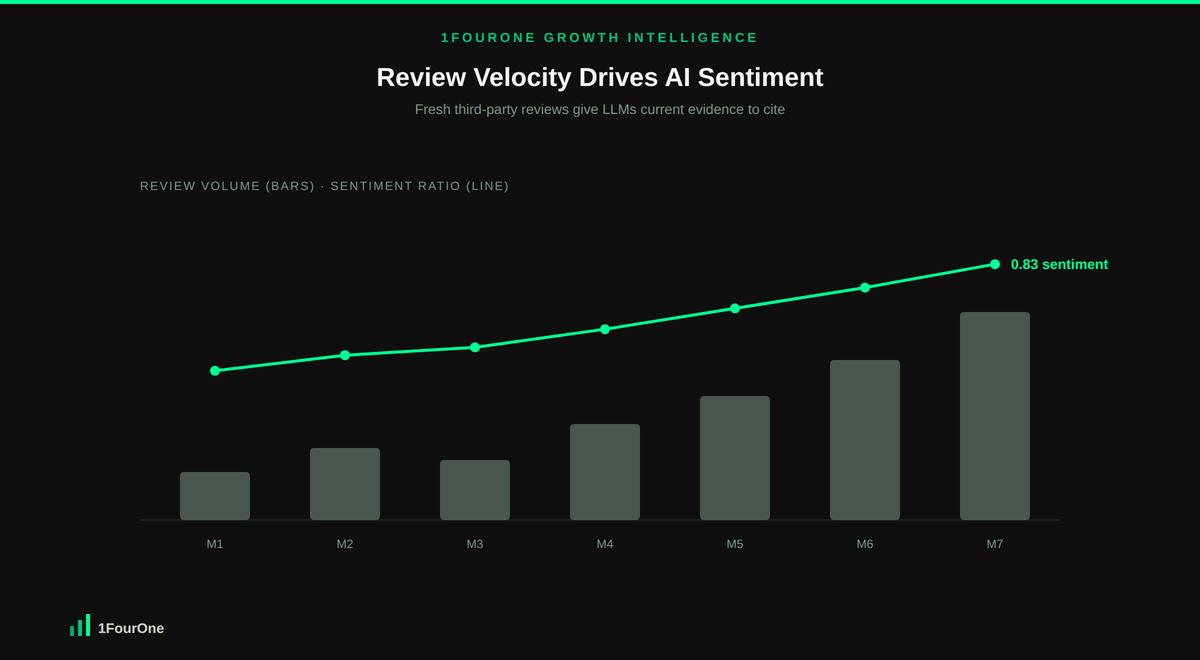
Actively monitor and increase the frequency of detailed customer reviews on independent platforms. LLMs use these external review aggregators to gauge current consumer sentiment. A continuous stream of fresh, positive reviews provides the real-time validation these models require to confidently recommend your brand.
Before investing in any fix, establish a baseline. Ask ChatGPT, Perplexity, and Gemini the exact questions your prospective customers would ask: a category recommendation, a comparison between you and your two closest competitors, and a direct question about your brand. Run each query three times across a single week and record whether your brand appears, how it is described, and which sources the model cites.
This manual approach has real limits. The output of an LLM is not deterministic, so a single test session tells you very little, and you have no way to see whether your visibility is improving or declining without repeating the exercise on a fixed schedule. Most marketing teams lack the time to run this consistently across every model, every week, across every product category that matters to the business.
A clothing retailer running this test, for example, might find that Perplexity names two competitors’ return policies directly while never mentioning the retailer’s own brand, even though its policy is more generous. That is a precise, actionable gap rather than a vague sense that visibility feels low.
A structured AI visibility audit solves this by standardising the test, logging citation sources against a fixed methodology, and giving you a comparison point for next quarter rather than a single snapshot. Treat the first measurement as the start of a tracking exercise, not a one-off report.
No. Traditional SEO still controls whether AI crawlers can find and parse your site in the first place, and conventional search remains a major traffic source for most retail brands. Generative engine optimisation extends that foundation with the structured data, third-party validation, and direct-answer formatting that LLMs specifically reward. Treat it as an additional layer, not a replacement programme.
Schema and on-page fixes can influence how different LLMs parse your site within weeks, since the next crawl picks up the change. Earned media and review velocity take longer, typically one to three months to accumulate enough volume to shift how a model describes your brand. Expect a measurable change in citation frequency within a single quarter if all five steps are actioned together, not just one.
Prioritise whichever platform your customers are most likely to use for research, which is rarely the same answer across every category. Perplexity tends to favour heavily structured, frequently updated sources, Gemini draws on Google’s existing index and Search Console signals, and ChatGPT leans on a broader mix of training data and live browsing. Most established retail brands need a presence across all three rather than picking one.
Yes, and arguably more easily than competing for traditional search rankings. LLMs reward clarity, specificity, and verifiable structured data over the domain authority and historical backlink volume that traditional SEO algorithms weight heavily. A smaller brand with precise, well-marked-up product data and a handful of credible third-party citations can out-cite a larger competitor whose content is harder for a model to parse.
Yes. Generative models draw heavily on third-party review aggregators to gauge current sentiment, since reviews update far more frequently than a brand’s own marketing copy. A steady stream of recent, detailed reviews gives an LLM fresher evidence to cite than a static product page, which is why review velocity is one of the five structural fixes above.
Allow them, with conditions. Blocking GPTBot, PerplexityBot, and similar crawlers removes any chance of your brand being cited, which defeats the purpose of the whole exercise. The more useful control is ensuring your robots.txt does not accidentally block these agents through an overly broad disallow rule written for a different purpose, and that your server responds quickly enough for the crawler to complete its pass before timing out.
Transitioning from legacy search optimisation to full conversational authority is a complex data engineering process. You cannot fix an AI search visibility deficit until you understand exactly how far behind your competitors you actually are. Guesswork and manual prompt testing will not provide the intelligence required to protect your market share.
1FourOne provides established retail brands with precise data on their exact position within the conversational search ecosystem. We map your current platform deficits and engineer data-driven playbooks to reclaim your category authority. Contact our Growth Intelligence team to baseline your performance metrics and begin capturing the buyers your current strategy is missing.
Get your competitive audit in 48 hours and see exactly where your revenue is leaking.
Get Your Audit →