Stopping Competitors From Hijacking Your Own Brand Searches

Implementing a defensive dynamic brand bid defence strategy is the most critical operational adjustment a mid-market e-commerce brand can execute to safeguard its high-intent organic conversion assets from aggressive competitor conquesting campaigns. Many established digital retailers evaluate their monthly paid media performance in isolation, completely overlooking the systematic margin drain that occurs when rival market participants bid directly on their trademarked corporate names. Allowing competing storefronts to capture the absolute top positions on your own brand searches introduces severe structural inefficiencies into your acquisition funnel. Shifting from a passive approach to a data-driven search protection framework ensures growth teams can block traffic poaching, stabilise distribution costs, and preserve customer lifetime value metrics.
Digital marketplace auctions operate on a continuous second-price bidding model that rewards aggressive, well-funded traffic acquisition pipelines. When an e-commerce competitor identifies that your brand commands significant consumer affinity, they can deploy targeted campaigns to intercept your prospective buyers at the exact moment of purchase intent. Failing to run an active protection framework allows these rivals to display alternative offers above your native organic search listings. This prominent visual placement diverts high-intent shoppers away from your digital storefront, severely compromising your conversion volumes.
Relying completely on organic search dominance to capture your brand queries introduces immense risk to your weekly unit economics. While your site may hold the primary organic position, modern search engine page layouts give massive visual preference to paid placements, push-down menus, and shopping carousels. When an aggressive competitor sets up a targeted campaign against your business name, your organic click-through rate can drop substantially. This change causes immediate transaction drops across your most profitable customer segments, as consumers are pulled into rival discovery flows.
To insulate your net margins from these external intercept campaigns, growth operations must establish a structured, programmatic defence system. Treating branded search terms as protected corporate capital ensures your marketing teams deploy media budgets based on strict efficiency targets rather than emotional reactions. By constructing a real-time auction tracking architecture, you can catch competitor movements early, adjust your defensive bidding filters dynamically, and preserve the commercial health of your core digital assets.
Tolerating rival customer acquisition campaigns on your trademarked search terms is an expensive strategic mistake that damages your blended media returns. True growth intelligence relies on separating natural, incremental organic traffic from conversions forced onto paid channels by competitor bidding pressure. When your digital teams evaluate search metrics without accounting for cross-channel keyword poaching, they systematically miscalculate their media efficiency ratios. This analytical oversight obscures real capital leaks, making it incredibly difficult to optimise your broader distribution pipelines.
Defending your brand search space is also directly linked to protecting the compounding value of your historical marketing investments. Clear industry documentation published by the Harvard Business Review confirms that increasing customer retention rates by 5% scales corporate profitability by 25% to 95%. This mathematical reality underscores why allocating budget to block a rival competitor acquisition channel play on your name delivers a massive return on capital. Defending your active customer cohorts from aggressive rival offers preserves customer lifetime value metrics across your entire product portfolio.
Achieving total operational transparency across these search auctions demands that your team integrate their tracking data directly with an enterprise ecommerce first party data strategy to monitor audience behaviour. Mapping how repeat buyers interact with paid search listings versus organic blocks allows you to build a highly optimised keyword management matrix. This clear data structure ensures you deploy paid brand ads only when a distinct competitor acquisition channel threat is actively degrading your organic visibility, preventing unnecessary expenditure on unpoached terms.
| Auction Scenario | Rival Bidding Activity | Organic Visibility Impact |
|---|---|---|
| Uncontested Brand Space | Zero competitor keyword targeting | Optimal (Organic listings capture maximum historical click-through rates) |
| Active Conquest Campaign | Rival bids aggressively on brand name | Poor (Paid ads push organic listings below the initial mobile fold) |
| Dynamic Script Defence | Automated script counters rival bids | Restored (Defensive paid ads reclaim the absolute top impression share) |
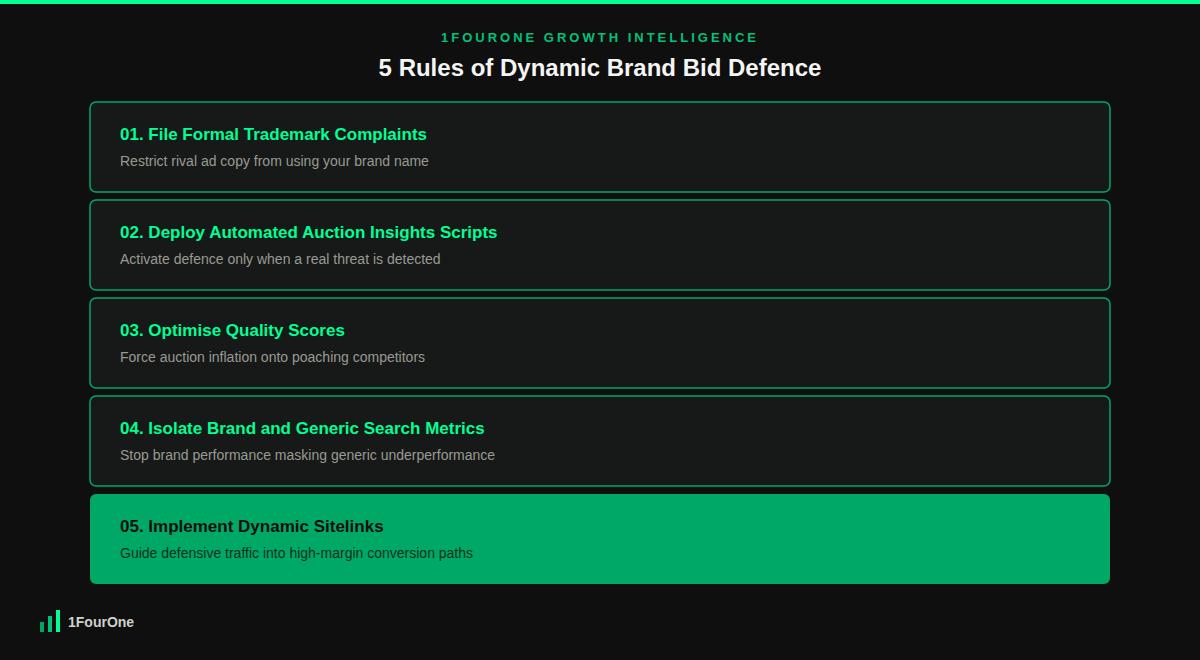
To systematically maximise your search engine real estate and eliminate auction capital leaks, your operations team must institutionalise this defensive methodology properly. This approach shifts your search engine strategy from passive performance monitoring to disciplined, automated auction defence rules. The following five rules provide a repeatable framework to block keyword poaching, optimise defensive script execution, and preserve marketing spend efficiency.
The primary structural defence against brand search poaching is restricting how competitors position their commercial messages when targeting your keywords. While search platforms permit rival businesses to bid on your brand name as a keyword trigger, they enforce strict limitations on the text displayed within the actual ad components. To activate these protections, your growth operations team must register your corporate credentials with the primary advertising networks.
According to the official legal guidelines published in the Google Ads Trademarks Policy, the platform will restrict the use of trademarked terms in ad copy if a formal complaint is submitted by the brand owner. Executing this documentation process prevents competitors from using your exact name in their headlines to deceive value-conscious shoppers. Restricting their copy options lowers their ad relevance scores and drives up their auction costs.
Maintaining a constant paid brand campaign when zero rivals are actively targeting your business name is a severe operational error that dilutes your marketing spend efficiency. To eliminate this continuous budget drain, your development team must build automated auction insight scripts that track impression share concurrency metrics hourly. These programs check the competitive landscape to verify if a rival competitor acquisition channel is active on your terms.
When the tracking script detects that competitor impression share rises above a pre-determined boundary, it automatically activates your defensive brand campaigns to reclaim the absolute top spot. If the rivals pause their conquesting campaigns, the script dials back your paid bids to allow organic listings to capture traffic at zero cost. This dynamic automation ensures you deploy ad capital only during active threat windows, protecting your operating cash flow completely.
The total cost required to secure the absolute top position in a paid search auction is directly governed by an account’s mathematical quality score calculation. Because your storefront domain matches your branded keywords perfectly, your account naturally maintains a massive quality score advantage over conquesting rivals. Your growth teams must maximise this structural advantage by aligning your ad headlines, extensions, and landing page paths perfectly.
Maintaining a perfect quality score ensures your brand can secure the top paid position at a fraction of the cost paid by poaching competitors. This cost discrepancy creates intense financial pressure on rival media buyers, forcing massive auction inflation on their campaigns whenever they attempt to capture your audience. Speeding up your transaction destinations via a specialised reduce checkout abandonment tactics framework further improves your landing page experience metrics, keeping your quality score locked at the absolute ceiling.
Blending high-converting brand search data with cold, non-branded generic search campaigns is an analytical error that distorts your growth reporting panels. Branded campaigns naturally deliver exceptionally high conversion rates and low acquisition costs, which can easily hide underperforming generic ad placements when aggregated. Your data management protocols must enforce a strict, complete separation between brand and non-brand keyword groups.
Evaluating your search budgets in completely isolated silos ensures that your marketing spend efficiency targets reflect true commercial performance. This strict accounting discipline prevents media buyers from expanding unoptimised generic ad sets based on top-line returns that are heavily subsidised by native brand affinity. Maintaining clean reporting boundaries allows you to allocate media capital only to campaigns that actively drive new, incremental market demand.
When competitor bidding pressure forces you to activate a defensive brand ad, you must use the expanded real estate to guide consumers into highly optimised conversion paths. Do not simply direct all paid brand traffic to your default homepage directory. Instead, deploy dynamic sitelink extensions that occupy maximum screen space and present clear, specialised choices based on historical consumer behaviour patterns.
Link your brand ad extensions directly to high-margin collection bundles, active clearance pages, or your customer onboarding portals. Growth teams should coordinate these pathways with their broader retention initiatives, referencing frameworks like our guide on loyalty program design to highlight reward portals to returning buyers. Dominating the search viewport with targeted links reduces the visual visibility of rival ads, keeping customer focus locked on finishing their transaction.
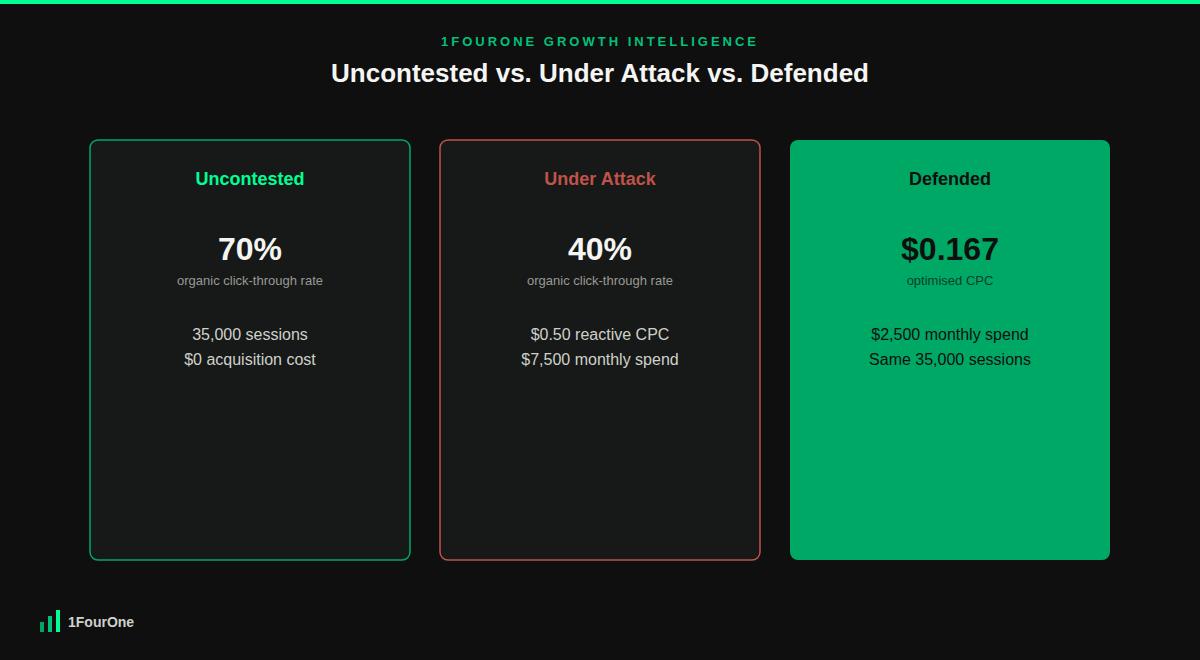
To evaluate the direct commercial return of a structured dynamic brand bid defence program, let us examine an established mid-market retail brand that receives exactly 50,000 monthly searches for its branded corporate terms. Under the historical baseline scenario, zero competitors bid on the brand’s name, allowing the native organic search listing to capture an optimal 70% click-through rate. This setup delivers 35,000 monthly site sessions to the store at zero cost.
With a fixed web conversion rate of 5.0% on brand traffic, this baseline traffic flow generates exactly 1,750 completed customer transactions per month (35,000 sessions multiplied by 0.05). Assuming the average order value is stable at $100, the brand secures exactly $175,000 in monthly gross revenue from these organic search queries. Because the acquisition cost is zero, this baseline state represents an exceptionally clean, high-margin revenue stream for the business.
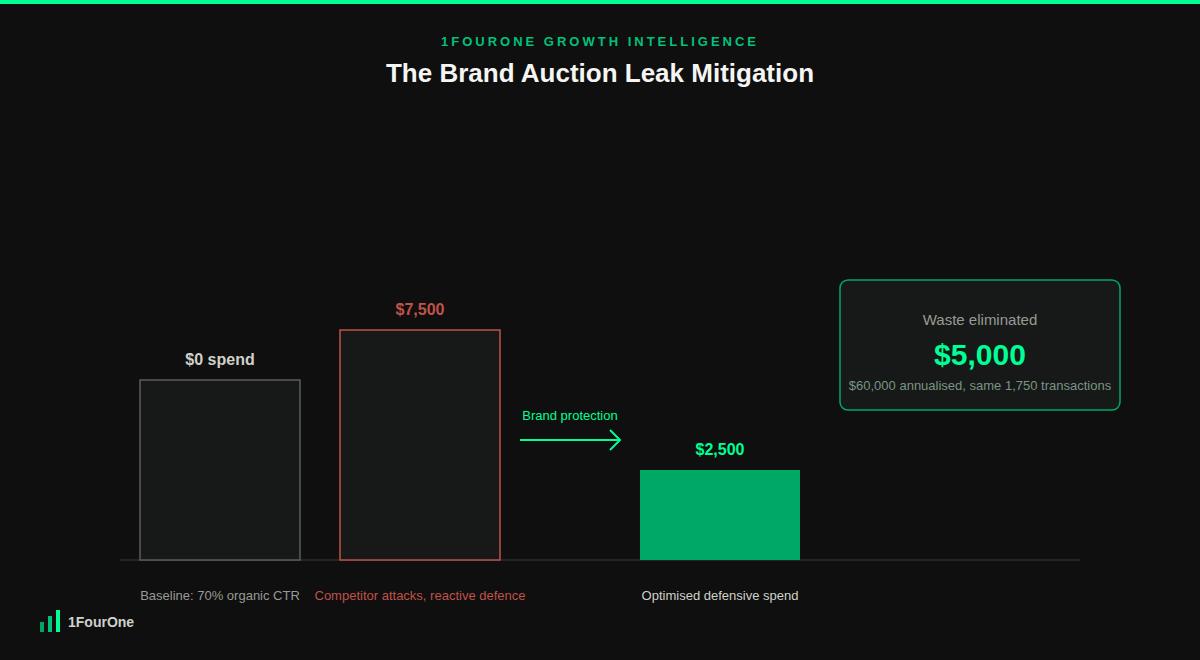
An aggressive competitor then launches a conquesting campaign targeting the brand’s name, capturing the top paid spot. This intervention drops the brand’s organic click-through rate from 70% down to 40% (20,000 sessions), while the rival poaches 10,000 sessions. To counter this loss, the brand reactively deploys a standard defensive brand ad, paying an average Cost Per Click of $0.50 to win back 15,000 sessions. This unoptimised reaction forces the brand to absorb a new $7,500 monthly ad spend asset liability simply to restore their original 35,000 combined session baseline (15,000 paid plus 20,000 organic).
The brand’s growth team audits this auction leak and implements a dynamic brand bid defence script. The automated system monitors competitor impression share hourly, dropping bids when the rival pauses and expanding bids only when the threat is active. Simultaneously, they file a formal trademark complaint to scrub their name from the rival’s ad copy, dropping the competitor’s relevance score and forcing severe auction inflation on their account.
This automated optimisation program completely restructures the auction economics. Because the rival’s quality score plummets due to the trademark block, their ad visibility drops, allowing the brand’s script to maintain the top paid spot while driving the average Cost Per Click down from $0.50 to approximately $0.167. The brand maintains its combined 35,000 session baseline (15,000 paid sessions plus 20,000 organic sessions), keeping total completed transactions stable at exactly 1,750 and gross monthly revenue flat at $175,000.
The optimisation success is measured by evaluating true marketing spend efficiency against the distorted defensive state, not by claiming fabricated top-line revenue growth that never happened. The automated framework drops the monthly defensive brand expenditure from $7,500 down to exactly $2,500 (15,000 paid sessions multiplied by the reduced $0.167 rate). This strategic adjustment reclaims exactly $5,000 in monthly operating capital ($7,500 baseline spend minus $2,500 optimised spend) that was previously lost to auction friction. The brand saves $60,000 in annualised media spend on a completely flat revenue baseline.
You cannot legally prevent a competitor from targeting your corporate name as an auction keyword trigger, as search networks permit open keyword bidding to maintain market competition. However, you can completely block them from displaying your trademarked name within their visible ad headlines and body text blocks by filing a formal complaint. Restricting their copy options lowers their ad relevance, driving up their auction costs significantly.
These automated tracking programs connect directly to platform reporting APIs to check daily impression share, overlap rates, and outranking shares across your keyword groups. When the script records a sudden jump in a competitor’s top-of-page frequency, it identifies the active threat and alters your account settings instantly. This programmatic monitoring protects your storefront real estate without requiring continuous manual campaign adjustments.
A minor amount of traffic cannibalisation can occur when a paid brand ad sits directly above a top organic listing, as some consumers will click the ad out of convenience. However, comprehensive industry testing confirms that running a joint paid and organic search layout increases your total combined click volume by 20% to 35% when competitors are active. The incremental volume gained far outweighs the micro cost of the paid clicks.
Your documentation must include your official corporate registration details, active trademark serial codes, and explicit descriptions of your protected product categories. Specify which competitor domains are violating your properties and outline the exact regions where your legal protections apply. Submitting this structured data pack ensures fast review timelines, allowing advertising networks to deploy copy restrictions rapidly.
Conquesting rival terms can serve as an effective customer acquisition method, provided your business possesses a distinct product or pricing advantage that can convert their audience. However, be fully prepared for lower match quality scores and higher click costs, as platform bidding models naturally favour the actual trademark owner. Evaluate these conquesting campaigns in an isolated budget silo to ensure they hit your marketing spend efficiency targets.
Allowing aggressive competitors to poach your high-intent search traffic without a structured defence is an expensive operational failure that degrades your retail margins. At 1FourOne, we eliminate digital media waste by deploying comprehensive dynamic brand bid defence frameworks that neutralise rival conquesting and shield your acquisition channels. Contact our growth operations team today to secure a data-driven performance audit built directly for your brand.
Get your competitive audit in 48 hours and see exactly where your revenue is leaking.
Get Your Audit →