The Mobile Checkout Mistakes Costing You Real Revenue

Implementing a disciplined mobile checkout optimisation strategy is the single highest-impact operational adjustment a mid-market e-commerce brand can execute to stabilise capital efficiency. While digital customer acquisition costs continue to climb across paid media channels, retail operations frequently ignore the catastrophic revenue drops occurring at the final stage of the transactional funnel.
Failing to tailor the payment journey to mobile users introduces immediate structural friction, driving qualified buyers directly into the arms of more agile market competitors. Brands must transition from generic, template-driven checkout designs to high-performance, mobile-first architectures to capture every dollar of existing market demand.
Mid-market retail brands spend substantial budgets optimising early-stage funnel metrics, yet they tolerate immense friction where capital is actually collected. Data indicates that while mobile devices drive over 70% of total e-commerce traffic, their completed transaction rates lag behind desktop environments. This metric discrepancy confirms that retail brands fail to accommodate mobile consumer behaviour. Addressing this operational gap requires more than visual aesthetic enhancements; it demands a systematic overhaul of input engineering, data validation protocols, and technical performance pipelines.
When user experiences are clunky or slow, a buyer’s purchase intent degrades rapidly. Mobile users operate in highly distracted environments, making them hyper-sensitive to long forms, unnecessary fields, and slow loading indicators. Every extra millisecond or field added to the validation path directly increases your baseline cart abandonment rate. To eliminate these continuous margin drains, growth teams must apply deep technical scrutiny to the entire transaction layer, ensuring that mobile interactions require minimal effort.
This technical optimisation sprint must be treated as a core element of your broader growth intelligence matrix. As established in our strategic guide on checkout abandonment, small structural changes to the transaction interface yield massive improvements to conversion metrics. Instead of relying on expensive, unverified customer acquisition strategies to grow top-line revenue, fixing your bottom-of-funnel conversion architecture allows you to capture more margin from your existing audience traffic.
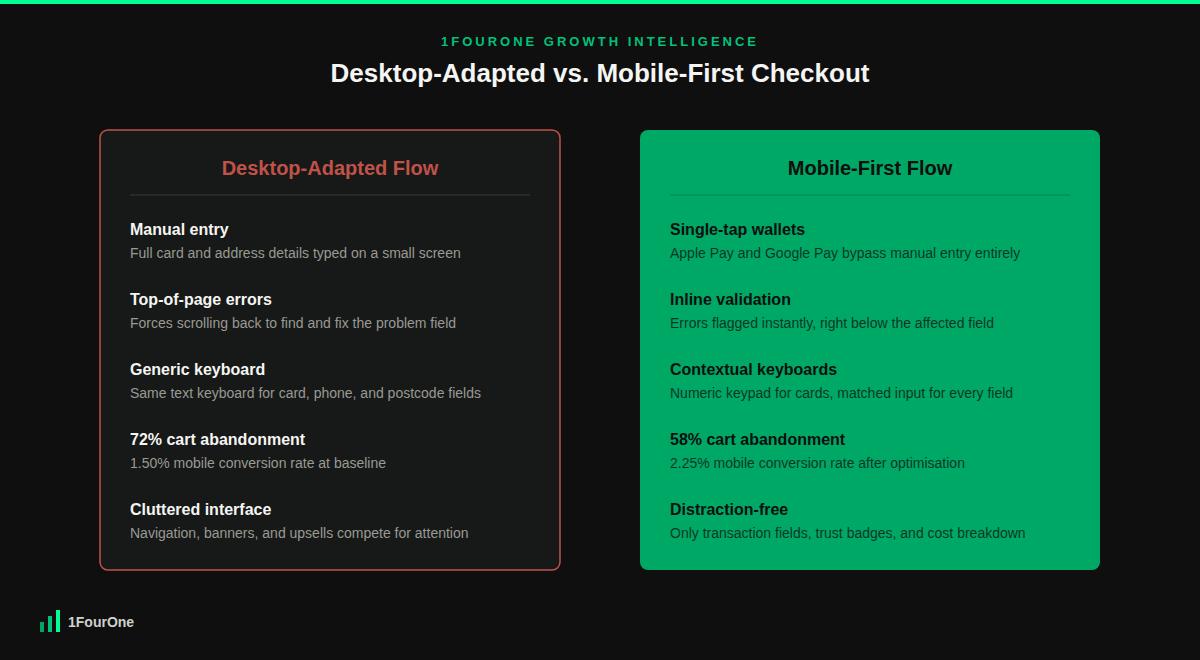
Desktop e-commerce interfaces rely on physical keyboards, large viewports, and highly stable internet connections. When these identical frameworks are shrunk down to fit mobile screens without deep layout adjustments, conversion rate optimisation failures occur. Microscopic tap targets cause accidental inputs, causing user frustration and high bounce rates. Multi-step validation processes that feel manageable on a desktop monitor become tedious hurdles on a small touch interface.
Mobile conversion drops are directly tied to how input errors are handled on small screens. Traditional validation layouts display generic error alerts at the top of a page, forcing a consumer to scroll backward to find the problem field. This clunky workflow causes immediate friction, which quickly drives up your cart abandonment rate. Mobile interfaces require inline validation, smart default fields, and automated address autocomplete tools to keep users moving forward efficiently.
Additionally, legacy transaction platforms often struggle with mobile network latency. Heavy JavaScript components, tracking scripts, and unoptimised security certificates slow down page response times, stalling the checkout exactly when a user is ready to pay. This issue highlights why continuous payment gateway optimisation is mandatory for modern retail brands. Transitioning to single-tap payment methods bypasses legacy form hurdles entirely, providing the frictionless checkout experience today’s consumers expect.
| Friction Point | Technical Root Cause | Operational Metric Impact |
|---|---|---|
| Form Input Fatigue | Manual entry required for billing, shipping, and credit card details | Spikes the baseline cart abandonment rate during the shipping selection step. |
| Validation Errors | Post-submit page refreshes with generic error alerts at the top | Degrades overall conversion rate optimisation KPIs due to session drops. |
| Gateway Latency | Unoptimised third-party API calls stalling the final transaction script | Causes double-submission errors or total payment phase abandonment. |
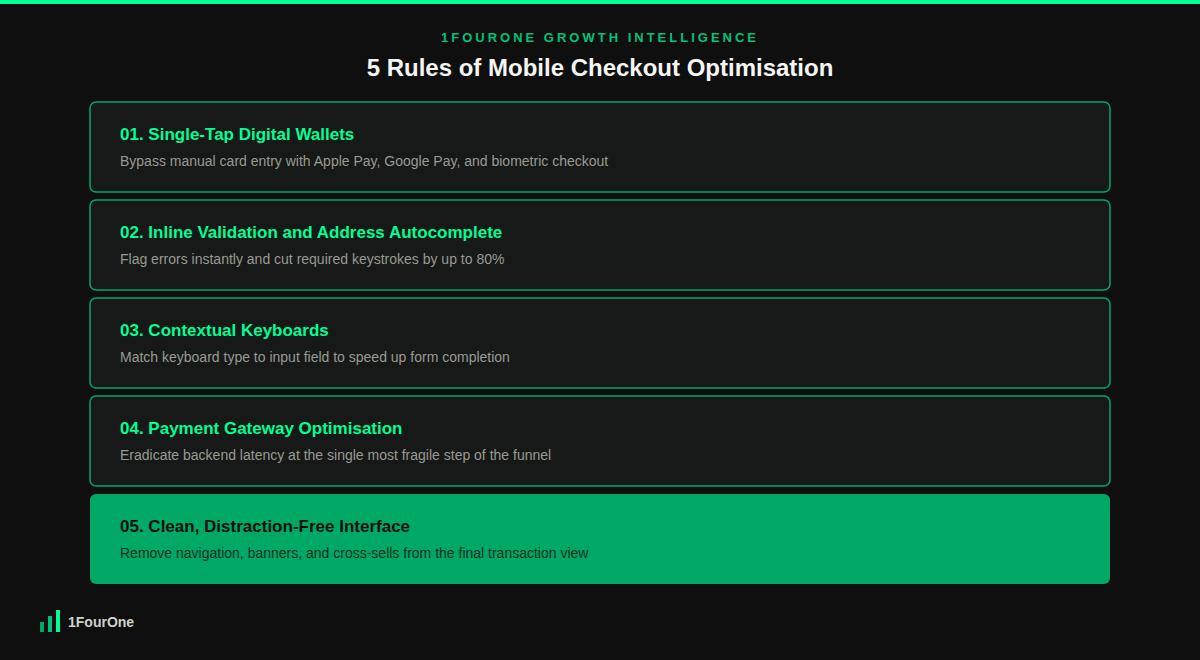
To systematically maximise your transaction efficiency, your growth operations team must execute a structured, mobile checkout optimisation roadmap. This process shifts your focus from cosmetic visual tweaks to strict technical design rules. The following five rules provide a repeatable framework to reduce input friction, eliminate payment delays, and reclaim your digital retail margins.
Manual data entry is the primary enemy of mobile conversion performance. Forcing a consumer to type a sixteen-digit credit card number, expiration date, and CVV code on a smartphone screen introduces massive room for input error. To eliminate this hurdle, you must prioritise single-tap express payment options like Apple Pay, Google Pay, and localised digital wallets. These modern frameworks allow consumers to securely complete their transactions in seconds using biometric authentication.
According to the Baymard Institute, checkout processes perceived as too long or complicated account for 18% of stated cart-abandonment reasons. Integrating express options directly on product detail and cart views bypasses standard multi-step forms entirely. This strategic implementation ensures that billing data, shipping preferences, and contact details are securely transmitted in a single interaction, instantly raising your transaction completion rates.
When manual entry is unavoidable, such as when a user is entering a unique shipping location, you must minimise active typing time. Implement predictive address autocomplete tools via high-performance APIs to reduce required keystrokes by up to 80%. As the consumer begins typing their building number, the interface should instantly display verified address matches, automatically populating the city, state, and postal code fields upon selection.
Simultaneously, use real-time inline validation to flag errors the moment a user moves from an input box. If a telephone number lacks digits or an email address misses a domain extension, display a clear message right below that specific field. Never wait for a user to click the final submit button to surface layout or formatting errors. Correcting typos immediately prevents the annoying page refreshes that break purchase momentum.
A simple yet frequently ignored rule of mobile interface design is matching the touch keyboard layout to the expected input data type. If a consumer taps into a credit card or telephone field, the screen must display a dedicated numeric keypad rather than a standard text keyboard. Managing this behaviour via clean HTML attribute declarations reduces manual correction errors and speeds up form completion times.
Apply these explicit input configurations to postal codes, quantities, and expiration dates across your entire transaction flow. For standard name and email inputs, ensure that automatic capitalisation and autocorrect features are disabled to prevent the system from corrupting real user data. This technical discipline removes micro-frustrations, creating a frictionless checkout environment that keeps users moving effortlessly toward completion.
The final submit phase is the most technically fragile moment of the entire digital customer journey. If your checkout architecture relies on unoptimised third-party scripts or poorly configured APIs, processing delays will occur. When a smartphone user encounters a frozen screen or an unresponsive processing icon after clicking pay, their anxiety spikes. This delay frequently causes them to close the browser app, leaving the transaction incomplete.
To address this vulnerability, your development team must focus heavily on continuous payment gateway optimisation. Use asynchronous processing scripts, choose modern payment processors with global edge routing networks, and remove unnecessary tracking tags from the final transactional path. Portent’s own site-speed research found that a site loading in one second converts up to three times better than one loading in five seconds, and identified checkout and login pages as the highest-impact page types of all. Eliminating backend processing delays protects your brand from structural conversion leaks.
Once a consumer enters the final transaction environment, your primary goal is to guide them to completion without any external distractions. Remove standard header navigation tabs, footer site directories, promotional discount banners, and newsletter opt-in forms from the checkout views. The interface should focus entirely on the transaction fields, explicit security trust badges, and a transparent order cost breakdown.
Displaying external links or unexpected cross-sell prompts at this late stage encourages users to exit the purchase funnel, driving up your cart abandonment rate. Keep your auxiliary choices, like optional gift wrapping or loyalty account creation, tucked cleanly away into post-purchase confirmation screens. A clean, single-purpose checkout view keeps customer focus locked on finishing the transaction, maximising your media investment efficiency.
To demonstrate the direct financial impact of an engineering-focused mobile checkout optimisation program, let us evaluate an established e-commerce retail operation generating 200,000 monthly mobile sessions. Under the brand’s baseline setup, the digital store uses a traditional multi-step desktop-adapted form layout, driving a mobile conversion rate of 1.50%. The store’s average order value across these digital transactions is stable at $100.
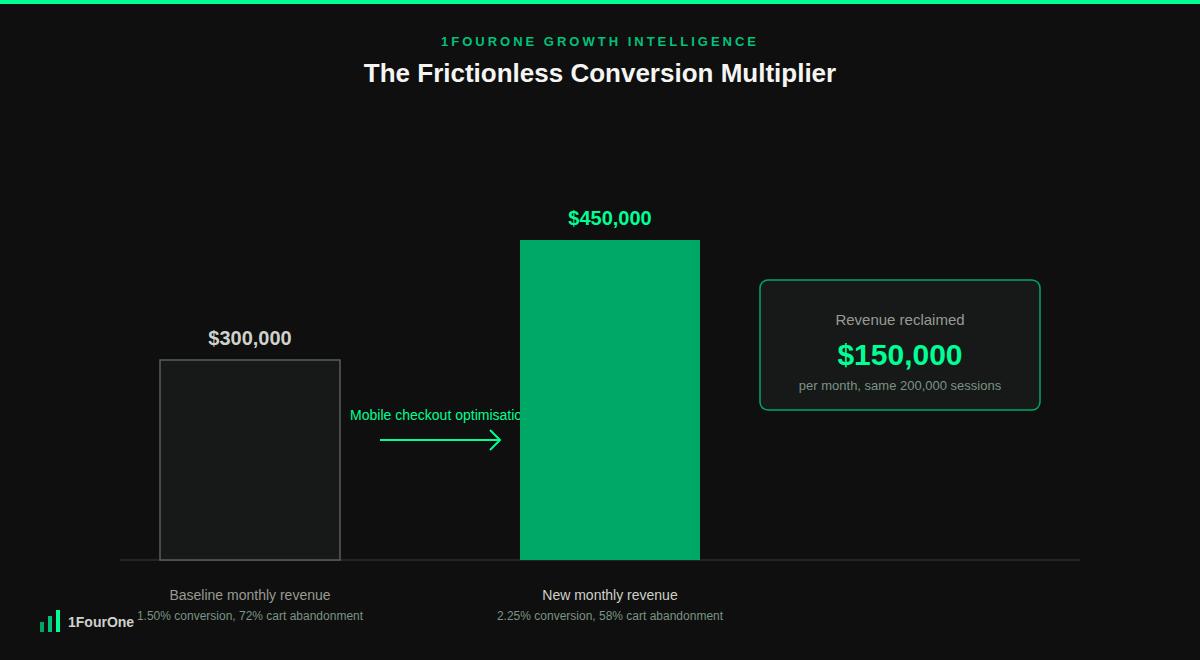
Operating with a 1.50% baseline mobile conversion rate across 200,000 sessions yields exactly 3,000 completed monthly transactions (200,000 sessions multiplied by 0.015). With the average order value fixed at $100, this baseline scenario generates exactly $300,000 in monthly gross revenue (3,000 transactions multiplied by $100). Reviewing the analytics data highlights that the store suffers from a painful 72% cart abandonment rate, caused by long manual forms and slow payment gateway load times.
The brand’s growth team reviews these metrics and deploys a comprehensive mobile checkout optimisation strategy to fix these bottom-of-funnel leaks. First, they integrate express digital wallets directly onto the primary cart view, allowing users to bypass manual form steps completely. Second, they deploy predictive address autocomplete APIs, switch on numeric contextual keyboards for card fields, and optimise their backend scripts to cut payment processing latency in half.
These targeted user-experience adjustments significantly reduce data input friction, dropping the store’s cart abandonment rate from 72% down to 58%. Because users can now navigate the transaction path with minimal effort, the overall mobile conversion rate scales from 1.50% up to 2.25%. With marketing budgets held completely flat, the total volume of monthly mobile site traffic remains constant at exactly 200,000 sessions.
Applying the updated 2.25% mobile conversion rate to the existing traffic volume of 200,000 sessions generates exactly 4,500 completed customer transactions per month (200,000 sessions multiplied by 0.0225). Assuming the average order value remains completely stable at the baseline level of $100, the brand’s newly optimised monthly gross revenue climbs to exactly $450,000 (4,500 completed transactions multiplied by $100).
The financial return of this optimisation sprint is immediate and highly profitable. Without spending a single additional dollar on paid media acquisition campaigns, the brand increases its monthly revenue by exactly $150,000 ($450,000 optimised revenue minus $300,000 baseline revenue). This capital optimisation framework protects retail margins and provides a highly efficient baseline to scale future marketing investments safely.
Data indicates that a single-page layout generally outperforms multi-step structures on mobile devices, provided the design is clean and lightweight. A single-page layout reduces perceived user effort by presenting all necessary fields in an easy-to-read vertical flow. However, ensure that the single-page format does not load heavy scripts that slow down mobile page response speeds.
Integrating predictive address autocomplete APIs can lower checkout friction significantly, often reducing address-related form drop-offs by 15% to 25%. By minimising manual typing errors and automatically filling in city and postal fields, you speed up the entire transaction journey. This adjustment is highly effective for international shoppers who use different address formats.
Modern express payment systems can be configured to work alongside standard post-purchase marketing scripts without conflict. The key is ensuring that your developers pass the completed transaction token securely through your primary platform before triggering the upsell view. Testing these API pipelines carefully ensures you maintain average order value metrics while capturing express transaction gains.
Your engineering team should set up real-time server-side logging to track the exact millisecond duration of every third-party payment API request. Monitor these processing times across different mobile networks, operating systems, and geographic regions to isolate slow processing connections. Work closely with your merchant provider to optimise these scripts and maintain rapid response times.
Forcing users to register a permanent password before they buy a product introduces massive friction that degrades your conversion rate optimisation metrics. You should always provide a visible, friction-free guest checkout option for new visitors. Allow buyers to easily save their account credentials on the post-purchase thank you page instead, keeping the initial path to purchase as fast as possible.
Allowing unoptimised checkout layouts to drain your hard-earned digital retail margins is an expensive operational mistake. At 1FourOne, we specialise in identifying hidden transactional leaks and deploying rigorous, data-driven optimisation strategies that protect your bottom-line revenue, the same discipline behind a sound ecommerce dynamic pricing strategy. Contact our growth engineering team today to secure a comprehensive performance audit tailored directly to your brand’s unique needs.
Get your competitive audit in 48 hours and see exactly where your revenue is leaking.
Get Your Audit →