Winning the AI Brand Comparison: ChatGPT and Perplexity
An AI brand comparison is the modern equivalent of the traditional search engine battleground. When a consumer asks a generative model to evaluate two competing products, they are seeking a definitive recommendation rather than a list of blue links. This shift means retail brands can no longer rely solely on legacy search engine ranking factors. If your technical architecture does not feed the right signals to these language models, your competitor will win the recommendation by default.
The mechanics of how these models evaluate products differ fundamentally from traditional keyword matching. A standard search engine crawls your site to index text, but a language model reads to synthesise meaning, context, and web consensus. When users enter chatgpt comparison prompts, the model pulls from a vast training corpus and real-time web retrieval to formulate a weighted opinion. This requires a specific approach to content structuring that prioritises clarity and third-party validation.
Mastering this new landscape is the core of generative engine optimization. It requires marketing teams to look beyond their own domain and influence the broader semantic web. This guide explains how language models construct that verdict and how you can position your retail business to dominate the generative search category.
Traditional search engines force users to perform the heavy lifting of data aggregation. A buyer researching a $1,500 espresso machine must open a dozen tabs, read multiple conflicting reviews, and manually build a mental matrix of features. Generative models remove this friction completely by synthesising the scattered data into a single, cohesive answer. This frictionless experience is precisely why Gartner predicts traditional search engine volume will drop 25% by 2026.
Consumers trust these models because the output feels authoritative and objective. The conversational interface mimics a consultation with an expert, providing clear pros and cons without the distraction of sponsored display advertisements. When a user asks a model which software platform is superior, they expect a definitive ruling rather than a directory. This places immense pressure on brands to ensure their technical specifications and market positioning are accurately represented in the training data.
Additionally, the queries themselves are becoming incredibly specific. Users are not just asking for general overviews, they are asking models to evaluate products based on highly personal criteria, such as specific integration capabilities or unique dietary requirements. The same pattern shows up across chatgpt comparison prompts in retail categories specifically: buyers increasingly name exact use cases rather than asking for a generic overview. To capture this intent, your digital presence must provide clear, structured data that directly answers these nuanced use cases.
When a model processes this kind of evaluation, it relies on a combination of baseline training data and retrieval-augmented generation. The baseline training data provides the algorithm with a historical understanding of your company’s reputation, product catalogue, and general market position. However, for current pricing or recent product updates, search-enabled models rely on real-time web scraping to fill in the gaps.
The algorithm evaluates entities based on semantic proximity and consensus. If a model consistently finds your product mentioned alongside positive attributes like durability or excellent customer service across authoritative domains, it builds a positive semantic association. Conversely, if the web consensus highlights technical failures or poor support, the model will reproduce those warnings in its final output. It is essentially a mathematical aggregation of digital sentiment.
This means your internal product pages are only one piece of the puzzle. The model actively weighs your claims against independent reviews, forum discussions, and industry publications. If your on-site claims contradict the broader web consensus, the model will likely prioritise the third-party data, highlighting the discrepancy directly to the potential buyer it never asked you to referee.
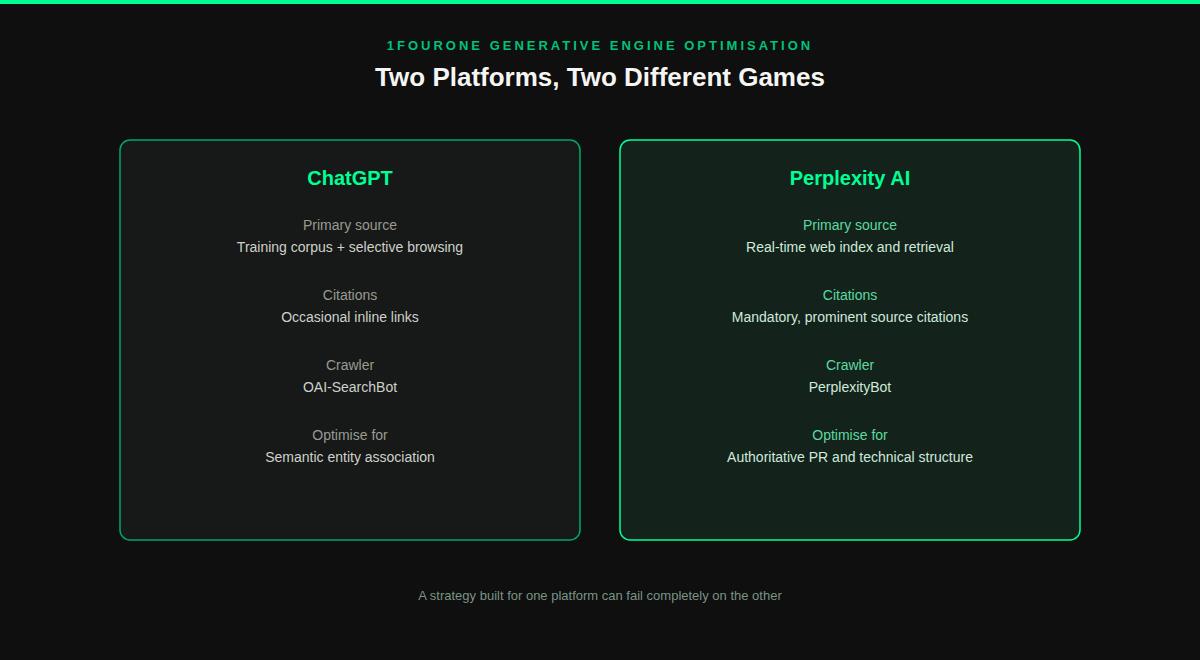
Not all artificial intelligence platforms source and display information in the same way, and an AI brand comparison run on one platform can produce a completely different outcome on another. Understanding the architectural differences between platforms is essential for securing positive perplexity brand recommendations. ChatGPT balances its massive internal training corpus with selective web browsing, whereas Perplexity operates primarily as a real-time answer engine that explicitly requires source citations to formulate a response.
This difference in architecture requires tailored optimisation strategies. A strategy that works for a static language model might fail completely in a real-time retrieval environment, which is exactly why perplexity brand recommendations need their own dedicated technical checklist rather than reusing a ChatGPT-focused plan. Marketing teams must ensure that their technical documentation is accessible to all types of crawler bots, not just the standard Googlebot.
| Feature | ChatGPT (GPT-4) | Perplexity AI |
|---|---|---|
| Primary data source | Training corpus with supplemental web search | Real-time web index and retrieval |
| Citation frequency | Occasional inline links | Mandatory, prominent source citations |
| Crawler identity | OAI-SearchBot | PerplexityBot |
| Optimisation focus | Semantic entity association | Authoritative PR and technical structure |
As detailed in recent analyses by Search Engine Land regarding Perplexity AI, optimising for these platforms requires a strict focus on factual content that provides direct answers. You cannot rely on keyword density or traditional backlink profiles to force your way into a generative recommendation. The content must be structured to facilitate easy extraction by natural language processing algorithms.
To succeed in this new environment, you must adopt a framework that prioritises machine readability. We outline this extensively in our guide to AI search visibility, where we detail the importance of structured data and entity relationships. The text on your product pages must be direct, factual, and completely free of marketing jargon that confuses extraction algorithms.
Implement a bottom-line-up-front structure for all product descriptions. State the core specifications, pricing, and primary use cases in the very first paragraph. Use descriptive, question-based headings to break up the text, followed immediately by concise, declarative answers. This format mirrors how the models themselves present information, increasing the likelihood that your exact phrasing will be retrieved and cited.
Finally, ensure your comparison pages actually address your competitors directly. Many brands are hesitant to mention rival companies on their own domain. If you do not control the narrative of how your product compares to a specific rival, the artificial intelligence will build that narrative using third-party data instead.
Your own website is a biased source, and generative models are programmed to seek independent verification. Securing strong AI search visibility requires a proactive approach to managing your off-site reputation, the same discipline that underpins durable AI search visibility across every platform, not just one. Models heavily weight information found on trusted review aggregator sites, industry publications, and established digital PR outlets.
If a user asks a model to compare two software platforms, the algorithm will instantly scan sites like G2, Capterra, or Trustpilot. If your competitor has a higher volume of detailed, positive reviews on these platforms, the model will mathematically favour them in the final output. You must actively encourage your most satisfied customers to leave detailed feedback on these specific third-party domains.
The specific language used in these reviews is also critical. A review that simply says great product is far less valuable than a review that says the integration saved our team ten hours a week. Language models extract these specific feature mentions to build their comparison matrices, providing the raw semantic material needed to recommend your brand.
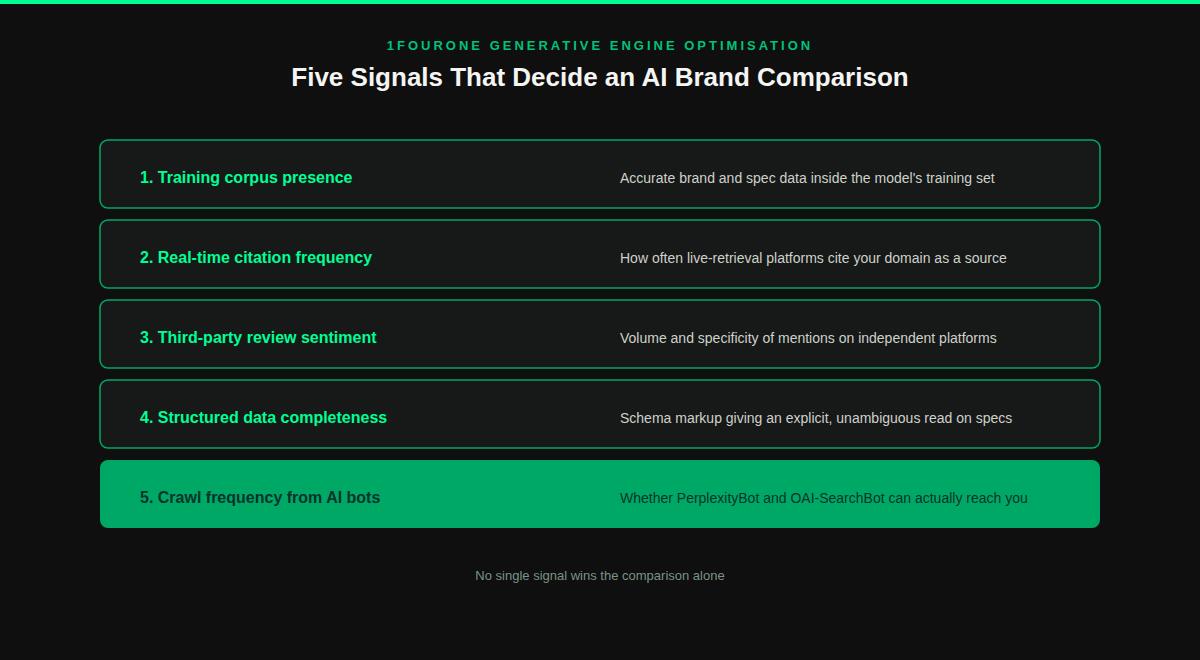
Pulling the mechanics above together, the outcome is ultimately decided by five measurable signals, not a single ranking factor the way classic SEO trained marketers to think.
No single signal wins the comparison alone. A brand with excellent reviews but blocked crawlers is invisible regardless of sentiment, and a brand with perfect schema markup but no third-party validation reads as unverified marketing copy to a model trained to be sceptical of self-reported claims.
Return to the $1,500 espresso machine from earlier. A buyer asks ChatGPT to compare two premium brands on noise level, milk texture, and maintenance cost. Brand A has thorough schema markup and a detailed specification page, but only a handful of reviews on third-party sites. Brand B has a thinner product page but hundreds of detailed Reddit threads and G2-style reviews mentioning exact decibel readings and descaling frequency.
In this scenario, Brand B is more likely to win the comparison despite the weaker on-site content, because the model is weighing independent, specific evidence over self-reported specifications it has less reason to trust. The lesson is not that on-site structure does not matter, it clearly does for extraction, but that it is necessary rather than sufficient. The brands that win consistently treat their own product pages and their external reputation as one connected system, not two separate projects run by different teams.
It depends entirely on the underlying architecture. Models using live retrieval, like Perplexity, update their answers in real time based on current web data. Static models update only when their core training data is refreshed, which can sometimes take months.
Generally, no. Blocking these crawlers prevents your brand from being cited in generative answers. This effectively hands your market share to competitors who allow their data to be indexed and cited.
Currently, organic generative responses cannot be bought directly in the same manner as Google Ads. However, platforms are actively experimenting with sponsored citations, meaning this environment is evolving rapidly.
Schema markup provides explicit, structured context about your products. It helps extraction algorithms accurately identify your price points, specifications, and review scores without having to guess based on standard paragraph text.
Yes, particularly on platforms that index real-time web discussions like Reddit. Models frequently use these forum discussions to gauge authentic user sentiment and identify common product complaints that may not appear in official reviews, and that sentiment regularly surfaces directly inside an AI brand comparison.
Yes, more easily than in traditional SEO. Generative models weigh specificity and verifiable evidence over domain authority, so a smaller brand with precise structured data and a handful of detailed third-party reviews can outperform a larger rival whose content is harder for a model to extract and trust.
Attempting to manually track your visibility across multiple generative platforms is a resource-intensive process prone to human error. Without a systematic approach to monitoring and optimisation, your brand risks being written out of the digital narrative entirely. The algorithms are constantly updating, and the data they use to evaluate your products shifts every single day.
1FourOne provides specialised auditing and optimisation services designed specifically for the generative era. We map your current share of voice, identify the technical deficits preventing accurate extraction, and build a structured data roadmap, drawing on the same methodology covered in our AI Brand Visibility Audit. Generative engine optimization is not a one-time project, it is the ongoing discipline that ensures your products are accurately represented in every AI brand comparison your category generates.
We move your team from reactive marketing tactics to a proactive generative strategy, securing your position as the authoritative answer in your category. Contact our Growth Intelligence team to baseline your current visibility and engineer a digital footprint that dominates the modern search landscape.
Get your competitive audit in 48 hours and see exactly where your revenue is leaking.
Get Your Audit →