AI Share of Voice: Your Complete 5-Step Measurement Guide
Your AI Share of Voice is the frequency with which ChatGPT, Google Gemini, and Perplexity cite and recommend your brand when buyers ask for category guidance. High-intent buyers are increasingly bypassing traditional search results entirely, getting their shortlist from a conversational AI platform instead of scrolling blue links. If your brand does not appear in those answers, you are invisible to a rapidly growing segment of the market. This guide introduces the 1FourOne Framework: a structured methodology to measure, evaluate, and grow your LLM brand visibility within conversational search.
AI Share of Voice is the frequency with which an engine names, cites, or recommends your brand across a defined set of category queries. It represents the proportion of conversational recommendations your brand commands relative to your direct competitors. This data directly shapes your brand consideration volume within modern buying journeys.
Legacy search metrics focus on ranking positions and raw impressions. Conversational search engines operate on a logic of extreme curation, narrowing thousands of potential web results down to a shortlist of one to three recommendations. Missing an AI recommendation means your brand is absent from that buyer session entirely.
Managing this footprint requires a shift in how marketing directors evaluate channel performance. Traditional traffic acquisition funnels are losing volume because consumers are getting answers directly inside the chat interface. Your brand citation rate is no longer a peripheral indicator. It is a critical revenue driver that determines whether your products enter the buyer consideration set at all.
The 1FourOne Framework treats conversational visibility as a data challenge with measurable inputs. Large language models do not pick recommendations at random. They pull information based on clear patterns of content quality, data structure, and third-party validation. Quantifying these patterns allows retail brands to protect their market share from faster-moving competitors.
Traditional search tracking assesses visibility by checking your domain’s position on a static results page. This methodology assumes a user will scroll through a list of blue links and choose where to click. AI search visibility ignores page rank entirely, focusing instead on whether your brand is included in the final conversational response.
In traditional search, multiple competitors can coexist on the first page, splitting clicks across results. In conversational engines, the interface is inherently restricted. The model acts as a filter, summarising the web on behalf of the user and returning a single authoritative recommendation rather than a ranked list.
This structural change removes the utility of standard search volume tracking. A high search volume for a category term matters very little if the dominant language models consistently recommend your primary rival. AI Share of Voice requires building the kind of structured, authoritative presence that causes models to cite your brand by default for unbranded queries. Gartner projects a 25% decline in traditional search volume by 2026 as AI assistants absorb more of the discovery journey, making this a structural shift rather than a short-term trend.
Traditional search tracking also cannot account for the multi-turn nature of AI research sessions. An individual researching a purchase via Perplexity will often refine their query four or five times within a single thread. Your LLM brand visibility must hold across these extended research sessions, not just at the level of a single keyword lookup.
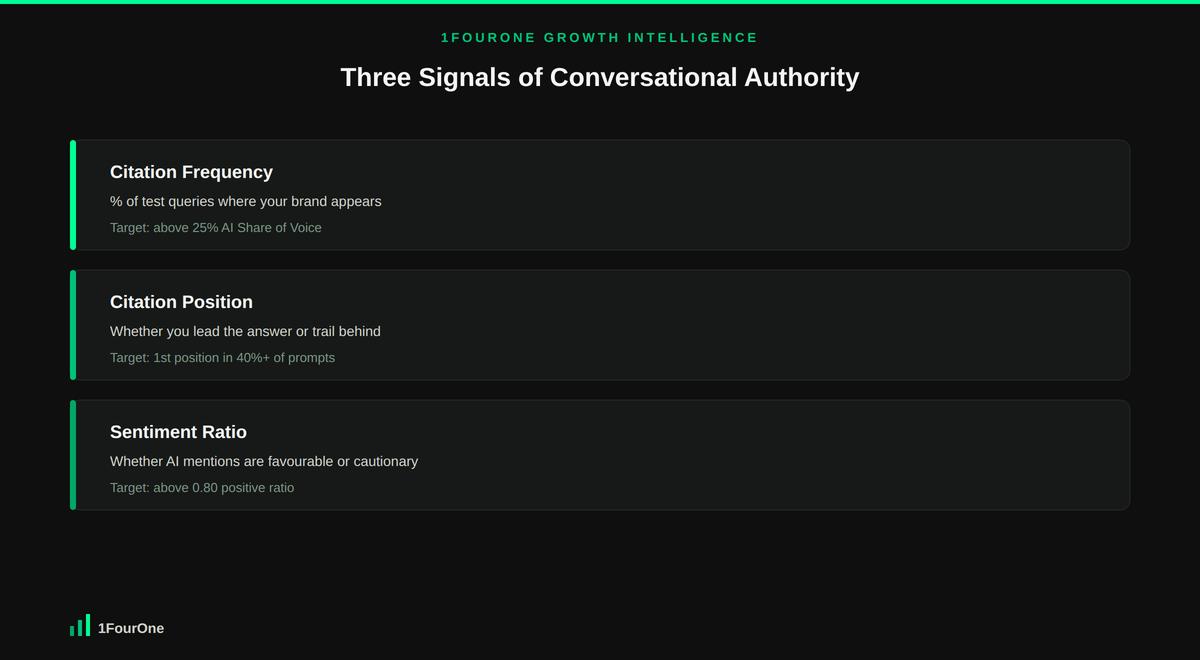
Large language models assess brands by processing web data through distinct retrieval and ranking layers. The 1FourOne Framework organises these signals into three core tracking dimensions to diagnose performance. You must monitor each dimension independently to identify precisely why an engine might be omitting your brand.
| Signal | What It Measures | What a Low Score Indicates | Target Benchmark |
|---|---|---|---|
| Citation Frequency | The % of test queries where your brand appears in the AI’s response | A content gap or technical crawl issue preventing the engine from reading your site | Above 25% AI Share of Voice in your primary category |
| Citation Position | Whether your brand leads the answer or appears as a lower footnote | Your brand citation rate is being outranked by competitors with stronger editorial authority | First-position mention in 40%+ of category prompts |
| Sentiment Ratio | Whether AI mentions are favourable or include cautionary language | Negative associations in your LLM brand visibility are actively dissuading buyers | Above 0.80 (80% of mentions positive) |
Citation frequency establishes your baseline AI Share of Voice across the model’s indexed sources. A low frequency points to a content gap or a technical crawl issue preventing the engine from reading your site accurately.
Citation position tracks whether your brand is presented as the primary recommendation or buried further down the response. Models naturally lead with their most confident recommendation. Citations that appear lower in the text generate substantially less click-through than those in the opening lines.
The sentiment ratio analyses the qualitative context of AI mentions. Conversational engines frequently include pros and cons alongside brand recommendations. A high citation frequency paired with cautionary language will actively dissuade buyers, making sentiment monitoring as important as raw citation volume.
Quantifying your brand citation rate requires a standardised approach to prompt testing across each engine. Because ChatGPT, Gemini, and Perplexity use distinct retrieval methods, you must evaluate each independently to build an accurate baseline. The 1FourOne measurement methodology breaks this into four stages.
First, build an unbranded prompt matrix that mirrors real consumer research behaviour. Avoid your direct brand name entirely, focusing on category discovery and problem-solving queries instead. A solid matrix includes 40 distinct queries distributed across product attributes, geographic locations, and target use cases.
Second, run these prompts using fresh, logged-out browser sessions to eliminate personal search history bias. Execute the entire matrix across all three platforms within a 48-hour window. This timing ensures that real-time engines like Perplexity are drawing from the same web snapshot as model-based engines.
Third, record every response in a structured spreadsheet. For each prompt, capture whether your brand appeared, its position within the response, and the specific third-party URLs the engine cited as source material. Those source URLs reveal exactly which external domains are driving your LLM brand visibility.
Finally, aggregate the data to calculate your AI Share of Voice score. Divide your total top-three citations by the total number of prompts tested to establish your platform baseline. Comparing this figure directly against your top three rivals exposes your competitive gap across each engine. For a full walkthrough of this process, see our AI brand visibility audit guide.
A low AI Share of Voice creates a silent, compounding revenue leak that standard attribution dashboards miss entirely. When a buyer uses an AI assistant to research a product category, their consideration set is formed before they ever visit a storefront. If your brand is absent from that response, you are removed from the purchase decision at its earliest stage.
This blind spot masks a significant misallocation of marketing budget for mid-market retail brands. Directors frequently invest in retargeting ads and competitive keyword bidding to capture low-funnel intent. But if conversational models are recommending your competitors during the research phase, those buyers never reach your paid advertising funnel in the first place.
The commercial cost is sharpest in high-average-order-value categories where buyers research extensively before purchasing. When someone asks Perplexity to compare the durability and warranty terms of three competing products, they are making a near-final decision. A weak brand citation rate at this stage hands the sale directly to a rival.
Over time, this displacement erodes organic brand equity and raises customer acquisition costs. As more consumers adopt conversational search, brands that rely solely on blue-link visibility will face a structural decline in new customer traffic. Building conversational authority now is the most defensible position available to mid-market retail brands.
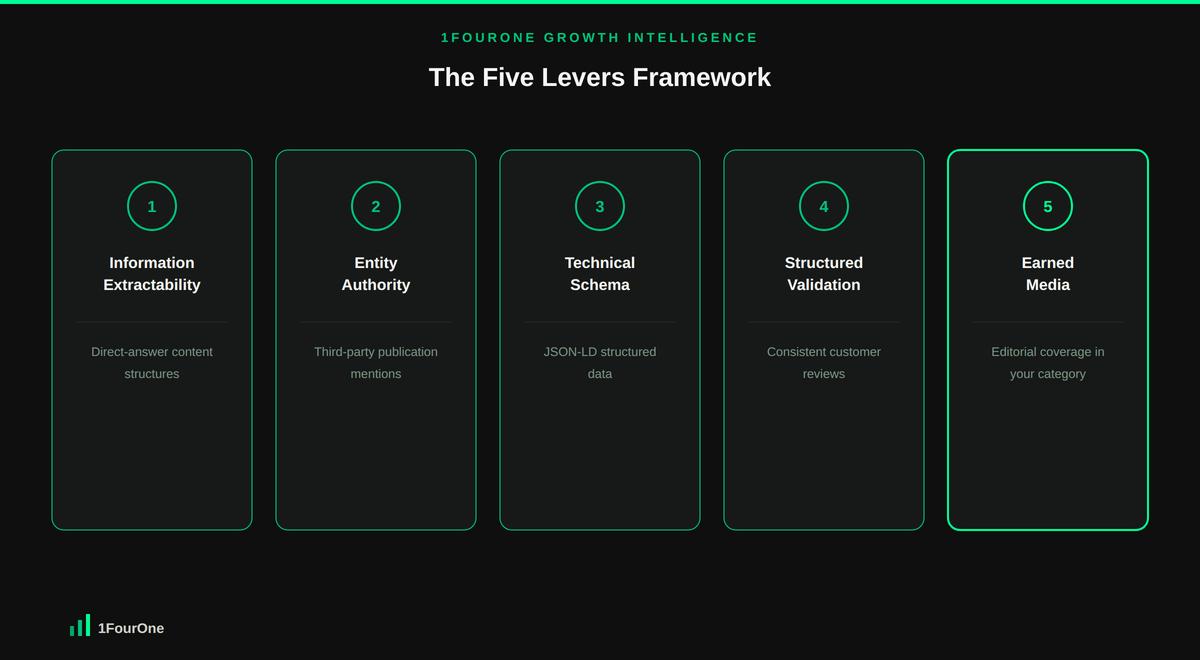
Growing your AI Share of Voice requires a deliberate content and authority strategy built around the signals language models prioritise. The 1FourOne Framework uses five levers to improve how engines retrieve and recommend your brand. You can deploy these in sequence or in parallel depending on where your biggest gaps sit.
The first lever, information extractability, focuses on your content structure. Language models favour content that states facts clearly and avoids padding. Writing paragraphs that lead with a direct, citable answer to a specific question gives crawlers what they need to select your content as a source, which directly improves your brand citation rate.
The technical schema lever provides the explicit data models need to verify your product information. Standard e-commerce schemas frequently omit critical fields such as materials, product weights, or delivery terms. Completing these fields in your JSON-LD implementation ensures crawlers index your products accurately and surface them in relevant responses.
Conversational models update their retrieval indexes continuously, meaning your AI Share of Voice can shift meaningfully in response to a single competitor article, a cluster of new reviews, or a change in how a platform weights its sources. A regular tracking cadence is the only way to catch these shifts before they compound into a structural disadvantage.
| Category Type | Recommended Frequency | Key Signals to Monitor | Minimum AI Share of Voice Target |
|---|---|---|---|
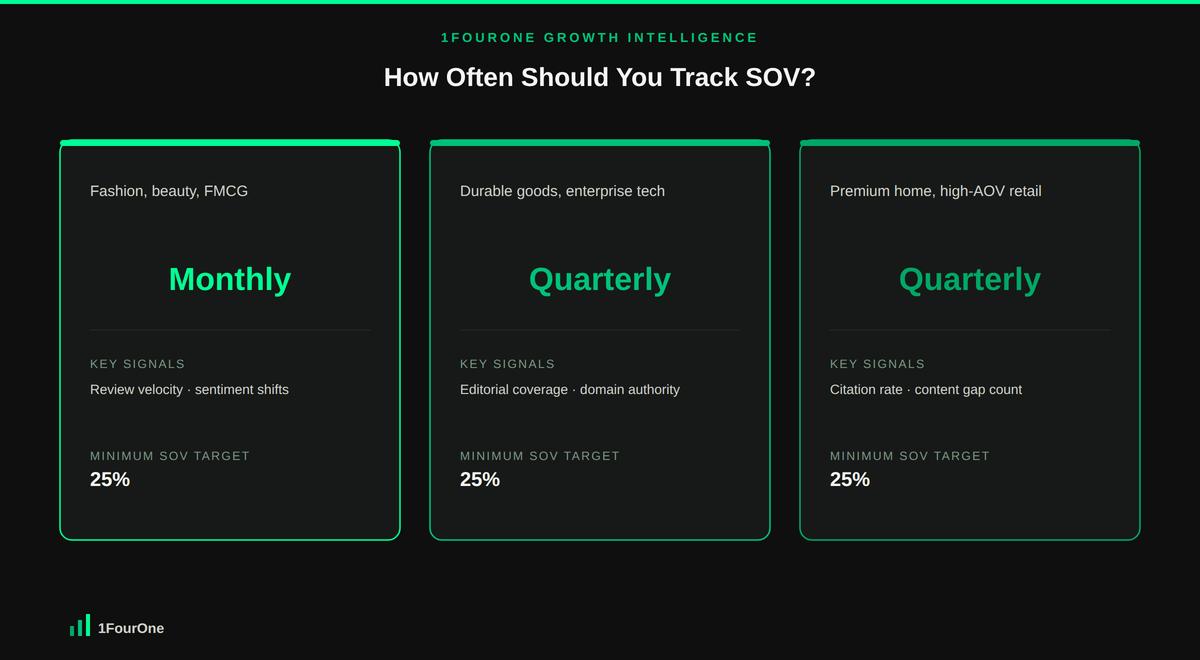
| Fashion, beauty, FMCG | Monthly | Review velocity, influencer mentions, sentiment shifts | 25% (below 15% requires immediate action) |
| Durable goods, enterprise technology | Quarterly | Editorial coverage, domain authority, competitor citation sources | 25% (structural changes move slowly but compound over time) |
| Premium home, high-AOV retail | Quarterly | Brand citation rate, content gap count, first-position share | 25% (buyers research extensively before purchasing) |
For fast-moving categories like fashion, beauty, and consumer goods, a monthly check ensures your content strategy responds to index changes before a competitor opens a gap. For durable goods, enterprise technology, and premium home retail, a quarterly cadence is sufficient to track baseline movement and adjust your content and PR plans.
Regardless of category, market leaders should set specific targets against their unbranded prompt matrix. A healthy baseline means commanding at least 25% AI Share of Voice within your core product vertical. Dropping below 15% indicates a meaningful LLM brand visibility gap that warrants immediate attention.
Get your competitive audit in 48 hours and see exactly where your revenue is leaking.
Get Your Audit →